

Dinosaur Tales
Sixty-five million years ago a great extinction took place on Earth. It is said to have wiped out just about all life on Earth including the dinosaurs. But did it? Alligators, sea turtles, sharks, horseshoe crabs, the platypuses, and cockroaches were among the survivors. But there were more. A large fish called the ‘coelacanth’ had been swimming in the ocean as far back as the Devonian period, 350 million years ago. Fossils of this large, oily fish have been found in lakes, swamps, inland seas, and the oceans of many parts of the world.
Dinosaurs, it is said, have been extinct for 65 million years, but a fisherman, it is reported, pulled one onto his boat in 1938. Captain Hendrick Goosen caught a 5-foot-long, 127-pound coelacanth off the coast of South Africa. He called a collector of oddities, and brought his catch to a university for study. Initially rejected as just another grouper, the creature was ultimately examined by ichthyologist J.B. Smith, who found otherwise.
Smith became obsessed with the notion that such a creature could have not survived the millions of years alone and set about to find them. He would be elated when a man who had attended his lecture on the bizarre Goosen discovery, claimed that in the Comoros Islands off Mozambique in Africa there were more. The locals caught them now and then and called them gombessa.
In recent years, according to Ancient Traces by Michael Baigent, there is evidence this “extinct” fish has turned up in Florida on one side of the Atlantic and in Spain on the other.
Evidence of Survival
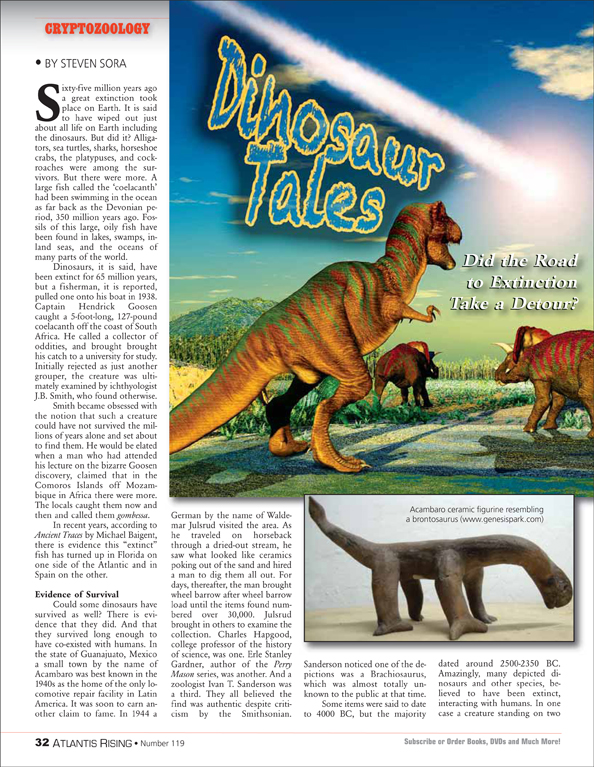
Could some dinosaurs have survived as well? There is evidence that they did—and that they survived long enough to have co-existed with humans. In the state of Guanajuato, Mexico a small town by the name of Acambaro was best known in the 1940s as the home of the only locomotive repair facility in Latin America. It was soon to earn another claim to fame. In 1944 a German by the name of Waldemar Julsrud visited the area. As he traveled on horseback through a dried-out stream, he saw what looked like ceramics poking out of the sand and hired a man to dig them all out. For days, thereafter, the man brought wheelbarrow after wheelbarrow load until the items found numbered over 30,000. Julsrud brought in others to examine the collection. Charles Hapgood, college professor of the history of science, was one. Erle Stanley Gardner, author of the Perry Mason series, was another. And a zoologist Ivan T. Sanderson was a third. They all believed the find was authentic despite criticism by the Smithsonian. Sanderson noticed one of the depictions was a Brachiosaurus, which was almost totally unknown to the public at that time.
Some items were said to date to 4000 BC, but the majority dated around 2500–2350 BC. Amazingly, many depicted dinosaurs and other species, believed to have been extinct, interacting with humans. In one case a creature standing on two legs with short arms was holding a human while biting off its head. The man was one-third the size of the creature, but this “monster” was small in comparison with those depicted on other ceramics, molded in the shape of brontosaurus-stegosaurus-like and tyrannosaurus-like dinosaurs. Two of the ceramics had women greeting tiny dinosaurs with open arms, like you might greet a pet. These had protruding spikes like a stegosaurus but stood on short legs with large tails. The head had a long snout somewhat like an anteater. The dinosaurs weren’t the only oddities. Statues of people ranging from Asian to Negroid to Central Americans were unearthed as well.
Further south in regions that the Olmec people inhabited there are also depictions of dinosaurs and dragons. The Oxtotitlan Cave has a dinosaur-like creature standing next to a man. The Olmecs also had depictions of men as Asians, Negroid, and Mediterranean.
While sites like Acambaro are unusual, they are not unique. In Ica, Peru, a Dr. Javier Cabrera has a private museum of 20,000 rocks and stones with odd etchings. Many depict men with feathered headdresses performing surgery, using stethoscopes, performing blood transfusions, and organ transplants. Others show carvings of stegosaurus, brontosaurus, and pterodactyls. Some show men attacking these dinosaurs. Even kangaroos, not indigenous to Peru, are carved into stones. Some Ica stones show humans riding pterodactyls. While this is very unlikely, to say the least, the stones can still be described as art, so artistic license is in play. Like the Acambaro stones, much further north there are stones in Dr. Cabrera’s collection also depicting small dinosaurs that reach only a man’s waist.
If this is evidence that man, at some time in recent history, co-existed with survivors of the great extinction, it is not limited to Central and South America. It has been only 50 years since the actual form of the Tyrannosaurus rex has become widely known. Scientists have only recently been able to virtually recreate extinct dinosaurs from their skeletons, yet one accurate depiction, made 12,000 years ago, of this large and aggressive creature has been found in Arizona’s Havasupai Canyon cave.
A more recent discovery of man and monster existing together was made in May 2006 in Florida. There, in a sinkhole 30 feet deep within the Aucilla River, mastodon bones and a crude knife were found. The site is the oldest in the Southeastern United States, dating to 14,500 years ago. Paleontologist, S. David Webb, has written of the discovery in his book, First Floridians and Last Mastodons.
On the other side of the world in a ruined temple at Angkor Wat in Cambodia, a stegosaur is part of a bas-relief. Between AD 800 and AD 1400 a Khmer artisan living million of years after that species supposedly went extinct, depicted one perfectly.
Dinosaurs of the Sea
Survivors of the great extinction included many sea creatures. The Plesiosaurus was originally a land creature that took to the sea and evolved into a longer-necked version with flippers. The most famous Plesiosaur is the elusive Loch Ness Monster. For decades hundreds in New England saw a less elusive sea monster. Dubbed the Gloucester Sea Serpent, it was first spotted in Maine but seemed to enjoy the Massachusetts waters more. Observed every summer, it was often seen swimming for hours at a time in shallow waters. Others have been reported in many places around the world. On April 25, 1977, the Japanese fishing vessel Zuiyo-Maru caught and photographed a plesiosaur near New Zealand. The dead creature was 33 feet long, and, while it was found as a rotting corpse, it still weighed 4,000 pounds. Plesiosaurs have been around for 135 million years.
Another sea creature is the Carcharodon Megalodon. Believed to have been extinct for a million years, a British survey ship in 1875 dredged up teeth that belonged to it, but they were not fossilized—they were actually teeth. They were five inches long and dated at 11,000 years old. The Megalodon grew to be twice the size of the largest great white shark. At 50 feet long and possessing a mouthful of teeth up to six inches long, it was a formidable creature. Polynesian seafarers claim that sharks of 100 feet in length exist in their seas. On the other side of the Pacific, an American anti-submarine frigate had its underwater tracking gear disabled by a large sea creature. In port later for repairs, the USS Stein was found to be imbedded with hundreds of one-inch teeth.
Dinosaurs on the Land
Possibly the last thing that anyone might believe to be alive in modern times is the Diplodocus—yet there is evidence that they are alive and well in Africa.
The Likoula swamp, in the northern jungles of the African Republic of Congo, is a constantly marshy area of 55,000 square miles. Hot and constantly humid, the area is infested with malaria-carrying mosquitoes, voracious ants, and venomous snakes. If you survive the heat and the insects, there are still leopards, panthers, and water buffalo to avoid. Very few people live in the swamp, most by the rivers. Those who do, fear one animal more than any other. They call it the ‘mokele-mbembe’. The native peoples have known of it for centuries, but Europeans first heard of it in the late eighteenth century. Described as having a body the size of an elephant with a very long flexible neck, it lived on plants but often attacked people with its very long tail. Fortunately, it was not carnivorous so its victims were not eaten. Zoologist James Powell and Professor Roy Mackal of Chicago University decided to seek it out. Powell went first to nearby Gambia where he showed pictures of various animals to a shaman. The medicine man recognized none, until he was shown a picture of a Diplodocus. He called it n’yamala. The descriptions of Gabon’s n’yamala and the mokele-mbembe of the Congo matched. The two scientists were not able to track down either for photographs, but they did collect numerous eyewitness accounts. They also received reports of other creatures. One they called emela-ntouka looks like a triceratops. Its name means “the killer of elephants.”
Others had more luck. An Englishman working in Zambia witnessed one of the creatures while fishing. As he watched the head rise above the waters, he had initially thought it was a large snake. Then he realized this was like nothing he had ever seen before. Luckily it sunk back into the waters without doing him harm.
Accounts of living dinosaurs in Africa were not uncommon. In 1776 Abbe Proyhart wrote of finding clawed animal footprints three-feet-across, as described by Pygmies in the Congo of the mokele-mbembe to members of a German expedition in 1913. Professor Mackal even documented a story of one village’s attempt to catch and kill one. They had succeeded, it was said, by making a barrier of sharp sticks that held the creature until they could kill it. This they did and then promptly ate it. According to Mackal, those who ate the meat died shortly afterwards.
Dinosaurs in the Air
One of the most successful orders of animals are flying reptiles known as pterosaurs. They have been around for 135 million years and diversified into 85 species. Some are as large as airplanes, but others are the size of tiny sparrows. Scientists agree on little regarding them—some researchers reporting that they had skin on their wings, others feathers; and, in Russia, paleontologists discovered a species with dense coats of long hairy scales. The real question is: how long did they survive? At Catal Huyuk, possibly the oldest city in the world, a painting shows a man being attacked by a pterodon. Carvings of this giant bird are also found in Mayan ruins at Tajin. Near Alton, Illinois, is the Piasa, immortalized in a rock-bluff painting first recorded in 1673. The Illini tribes say its name means, “Giant Bird that Devours Man.” It may not have disappeared, as it is said to have reared its head as late as July 25, 1977, at Kickapoo Creek, Illinois, where two giant birds, it was said, attempted to carry off a ten-year-old boy.
In 1975 a skeleton of a giant pterodon was found in Big Bend Park in Texas. It had a wingspan of 51 feet, making it the largest flying dinosaur fossil ever found. The Tombstone (Arizona) Epitaph of April 26, 1980, reported that two men discovered and attempted to kill a winged monster, 92 feet in length. In October of 2002 The Anchorage Daily News of Alaska reported several sightings of pterodactyls the size of a Cessna aircraft. The extinct dinosaur was seen by villagers in Togiak and Manokotak as well as by a bush pilot who said he was only a thousand feet away from it. Similar sightings were reported the same year in remote Wyoming County in Pennsylvania. A number of witnesses saw two enormous blackbirds land in a tree. Their estimated wingspan was said to be twelve feet, which was two feet less than in the Alaska sightings. Could the Native American belief in Thunderbirds be more than legend?
In the last hundred-plus years, over 300 major species have been scientifically unveiled. The list includes the world’s largest lizard, the Komodo dragon, an ice-age relic called the Chacoan peccary, the Cambodian ox, the buffalo-sized Vu Quang ox, the giant Munjac deer, tree kangaroos, short-necked giraffes and a dozen South American monkeys. The planet still contains massive forests, large jungles and vast deserts that may hold creatures that have survived multiple ice ages and the mass extinctions of millions of years.
Jurrasic Soft Tissue

Who knew? How could we have known that dinosaurs were such saintly beings? St. Bernadette, St. Silvan, stand aside (see “The Mysterious Gifts of the Saints” AR #124). The Church of Orthodox Science has declared the bodies of the clearly holy dinosaurs to be, well, incorrupt. Well, almost, but hey, 199.5 million years of preservation for even a saint’s body isn’t all that bad. Pilgrimages are being organized.
As the canonizations proceed, an amazing sleight of hand is also whisking before our eyes. Three years ago (AR #106), I described a crisis raging full force around the subject of the actual age of dinosaur remains, thereby equally implying a crisis in our historical understanding; namely, just when did the dinosaurs actually perish? Was it really 65 million or even 200 million years ago, or was it within the effective range of carbon dating; i.e., 50,000 years, 25,000 years ago, or less? The crisis stems from the discovery—with now apparent great frequency—of organic matter within and without the bones of these dinosaurs. In turn, this foundational narrative supporting the long ages required for Darwinian evolution—the long and ancient history of the dinosaurs—stands in jeopardy. For current science, this threat of a massive overturning is very real. And very disturbing.
The experts whose province actually is the subject of organic matter longevity—the molecular biologists and biochemists—assert, based on both theoretical structure and extensive repeated experimentation, that the maximum longevity of protein is 100,000 years. Simply the natural, inexorable, structure-breakdown process of the law of entropy in matter assures this. These biochemistry-established decay rates have yet to be disproven. Yet we have organic materials—blood vessels, osteocytes (tiny bone cells)—found within the bones of dinos, which, based on high guesswork, even on circularly reasoned estimations on the age of the geological stratum in which the bones are found (see AR #70), are stated to be from the Cretaceous (68 million, 80 million years old) and even from the Jurassic (199.5 million years old).
Dr. Mary Schweitzer, in 2005, was the first official publisher/defender of this organic material discovery, in this case, organic matter found in the thighbone of a mama T-Rex supposedly 65 million years old. I say the “first publisher” because, it turns out, she was far from the first discoverer. This phenomenon has been known (and not talked about) for years. Schweitzer, however, also became the chief theoretician for “explaining” this miracle. Mixing ostrich and chicken blood vessels in an iron-rich solution, she was able to extend the life of these vessels by 200X, where they yet were in a (vaguely described) “recognizable” condition; i.e., with some (unspecified) degree of preserved structure. More specifically, from an expected 3.5 days, she achieved 720 days. That the experiment employed utterly artificial conditions is ignored. That her preservative mechanism is orders of magnitude short of power, for she requires not 200X, but 20,000,000,000X to account for 199.5 million years—also ignored—but more on this later.
The New Normal
So, what has happened since? Firstly, the Schweitzer “explanation” is still the “go to” explanation—unquestioned. But it is worse. The miraculous preservation of organic matter in remains supposedly many tens of millions of years old is now being passed off as simply “normal.” Consider, for example, a January, 2017 piece in the Christian Science Monitor discussing a recently published article by Dr. Robert Reisz (in Nature Communications) on the discovery of collagen in a denizen of the Jurassic, a 195-million-year-old Lufengosaurus in China (see sidebar). The article quotes Dr. Stephen Brusatte, a paleontologist at University of Edinburgh: “It wouldn’t surprise me if this type of preservation is much more common than we might think…This realization could be a game changer for paleontologists and will give us new ways to study dinosaurs that we never before imagined.” And then the kicker: “Dr. Brusatte sees Reisz’s work as key support for Schweitzer’s controversial research. Taken together, he says, this kind of research ‘tells us that soft tissues and microscopic tissues may be able to be preserved for a huge swath of time—hundreds of millions of years.’”
This is just one, typical example of the new tone of discussion. Biochemistry, go away. Poor troglodyte molecular biologists and biochemists. Protein longevity 100k years? How quaint. And long live the Darwinian story.
Schweitzer’s Magical Mystery Mechanism
Let’s look a bit more at Dr. Schweitzer’s born-in-2013, now trusty “go-to” explanation, that is, at her own sleight of hand. It is interesting to note, firstly, that the paper trots out the same Ms. T-Rex bone that had now been resting in Schweitzer’s lab for eight years. A microscope picture shows the iron particles (Fe) clustered tightly around the blood vessels, in her words, “infiltrating an organic layer.” But eight years in a nice dry lab, complete with handling, possible reagents, etc., is not the same as eight years at Hell Creek, Montana, where the soil is indeed known for containing moisture.
And iron particles love moisture. This love leads to forming iron oxide—a form of rust. Mark Armitage, a microscopy expert, discoverer of a number of fossils at Hell Creek, and fired from his lab-head position at Cal State for publishing in a peer reviewed journal on the subject of dinosaur soft tissue preservation, points out the following: It is quite possible that in actuality, while at Hell Creek, surrounded by moisture, the situation within the T-Rex thigh was relative stasis. Take the bone out and put it in a dry place. The matrix begins to dry out. Where do the iron particles go? Why, to the last source of moisture, namely to the walls of blood vessels. Can Schweitzer rule this out? Did she? No and no.
So let’s look again at that “go-to” experiment that demonstrated that “iron has a role” in soft tissue preservation. Note, the paper is not saying that it is iron that does the preserving—only that it “has a role.” But what this is—is questionable. To begin with, what did she do initially with the chicken and ostrich blood vessels she attempted to preserve via iron? Buried in the “methods” section of the paper, in an unlaudable non-effort to replicate the conditions of the burial of Ms. T-Rex at Hell Creek, we find that Schweitzer: a) put an anticoagulant into the blood; b) used centrifuges—ultra high speed—on the blood, over and over, and, c) used molecular filters on the tissue before the experiment began.
Why? Why all this? Begin with the anti-coagulant. The prime directive of blood, when exposed, is to coagulate. This is nature’s fundamental organism-saving device to stop us from bleeding to death. But if the blood was coagulated, it would have bound up the iron and made it unavailable for her experiment. She needed the iron free and available. The anticoagulant prevented it from clotting. Why the ultra-centrifuges used multiple times? She had to filter out all the serum, thus all the clotting factors that bind up these proteins tightly in the clotting reaction. She had to remove all the cells and sub-platelet cells—anything relating to clotting. And finally, she had to use a molecular filter to eliminate these things.
After all this, she was left with the red blood cells, which she then lysed (broke open), freeing the hemoglobin (which holds the iron). Then she left this on a lab bench for two years at room temperature, in the absence of water, the freeze-thaw cycle, or the heat of the Montana summer. Though I’m sure that research teams are busily searching the site for the syringe of anticoagulant, the centrifuges, and molecular filters that Ms. T-Rex carried at all times in her Prada purse; needless to say, it is not too likely that any of these things happened at Hell Creek when Ms. T-Rex met her end—along with many others in her bridge club at the time.
Which brings us to the notion, which arose from all these machinations, that iron is now a recognized fixative agent for preserving tissue. Schweitzer pointed to these as a preservative cause in that microscope slide where the FE particles are clustering along the blood vessels. Above this line of Fe particles is what she termed, in a misleading way, an area of “amorphous structure.” On closer look, this is also clearly fine structure, equally well preserved, which the iron apparently magically acts upon from a distance. In any case, here is the problem: Iron particles are nanometers in size. Yet standard fixative agents, such as formaldehyde, aldehyde, or formalin, are but several angstroms in size—vastly smaller. These agents work in tiny gaps of the amine sections of the protein, binding these together (the rest of the protein being fully subject to normal degradation). To employ an iron particle, to use Armitage’s metaphor, is like driving a garbage truck into a pile of papers when all you need is a tiny paper clip to hold the papers together. If iron actually worked, he notes, one could make a mint with a patent. The world of microscopy—whose business revolves around fixing tissue for microscope viewing—would be stampeding to your door. Iron, as a fixative, is a myth.
Schweitzer, while invoking iron fixation as a cause, also speculated that iron might be preventing bacteria from doing its normal work of breaking down organic matter. In other words, she has little clarity what iron does, or if. Combined with other problems, like the fact that places like the insides of Triceratops horns have no blood vessels to carry iron, invoking Schweitzer’s solution is roughly like wafting a smoke cloud by swinging your incense censor over both the subject and the burial shrine of St. Mother T-Rex. There is an obvious remedy.
Carbon Dating—What Happened to It?
What we have now is the ludicrous absence of that hitherto infallible, worshipped, and revered dating method called—oh, what was it again, yes—carbon dating! One resistance to this hitherto from the “scientific” community has been “contaminants”; as in, contaminants would invalidate the dating. Another has been that the bones are all in fact mineralized, truly fossilized or petrified, and thus obviously have no organic material—so go away C-14 people. This latter, by the way, is largely bunk. Armitage points out that these remains are indeed just bones—they are not fossilized. The bones are often simply restored via a standard EDTA cleaning solution. Armitage has videos of cleaning up a Triceratops horn found at Hell Creek, using a simple saline solution for cleaning, then slicing it open and revealing a mass of spongy, highly elastic, organic material.
But where is the “contamination” when opening and testing the insides of supposed fossilized bone? Seriously, this threat cannot be controlled for? (There are plenty of protocols.) The issue screams for carbon dating—not that it hasn’t been done. Members of the Paleochronology group presented their findings at the 2012 Western Pacific Geophysics Meeting in Singapore, August 13-17, a conference of the American Geophysical Union (AGU) and the Asia Oceania Geosciences Society (AOGS). Their carbon-14 dating of multiple samples of bone from eight dinosaurs found in Texas, Alaska, Colorado, and Montana revealed that the bones are hardly from the Jurassic or Cretaceous but rather 22,000 to 39,000 years old. Not to worry. After the conference, the abstract of the study was removed from the conference website by two chairmen. Unwilling to challenge the data openly, they erased the report from public view without a word to the authors. When the authors inquired, they received a letter simply stating that, “There is obviously an error in these data. The abstract was apparently not reviewed properly and was accepted in error.”
There are other similar incidents. The degraded nature of the situation and of current science speaks for itself. I fear that if I were a member of orthodox science staunchly defending Darwinian theory, in continuing this suppression of results, stifling of discussion and cruel destruction of careers, I myself, when at St. Peter’s gate, would fail to enjoy the company of the saintly dinosaurs—maybe unless I were a biochemist.
SIDEBAR:
195-Million-Year-Old Protein
University of Toronto Press Release • February 2017
By Nicolle Wahl
New research from scientists at the University of Toronto and researchers in China and Taiwan provides the first evidence that proteins have been preserved within the 195-million-year-old rib of the sauropodomorph dinosaur Lufengosaurus.
The study appeared in the Jan. 31, 2017 issue of the journal Nature Communications, and the news is already making headlines around the world.
“These dinosaur proteins are more than 100 million years older than anything previously discovered,” says Professor Robert Reisz, a specialist in vertebrate paleontology in the department of biology at U of T Mississauga. “These proteins are the building blocks of animal soft tissues, and it’s exciting to understand how they have been preserved.”
The Canada-Taiwan research team, led by Reisz, used the synchrotron at the Taiwanese National Synchrotron Radiation Research Center to find the substance in place, known as collagen type I, preserved within the tiny vascular canals of the rib where blood vessels and blood would be in the living dinosaur.
The collagen was found together with lots of small, spherical, hematite particles. Hematite is a mineral that can be formed from the iron in hemoglobin, the oxygen-transport protein in red blood cells. The chemical bond between iron and oxygen is what gives blood cells their red color.
Reisz and his colleagues believe that these hematite particles were derived from the original blood of the dinosaur and that they acted as the catalyst for preserving the protein in the vascular canals of the bone. These collagen pieces are probably remnants of the blood vessels that supplied blood to the bone cells in the living dinosaur.
“Interestingly, there was no evidence of preservation of organic remains in the main mass of the bone, only in the small vascular canals that ran along the length of the rib, where hematite was also present” says Reisz.
“Our localized search, in areas of the bone that are likely to preserve remnants of the original soft tissues, is more likely to succeed than previously used methods. This approach has great future potential, because localized searches will yield important results even when the amount of organic remains is miniscule.”
Previous evidence of preserved collagen date back to the Late Cretaceous Period—more than 100 million years younger than this discovery—but those studies extracted the organic remains by dissolving away all other parts of the fossil, without a clear understanding of the precise origins of the collagen.
This research allowed the scientists to find the collagen in place without dissolving the rest of the fossil, and it has helped them understand how the organic remains were preserved. Reisz believes that future explorations for even older proteins will be possible if this technique is used.
Scent of a Dinosaur

Something strange has been happening in Dino-World. Something disconcerting. It started in 2,000 on the dusty plains near Hell Creek, Montana, in a layer of earth deemed to be 65 million years old, when a large female T. rex skeleton was discovered. Ms. T. rex—or perhaps Mrs. T. rex, as she turned out to be pregnant—appeared to be another gift for the standard story of dinosaur history. But the gift unexpectedly turned out to be in a box from Pandora herself. As I described earlier (“The Strange Chaos of the Dating System,” AR #70), because the intact, 3.5-foot-long femur was so large and heavy (3000 lbs.), it had to be broken in half to be lifted out by helicopter. Some fragments of the freshly broken bone were sent to Dr. Mary Schweitzer at North Carolina State.
Mary Schweitzer was fully prepared for the opportunity. Earlier, while at Northern Montana University, she had discovered hemoglobin molecules in dinosaur bone samples, publishing a paper in 1997 on the subject. Once, curious that she had noted the distinct smell of death on a T. rex, similar to a cadaver in her lab, and given the conventional wisdom that such fossils were made up entirely of minerals, Schweitzer mentioned this anxiously to her mentor, the great dino-fossil hunter, Dr. Jack Horner. Apparently inured to the smell of death, he answered: “Oh, yeah, all Hell Creek bones smell.”
She was lucky to be at North Carolina State; the 1997 paper had not helped her career. Hemoglobin does not last 65 million years. In fact, the scientific consensus is that the longevity of protein is at maximum 100,000 years. But in 2004, in looking deeply into the T. rex sample from Horner, Mary Schweitzer now discovered soft-tissue, specifically, collagen, the kind of tissue that doesn’t last a week when placed on a shelf. More analysis found the fine structure of blood vessels, then osteocytes—the tiny cells of the bone. Another T. rex that strode the earth 68 million years ago revealed a fine network of almost-clear branching vessels, and within, as her 2005 paper in Science observed, “round microstructures,” namely and less diplomatically, blood cells. So it is not just dinosaur soft tissue but the presence of detectable proteins such as collagen, hemoglobin, osteocalcin, actin, and tubulin that must be accounted for. These are complex molecules that continually tend to break down to simpler ones. Schweitzer has even recovered fragments of the even more fragile and complex molecule, DNA (max longevity 25,000 years).
These were not the only dinosaurs revealing soft tissue. Schweitzer found this in several, including a 199.6 million-year-old specimen. But the problem is beyond Schweitzer’s pesky peering, for the list of dinosaurs discovered with soft tissue, even with remnants of skin, is long and growing. Other examples of soft tissue in fossils that are supposedly millions of years old have been found: muscle tissue in a salamander fossil that is supposed to be 18 million years old; retinal tissue in a mosasaur fossil that is supposed to be 70 million years old; and what appear to be bone cells from the same mosasaur fossil. A list can be found on http://www.theologyonline.com/forums/showthread.php?t=92405. A fire was burning in Dino-World and there was plenty of material to fuel it. A 2010 National Geographic’s article titled, “Many Dino Fossils Could Have Soft Tissue Inside” reveals that the scientific community is expecting many more examples of dinosaur soft tissue in the future. These facts have been a thorn in their side for several years now as they are incredibly difficult to explain within an evolutionary (millions of years) time frame.
Thomas G. Kaye made an attempt in a 2008 paper, which was briefly hailed as the much needed fire extinguisher. His argument “Dinosaurian Soft Tissues Interpreted as Bacterial Biofilms” in the journal Plos One, was that these findings were merely “bio-film,” that is, a coating from extraneous biological organisms that had made it into the dead dinosaurs. This served briefly as the ‘go-to’ answer and dowsed the fire for about as long as it took Schweitzer to publish another paper. This one (Science, 2009), examining an 80 million-year-old Hadrosaur, demonstrated the reality of the detailed structures via mass spectrometry and molecular analysis. The bio-film theory decayed more quickly than its fossil subjects.
But now Dr. Schweitzer’s role in the story changes. She becomes the fire fighter, in fact, the chief of the department. Searching for an answer on how these tissue structures could be preserved for millions and millions of years, she tried something. The common thread running through “many exceptionally preserved fossils,” Schweitzer noted, is the presence of iron. Iron is found in hemoglobin. Iron atoms, once released from their bonds to hemoglobin molecules, would be highly reactive and Schweitzer hypothesizes that such iron “contributes to preservation in deep time, perhaps by both free-radical-mediated fixation and anti-microbial activity.” In other words, iron might stabilize bimolecular structures, deactivate enzymes that ordinarily break down tissue soon after death, and possibly inhibit bacterial degradation.
As reported in her November 2013 article in Proceedings of Royal Society B, to test whether iron such as that carried in hemoglobin can act as a preservative, Schweitzer’s team tested it on ostrich blood vessels. They soaked the vessels in one of three liquids: a concentrated solution of blood whose red blood cells had been destroyed, a pH-controlled saltwater solution, or sterile distilled water. They found that while the blood vessels soaked in distilled water and salt water degraded significantly in a matter of three days, the ones that had been soaked in the blood concentrate “remained intact for more than two years at room temperature with virtually no change.” This represented a 200-fold increase in stability in the presence of hemoglobin, Schweitzer reported, confirming hemoglobin’s tissue fixation properties and supporting the possibility that iron could thus, under the right conditions, protect biomaterials (tissues, cells, and molecules) from degradation over deep time.
Dr. Schweitzer believes that highly reactive ions known as free radicals, which are produced by iron as it is released from the hemoglobin, interact with the organic tissue causing abnormal chemical bonds to form. These bonds effectively tie proteins in knots at the molecular level, much as the preservative formaldehyde does. This knot tying makes the proteins unrecognizable to the sorts of bacteria that would normally consume them. This, she theorized, is how the soft tissues manage to survive for millions of years without rotting away.
The power in this argument is its seeming simplicity. The “average Joe” might think; “I get it, iron acts as a preserving agent like formaldehyde, the stuff scientists use to embalm things—like those animals preserved in jars in laboratories. So the iron in the dinosaurs’ blood must have preserved the organic material.” Thus, this finding has been hailed in evolutionist circles as the definitive fire extinguisher. A Google search on the web for “dinosaur soft tissue” yields a preponderance of hits in the flavor of “Researchers Finally Have an Explanation for Dinosaur Soft Tissue Discovery,” or “Iron Preserves Ancient Dinosaur Soft Tissue in Fossils,” or “Controversial T. rex Soft Tissue Discovery Finally Has an Explanation.” Schweitzer’s study is clearly now the fire hose of first resort to end discussion and debate on the actual age of the dinosaurs.
The press, however, has distorted the science. While the study represents a first step in understanding how soft tissue can be found in fossils, it doesn’t solve the mystery of how it could be preserved for millions of years. There are a few problems.
Problems
So let us first do some math. If we allow that the control ostrich vessels sitting in water lasted 3.5 days, then getting the iron-prepared version to last two years or 720 days is, at 720/3.5 = 208, roughly the 200-fold increase in stability. Yet Schweitzer, as noted earlier, had found collagen in dinosaurs with ages of 145–199 million years. The 199-million-year figure gives us 72,635,000,000 days. When divided by 3.5, we get a needed 20,752,857,142-fold increase in stability, that is, roughly a 20-billion fold increase. The mechanism that Schweitzer is proposing must have tremendous power if it is truly to preserve tissue through “deep time,” that is, we need orders of magnitude more than 200 times.
Schweitzer did a microscopic examination of the structure of the vessels after two years to assert they were still “recognizable.” It is doubtful that microscopic examination is sufficient to determine the amount of degradation; rather, molecular analysis via mass spectrometry is required to establish whether tissues are breaking down. This is to say, the real question is why there has been no attempt to ascertain the actual rate of the degradation. This is the critical component required to even begin projecting the actual amount of time over which preservation could be expected. I suspect it is an answer that would not be welcome in the halls of current theory.
The ostrich vessels were soaked in pure hemoglobin for five days, not lysed cells or materials that could be expected to mimic what would be present in an animal carcass. One can ask, how realistic is a concentrated hemoglobin extract, compared to the real world? Mama T. rex did not have the advantage of scientists treating her carcass with a blood-soup concentrate. While unrealistically concentrated hemoglobin might preserve for a time, it doesn’t follow that natural, dilute hemoglobin will act the same way. Indeed, tissues rich in blood vessels, such as lungs and gills, often decay very quickly.
It is not plausible that iron could be as good a preservative as formaldehyde, which directly forms covalent cross-links between protein chains, something iron can’t do. But even if we grant that it had the same preservative power, there is no reason to expect that formaldehyde could preserve soft tissues and fine cellular details for many millions of years. The use of formaldehyde is to slow down, not stop, the relentless process of decomposition. After only some 90 years, the embalmed body of Lenin has been widely suspected of being faked or touched up since it looks a little too good. More recent photos show it looking distinctly “ragged” compared to earlier photos.
Many of the still-fresh fossil biochemicals described in the literature do not show evidence of nearby iron. For example, researchers have encountered bone cells called osteocytes locked inside dinosaur bones, including a Triceratops horn core. These cells have fine, threadlike extensions that penetrate the bone’s mineral matrix through tiny tunnels called canaliculi. Could concentrated blood penetrate and preserve those almost inaccessible bone cells? Schweitzer thinks so, writing, “In life, blood cells rich in iron-containing [hemoglobin] flow through vessels, and have access to bone osteocytes through the lacuna-canalicular network.” Yet, this was simply asserted, not demonstrated.
But it is worse, for there are finds where the soft tissue is not safely contained within the bones at all but, rather, it is the external skin! (See for example, “Infrared Mapping Resolves Soft-Tissue Preservation in 50-Million-Year-Old Reptile Skin,” Proceedings of Royal Society B.) Maria McNamara and her colleagues, when examining a salamander fossil supposedly 18 million years old, (also in Proceedings), were shocked to find beautifully preserved muscle tissue on (not inside) the bone. They show that the characteristics of the soft tissue are all very similar to the characteristics of the muscle tissue of modern salamanders, and the few differences that do exist are probably the result of “initial, limited decay.” They write:
The muscle is preserved organically, in three dimensions, and with the highest fidelity of morphological preservation yet documented from the fossil record… Slight differences between the fossil tissues and their counterparts in extant amphibians reflect limited degradation during fossilization… Our results provide unequivocal evidence that high-fidelity organic preservation of extremely labile tissues is not only feasible, but likely to be common.
What we are witnessing now is a science that is making a paradigm-saving move. We began with the thesis that the dinosaur is, say, 68 million years old (despite numerous dating technique problems). We add the scientific understanding that no protein, collagen, DNA, etc., can last more than 100,000 years. We then discover that protein, collagen, etc., have been found in these fossils. Therefore, the saving move: protein, collagen, and DNA must be able to survive 68 million years, though we don’t know how and the deeply mysterious process needs to overthrow current biochemical and even thermodynamic understanding (given the inexorable law of entropy acting on organized structure). Why? Because we know the dinosaur is 68 million years old! Never can we consider that the original theory of 68 million years is wrong. This would mean great amounts of egg protein upon our face (which—even worse—we now know could be there 68 million+ years).
In all this, the question begins to scream: What is the problem with doing a little carbon-14 dating on these fossils? Or should I say, “on these remains?” Hitherto, the assumption has been that 199-million-year-old fossils could hold not even one atom of C14, given C14’s half-life of but 5,730 years, and C14-dating’s 250,000-year maximum reach into the past. This is now absurd; there is organic matter coming out of these fossils’ ears. Clearly the scientific establishment does not want to know the answer. As I had noted earlier (AR #70), “There is not time for Mama T. rex to sleep 65 million years.”
There is now even less.


