Are Cause and Effect in Proper Order?
Could climate change cause pole shift, or could pole shift cause climate change? Those may seem like strange questions but they are being asked in some very select scientific circles, and it is worth asking if official answers depend on factors other than actual science.
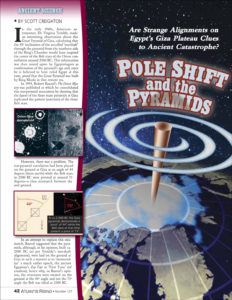
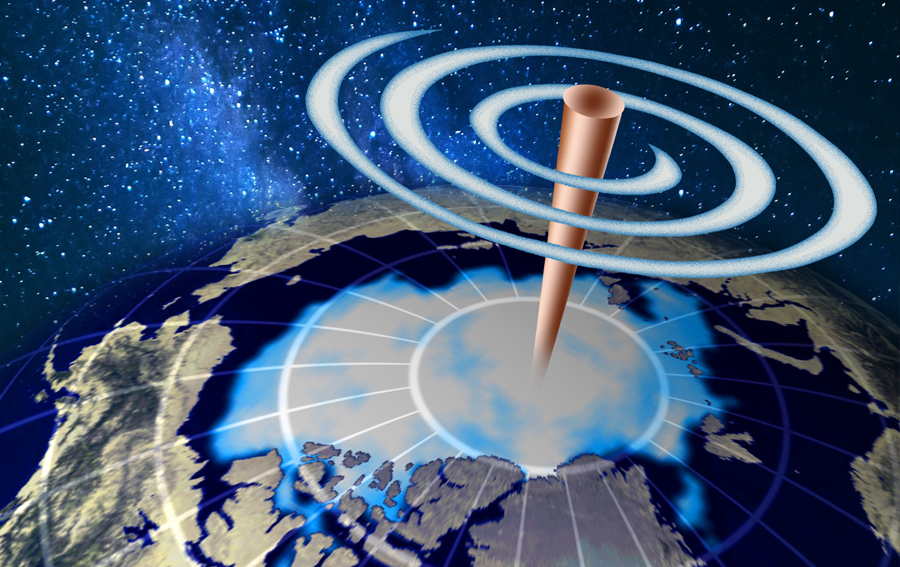
Earth’s pole is doubtless shifting—at least the magnetic one—and faster than previously expected. So says the National Oceanic and Atmospheric Administration (NOAA). A few years ago, navigational services around the world were alerted that the magnetic North Pole is moving toward Siberia at about 34 miles a year. Satellite studies have confirmed the shift and, moreover, that it is picking up speed. While such developments may have mattered little in pre-industrial times, today’s world with its heavy dependence on satellite communications, electrical grids, the internet, etc. has plenty of reason for concern.
Not to be confused with the main polar axis, currently aimed at the North Star Polaris, the positioning of the magnetic pole is, according to conventional theory, determined by molten iron and nickel, said to reside at the Earth’s core. As this mass ‘sloshes about,’ the theory has been, the magnetic pole moves. But what about the role of accelerated glacial melting, and the chronic depletion of ground water feared by global warming’s true believers?
According to Shanshan Deng, researcher at the Institute of Geographic Sciences and Natural Resources at the Chinese Academy of Sciences, rapidly melting ice was the most likely cause of a directional change of polar drift in the 1990s. In a new paper published the journal Geophysical Research Letters/American Geophysical Union, Deng says that melting glaciers redistributed enough water to cause the direction of “polar wander” to turn and accelerate toward the East (https://agupubs.onlinelibrary.wiley.com/doi/10.1029/2020GL092114). But, might the scientists have confused cause and effect? In 2011, a different argument was made by a respected Harvard Earth Sciences researcher.
Professor Peter Huybers used state-of-the-art computer models to prove that tiny shifts in Earth’s axis, cause glaciers to either advance or retreat in cycles lasting either 10,000 or 40,000 years. In a paper published in a December, 2011 issue of the journal Nature, Huybers explained that there are two cycles of tilt change known as ‘obliquity’ and ‘precession.’ When they align correctly, ice melts. When they oppose each other, glaciers advance. In past periods of deglaciation, sea levels have risen by 130 meters, and temperatures by 5 degrees C. Moreover, atmospheric CO2 in such periods has increased by over 40%. (https://agupubs.onlinelibrary.wiley.com/doi/10.1029/2007PA001463)
‘Precession’ is also known as the cycle behind the so-called astronomical ages where the Zodiac constellation which appears at sunrise, shifts slowly backward, at the rate about two thousand years per sign—based on the appearance at sunrise of the constellation Aquarius, we are now entering a cycle dubbed the age of Aquarius. Many modern alternative scholars, as well as ancient sages, have believed that the ‘precession of the equinoxes’ tracks the rise and fall of civilizations.
Also relevant may be the ideas of cartographer Charles Hapgood who wrote that significant periodic shifts of the planet’s poles are at least one cause of what we term ‘ice ages’, as vast regions move quickly from temperate areas to cold ones and vice versa. Hapgood believed that the rapidity of this process accounts for the fact that we still find undigested summer plants in the stomachs of mammoths found frozen in Siberia. Albert Einstein, himself, endorsed many of Hapgood’s conclusions.
Below are articles from our back issues that connect very directly to this content.
Available for purchase and download.
 Issue #127
Pole Shift and the Pyramids