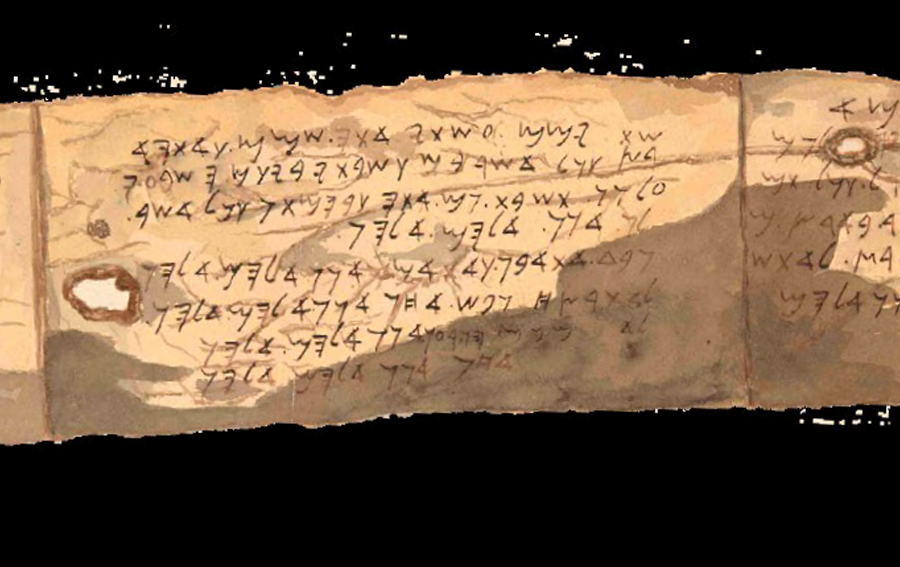
When talking about ‘law’ in the history of civilization, questions about the origins of the “Ten Commandments” in the Bible have, for millennia, been at the top of most lists. In 1883—near the very spot, where, 63 years later, the celebrated Dead Sea Scrolls would be found—Jerusalem antiquities dealer Moses Wilhelm Shapira, claimed to have found a set of leather fragments bearing in Paleo-Hebrew text an alternative version of the tablets of stone, said by Genesis and Deuteronomy to be delivered by Moses himself.
Almost instantly, Shapira’s discovery was vehemently denounced as a forgery, and so—suffering presumably from a broken heart—within a year he committed suicide. Could his tragic reaction have been about 130 years premature? In The Valediction of Moses: A Proto-Biblical Book (Mohr Siebeck, 2021), Idan Dershowitz, a top German Biblical scholar has now revisited Shapira’s paradigmbusting discovery. Not only, claims Dershowitz, is Shapira’s text genuine, it is a true forebear for the Book of Deuteronomy.
Dershowitz, University of Potsdam’s Chair of Hebrew bible and its exegesis, wrote in a March 2021 article for the German scholarly journal De Gruyter, that Shapira’s own notes make it clear that he was no forger, and, indeed, was struggling to understand and decode text that he had acquired from Bedouins, who had found it in a cave above Wadi al- Mujib near the Dead Sea.
Dershowitz was especially impressed by parallels with accounts of scroll discoveries which did not occur until 1946/47, many decades after Shapira’s death. Dershowitz also thinks that certain words in the text show a knowledge of Paleo-Hebrew that would have been beyond that of any potential 19th-century forger, sophisticated or otherwise. The problem is Shapira’s original text has been missing for over a century, making it impossible to conduct the kind of tests that could settle some of the issues. Still, most mainstream scholars remain convinced that Shapira’s text,challenging orthodoxy as it does, must be fake.
The mysteries of ancient Hebrew, however, far exceed the mundane assumptions of most mainstream scholars. Journalist Michael Drosnin, for instance, believed the events of all times were foretold by God himself in the letters of the Hebrew Torah. Drosnin’s 1997 best-seller, The Bible Code, was based on the findings of Israeli mathematician Eliyahu Rips, who, in the late 1970s, had written a paper arguing that coded prophetic messages, identified through computer analysis, could be detected in the Hebrew Torah.
In 1994, with colleagues, Rips published in the journal Statistical Science “Equidistant Letter Sequences in the Book of Genesis,” purporting to show such messages. So seriously did Rips regard the issue, that in 1994 he wrote to Israeli prime minister Yitzhak Rabin warning him of an “assassination,” as mentioned by a passage found in the Torah. A year later the prime minister was, in fact, assassinated.
Nonetheless, Rips’ result, detractors argue, is statistically insignificant, and can be replicated in any sufficiently large body of text. Another surprising mystery of the Hebrew text comes from American physicist Stan Tenen. In November 1997, reporter Cynthia Logan interviewed Tenen for Atlantis Rising Magazine #13. In “Secrets of the Hebrew Letters” (subsequently reprinted in Forbidden Religion, Suppressed Heresies of the West (Inner Traditions, 2006, edited by this author), she explained that Tenen believed all the letters in the Hebrew alphabet are constructed from shadows cast by a human hand holding a ritual strap and cloth before a flame as directed by tradition.
Tenen believed the first words of Genesis generate a mathematical torus, or doughnut-like shape. When a particular portion is removed from this ‘doughnut,’ its shape, he claimed, mirrors the human hand. The Hebrew alphabet, said Tenen, is based on the human hand.
One of the strangest examples of Hebrew letters formed by a mysterious hand can be found in the fall of Babylonian king Belshazzar in 539 BC, whose doomed last feast, is described in chapter 5 of the Book of Daniel in the Old Testament, and has been commemorated artistically by many, including composer George Frederic Handel. In his 1635 AD oil, the Dutch painter Rembrandt portrayed the feast’s startling interruption by a disembodied hand, writing on the wall.
The message, which Babylonian ‘wise men’ could not read, led to an emergency call to Daniel, the Hebrew prophet, who, according to the King James Bible, translated it as “Thou art weighed in the balances and found wanting;” in other words, as a prophecy of Belshazzar’s impending fall. Rembrandt apparently painted the message in Aramaic, which, like Hebrew, is written in rightto- left rows, not in right-toleft columns, as shown in the painting. Nevertheless, ever since Belshazzar, to “read the handwriting on the wall,” has referred to a perception of looming danger.
Like, ‘reading between the lines,’ such useful intuitions, as Moses Wilhelm Shapira might have feared, could be beyond orthodoxy’s grasp.
Below are articles from our back issues that connect very directly to this content.
Available for purchase and download.
 Issue #117
Search for the Garden of Eden