Posted on

Should Earthling’s Welcome ET?

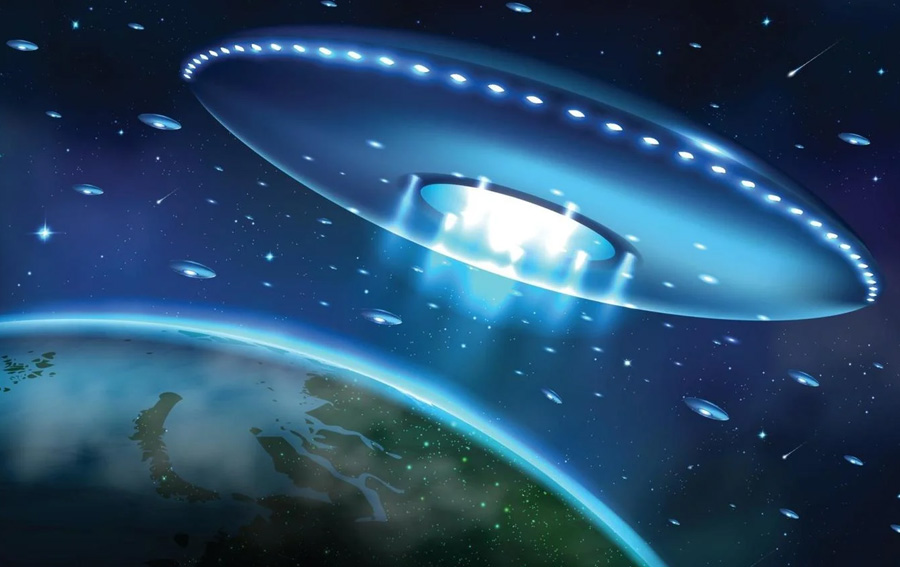
Tantalizing new evidence released by the U.S, military suggests that we may be on the threshold of some unprecedented contact with extra-terrestrial intelligence. But something the people of Earth should NOT be doing, is trying to make such contact. Indeed, the whole idea is ‘reckless’ and we should stop trying to communicate with unknown worlds right now. That is the gist of a June, 2021 op-ed in the Washington Post by influential physicist and science writer Mark Buchanan. Among scientists agreeing with him is SETI astronomer Joe Gertz who sees such efforts as ‘the reckless endangerment of all mankind’ (https://www.washingtonpost.com/outlook/ufo-report-aliens-seti/2021/06/09/1402f6a8-c899-11eb-81b1-34796c7393af_story.html)

Buchanan and Gertz find themselves echoing the views of the late astrophysicist Stephen Hawking who warned that rather than seeking such contact we should be trying to avoid it. It is not that Hawking thought there is no life out there. On the contrary, he thought that, given the odds, there almost certainly is. It is just that there is no telling what it is like, and prudence would dictate that we do what we can to stay out of its way until we know a great deal more than we do now. I wrote about the Hawking warnings in my publisher’s letter for Atlantis Rising Magazine #82 (July/August, 2010).

Most alien life Hawking believed is probably microbial or simple animals. Any intelligent life and even civilized life, he thought, might very well view Earth as a target for colonization or some other form of exploitation. The first contact with arriving ETs might be very much like that of the American Indians greeting the European explorers, and that didn’t work out very well for the Indians, he reminded us. One also recalls the cargo cults of the south Pacific during World War II.

On some South Pacific islands in the 1940s the native tribes came to believe that western manufactured stuff (“Cargo”) had been created by divine spirits in the sky and was intended for their people. They objected to the unfairness of sending such bounty to white people alone and formed what were called “cargo cults” to enlist the gods in their cause. Meanwhile on other islands the natives worshiped the Americans who flew in the “cargo.” The phenomenon was studied and written up by celebrated anthropologist Margaret Mead. Later, in the early days of NASA, Mead joined in a report from the Brookings institute recommending that any possible future discoveries of extraterrestrial life be withheld from the public on the grounds that, as in the South Pacific, such contact could be calamitous. Could she have had a point?

Interplanetary travelers, Hawking pointed out, could very well be nomads or pirates out to raid Earth to extract its resources and then to move on. If Hawking was right, then someone should warn some of those at SETI (the Search for Extra-Terrestrial Intelligence) like Douglas Vakoch who runs a nonprofit research organization devoted to transmitting intentional signals to extraterrestrial civilizations, and seem to think it a good idea to broadcast our presence to the universe.

And what about some politicians who have complained that Hollywood portrayals often make aliens look unflatteringly threatening? For this school of thought, the politically correct treatment of aliens ought to be more like what was portrayed in the movie ET. But what if the aliens are more like those we saw in Independence Day, merciless and predatory?

Do we really know what to expect, and should we gamble the human race on the answer?
Posted on

When ‘Potbelly’s Are Attractive

Ancient Magnetic Technology

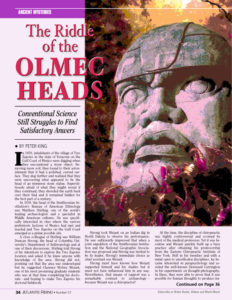
Many centuries before the Mayans, a much more mysterious culture held sway in Central America. The pre-historic inhabitants of Guatemala’s Monte Alto region, were known as the Olmec, or the inhabitants of “Olmec Land.” Today conventional archaeology describes them as ‘proto Mayans,’ but a legacy including many immense, perfectly carved, stone heads—apparently of African origin—and other haunting images, has never been properly explained. And, but for those amazing sculptures, conventionally, but unreliably, dated to the first millennium BC, archaeologists have had little to go on. Lately, though new research has provided another clue to consider, electromagnetism. Artisans of the area, it turns out, understood not only its attractive powers, but how to incorporate it in their work product.

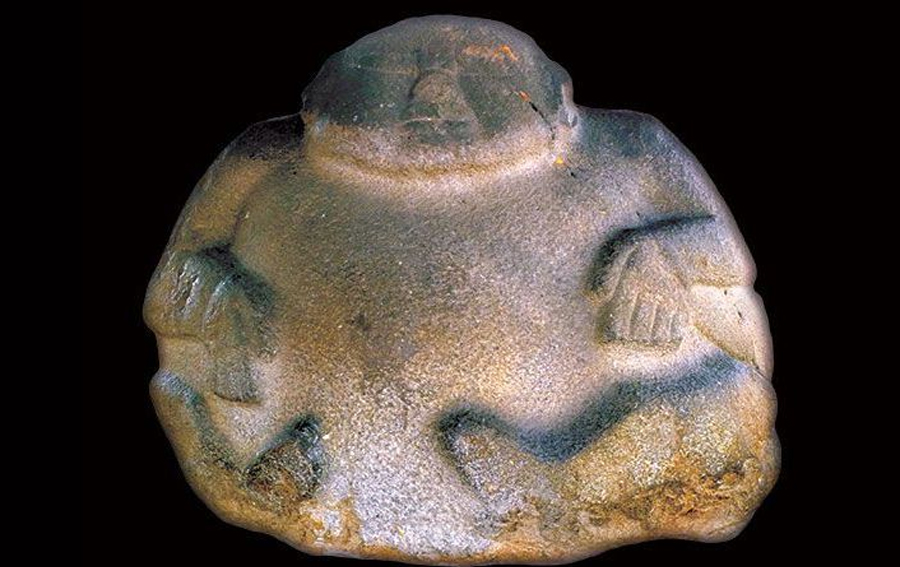
Rounded basalt carvings of obese humans–known as ‘potbelly sculptures’–have been studied for their magnetic properties. According to a Harvard report published in the Journal of Archaeological Science (June, 2019), the ‘potbelly sculptures’ are made from stone magnetized by natural lightning strikes, but their magnetic fields have been skillfully made to coincide with points of strength and weakness in the carved image. The center of a magnetic field, for example, lines up with the navel of a carved figure. The study’s conclusion was that the alignments were real and non random (https://news.harvard.edu/gazette/story/2019/07/harvard-study-reveals-ancient-mesoamericans-knowledge-about-earths-magnetism/). Yet Central America is not the only place where advanced ancient magnetic technology has been found.

Just 30 miles from Stonehenge in Southwest England, the monuments of Avebury provide another startling example. Roughly three times the size of Stonehenge, Avebury includes a complete English village and many gigantic standing stones whose true purpose has been lost to history. But, in their much read, and now out-of-print, 2005 book, Seed of Knowledge, Stone of Plenty: Understanding the Lost Technology of the Ancient Megalith-Builders, researcher John Burke, and photographer Kaj Halberg published an extensive study of Avebury’s magnetic (EM) fields. After taking over 1000 precise readings with a flux magnetometer, it was determined that of the 66 stones remaining upright at Avebury, all have north poles pointing toward the next stone in line. (https://www.aetherforce.energy/seed-of-knowledge-stone-of-plenty-by-john-burke-entire-book/)

Like loadstones, all stones have leftover magnetic polarity from when they were first formed in the earth. But, as with most such stones, like Avebury’s ‘sarsens,’ the polarity is so subtle that modern scientific instruments are required to measure it. The odds that such a fully aligned magnetic configuration could be accidental are comparable to those of flipping a coin 66 times and getting heads every time. The clear implication is that, over five thousand years ago, Avebury’s builders were capable of  determining the magnetic polarity of the stones they used and had compelling reasons to arrange them as they did.

Burke and Halberg also took their electrostatic voltmeters and magnetometers to over 80 ancient sites in Europe, North America, and South America, and catalogued in their book many similar examples of the highly knowledgeable application of naturally produced and harnessed electromagnetism. The exposure of seeds to certain naturally occurring EM forces at many ancient mounds and megalithic sites, the authors believe, led to an expectation by the ancients of increased crop yields. When subjected to a mild electrostatic charge, they point out, seeds tend to propagate faster than those left unexposed. Nevertheless, the peculiar arrangement of electromagnet polarities among Avebury’s stones has remained a mystery to the authors.

Prior to the compass, which is thought to have been invented about 200 BC during the Han Dynasty in China, standard academic history makes no mention of such advanced ancient magnetic technology.

Below are articles from our back issues that connect very directly to this content.
Available for purchase and download.

Issue #57
The Riddle of the Olmec Heads


From the member archives
The Riddle of the Olmec Heads

Posted on

Mystery Growing for Unexplained Space Signals

Could ET be calling? Most scientists are not ready to pick up the phone yet, but they acknowledge they have a major puzzle on their hands. Intense bursts of unexplained, but rapid regularly recurring radio activity have now been picked up by major radio telescopes all over the world. The ‘fast radio bursts’ (FRBs) with  unknown origins are now considered among the most mysterious anomalies in astrophysics.

In June, 2020, England’s Jodrell Bank Observatory reported an FRB with a cycle of 157 days. Another signal, coming from a galaxy 500 million light-years away, is repeating like clockwork every 16 days. Still another burst pattern (FRB180916.J0158+65) produces radio waves for a period of four days, stops for a period of 12 days, then repeats itself. According to a pre-published study, the first 28 patterns of the latter were observed between September 2018 and October 2019 (https://arxiv.org/pdf/2001.10275.pdf).

First detected in 2007 by astronomer Duncan Lorimer  at the Parkes Observatory in New South Wales, Australia, the mystery broadcasts appeared to be emanating from beyond the Milky Way. Later when similar signals came from much closer, but were not immediately confirmed by any other receivers, they were written off as some kind of fluke, but not any more.

In April, 2020, astronomers at the Canadian Hydrogen Intensity Mapping Experiment (CHIME), reported a bright radio burst from the direction of the Galactic magnetar SGR 1935+2154 about 30,000 light years away in the Vulpecula constellation. Referred to as FRB 200428, the burst was cited as the first of its kind detected within the Milky Way, and the first ever to be linked to a known source, a magnetar.

The big question remains though, what are FRBs? There are, apparently, several schools of thought. Some radio astronomers think they may be caused by pulses from the collapse of super massive stars. Others believe they may be generated by solar flares from nearby stars. Some have argued that they could be some kind of signature for long-sought Dark Matter. And yes, some scientists have even begun to speculate about extraterrestrial civilizations. That kind of talk may cause heartburn among the scientific elite, but it has, not yet, been ruled out.

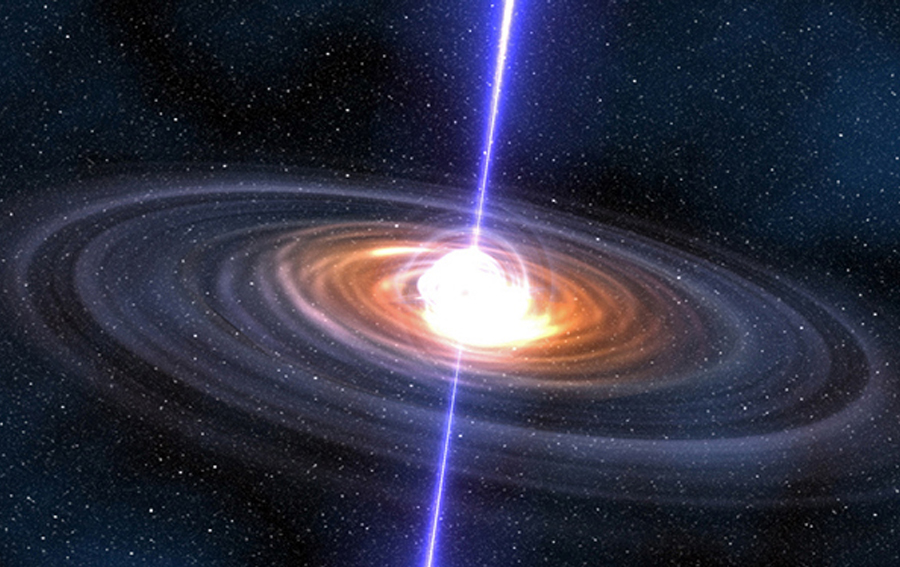
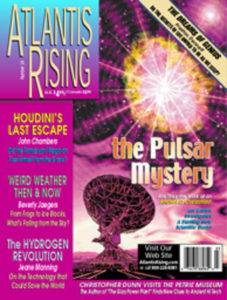
In August 1977 an unexplained signal which appeared to have an intelligent origin was picked up by Jerry R. Ehman working on a SETI (Search for Extra-Terrestrial Intelligence) project for Ohio State University. Ehman famously wrote “Wow!” on the computer printout, and ever since it has been called ‘the Wow! signal.’ The event never recurred and was ultimately written off as a fluke, but it has never been satisfactorily explained by orthodox science. Undeterred, physicist Dr. Paul Laviolette, speculated that the “Wow! Signal” was, indeed, the work of an extra-terrestrial civilization. In his book, Decoding the Message of the Pulsars, (Starlane Publications, 2006), Laviolette argued that since 1967 astronomers have been analyzing very precisely timed signals coming from radio-emitting beacons termed “pulsars.” Pulsars, claimed LaViolette, could be immense navigational beacons created by an ancient spacefaring civilization. (See “The Pulsar Mystery,” in Atlantis Rising Magazine #24, August, 2000)

Everybody agrees, the mysterious signals need more study. In the meantime the sky is being watched with unusual care for the illusive irrefutable scientific proof that we are not alone.

Below are articles from our back issues that connect very directly to this content.
Available for purchase and download.

Issue #24
The Pulsar Mystery

From the member archives
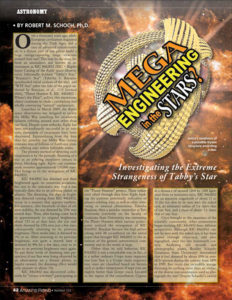
Mega Engineering in the Stars