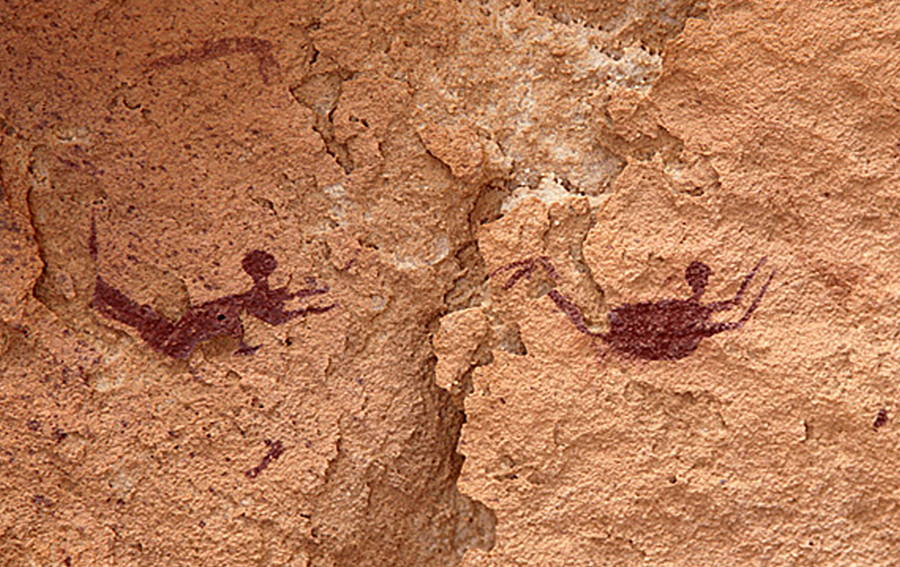
In the acclaimed 1996 British Movie The English Patient, the title sequence features ancient rock art from the ‘Cave of the Swimmers,’ found in the mountainous Gilf Kebir plateau of the Libyan Desert sector of the Sahara. The question one might ask is why, in one of the driest regions on earth, are ‘swimmers’ featured? For armchair investigators, the mention of lost worlds can conjure up many images, from deep sea divers to jungle temples; from musty libraries, to maybe even the vast uncharted sands of places like the Sahara, but why swimmers? Twenty thousand years ago, it turns out, the Sahara was no desert. The Sahara was, in fact, once a great ‘oasis,’ populated by humans and animals of many descriptions.
An MIT study, January 2019, by the journal Science Advances was based on analysis of dust deposits off the coast of West Africa over the last 240,000 years. That study revealed a regular 20,000-year cycle of changes from wet to dry, and vice versa, synching up with monsoonal activity, brought on, say researchers, by periodic changes in the Earth’s axis. Now, a new study, published in January 2021, by researchers from the University of Hawaii, Manoa, is looking at sedimentary cores from the Mediterranean Sea floor, where once mighty rivers emptied into the Gulf of Sirte (Sidra). That study, published in Nature Geoscience, reinforces the point that for at least 160,000 years, the Sahara’s climate has alternated drastically, but regularly, between lush and desert conditions. Prehistoric images of giraffes, crocodiles and other creatures—as well as stone-age cave art of swimming humans— can still be found in one of the driest areas on Earth.
With a technique called piston coring, scientists pressed giant cylinders into the ocean’s floor, and brought up 30-foot columns of mud, containing millions of microorganisms for cataloguing and crossreference with known river discharges.
According to Cécile Blanchet, lead author of the UH study, the changes in Sahara’s climate could have had a profound effect on the movement of both human and animal populations. One clear takeaway is that the history of the Sahara as we know it is, by no means, complete and it might be worthwhile to look more seriously at alternative narratives for Sahara’s history.
In the early 1990s, when John Anthony West, and Boston University geologist Robert Schoch first argued publicly that the Great Sphinx of Giza, which sits on the eastern edge of the Sahara, had been weathered by massive rainfall, they were greeted with scorn by Egyptologists.
And despite widespread acceptance of their proposition by professional geologists, Egyptologists, according to Wikipedia, consider the “Sphinx water erosion hypothesis” a “fringe theory.” Of course, it can be argued, the main reason Egyptologists object, is it threatens their cherished timeline, that the Sphinx was built only about 4,000 years ago.
Never mind that conditions on the Giza plateau have been desert-like virtually ever since. The kind of massive rainfall needed to produce weathering like that found on the Sphinx and in its enclosure could be the product of a much earlier time than Egyptology is willing to admit—one like those identified by the UH study.
Another missing piece to the Sahara story might be found in a previously unexplained feature in Mauritania. Indeed some, like YouTube channel producer Jimmy Bright, think the spot might be the remains of Atlantis. As we explained in Atlantis Rising Magazine #133, November/December 2018, there is an area in the western Sahara once known as the Richat structure, also called the ‘Eye of the Sahara’ that is composed of immense concentric circles of raised ground—once, perhaps, serving as waterways.
The circumference of the Richat is very close to the dimensions specified by Plato for Atlantis, about 23 kilometers, and is bordered by mountains to the north and has what looks like an opening to the sea on the south, just as Plato described. Discovered by the NASA astronauts of Gemini IV in 1965, the Richat was first thought to be an impact crater, now ruled out by the absence of melted rock which would be expected in any large impact crater.
The prevailing view now is that the Richat is what remains of once domed layers of Earth’s crust, a notion, that has never been fully investigated, much less, proven.
Bright thinks that before the last ice age—the so-called Younger Dryas, that began about 11,500 years ago, about the time that Plato says Atlantis went down— the Richat must have been at sea-level, with water then filling its circular channels.
That the Sahara might have been home to an advanced civilization is not a new idea. Hermetic traditions, like Theosophy, have long claimed Egypt as the origination point for many esoteric teachings. Plato, himself, said his Atlantis story came from priests at Sais, an ancient city on the Eastern edge of the Sahara.
Below are articles from our back issues that connect very directly to this content.
Available for purchase and download.
 Issue #70
Atlantis of the Sands?