The Amazon has long been a river of mystery. Alternative researchers like Harold T. Wilkins and Ivan T. Sanderson believed the region was home to an advanced ancient civilization. Legends like ‘El Dorado’ led many to dream of fabulous temples and hoards of gold waiting in the jungles. In southern Brazil in the 1920s, celebrated British explorer Col. Percy Fawcett disappeared while searching for a lost jungle city. Even though the dream of a forgotten ancient civilization in the Amazonian rainforests has never fully materialized, the mythic possibilities have continued to enflame the public imagination.
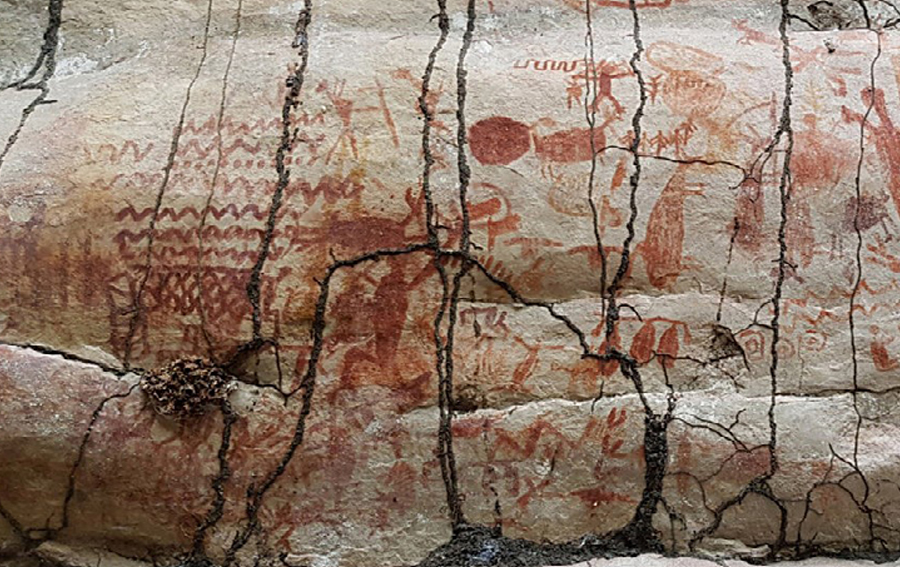
And now, a new television documentary may be adding fuel to the fire. In January, with much fanfare, Channel 4, the British news broadcaster, unveiled an immense display of “ice age” rock art with tens of thousands of paintings of people, animals, and abstract symbols. In Jungle Mystery: Lost Kingdoms of the Amazon, Palaeo-anthropologist Ella Al-Shamahi revealed in an almost inaccessible area of Colombia, an eight-mile stretch of spectacular, previously unknown, cliff-face art.
Many drawings, mostly in longlasting red ochre paint, show large, now-extinct animals such as mastodons. Clearly the product of sustained indigenous effort over generations, the site is an emphatic rejection of the once orthodox doctrine that no humans were present in the Americas at the time. Dubbed the “Sistine Chapel” of ancient rock art, the spot is believed to be at least 12,500 years old, but it could be much older. Strangely, the drawings resemble discoveries of cave art made in the 1970s in neighboring Brazil, derided by some ‘experts,’ but considered by others to be evidence that humans were present in South America over 29,000 years ago.
For many years, Niede Guidon, a Franco-Brazilian archaeologist, carried out largescale excavations at a cave called Pedra Furada. Though her work was systematically attacked, she continued to defend its validity, commenting in an interview with Athena Review (2002, vol. 3. no. 2), “The theories on the peopling of America are only theories, and in prehistory it is not possible to say that something does not exist only because we do not find it. A theory is not a law, but may and must be changed each time new facts are discovered.”
Paintings at Pedra Furada can now be compared to those reported in such profusion in Colombia. Pedra Furada, Guidon said then, was the oldest such cave ever found in the Americas, and art was present there in greater abundance than at any other ancient cave site, including Europe. Her findings were largely rejected, because academic archaeology then insisted that human habitation in the Americas went back only about 12,000 years to the so-called Clovis horizon when Siberians, presumably, crossed the ancient Bering Straits ice bridge, and proceeded to populate the Americas. That school of thought, however, has taken some direct hits of late and now appears to be, finally, on its way to the dust heap. One of the earliest serious challenges to the Clovis hypothesis was recently revisited in southern Chile.
At Monte Verde, new evidence suggests that a much-disputed dating of 14,500 years BP, proposed in the 1970s by Vanderbilt archaeologist Tim Dillehay may, if anything, have undershot the mark, and that human antiquity in the Americas could actually be far greater than even many cuttingedge experts have supposed. Meanwhile, remains found in Yukon, South Carolina, Alberta, and elsewhere, have firmly established that, well before Clovis, humanity was present in the Americas. In Chesapeake Bay, for example, in 2017, in an area underwater for 14,000 years, a 22,000-yearold mastodon skull along with sophisticated flint knives was dredged up by University of Delaware geologist Darrin Lowery. Lowery believed that rather than being colonized from the northwest, America may have been settled from the east, i.e., Europe, by very ancient seafarers—so-called Solutreans.
Smithsonian Magazine in recent years has chronicled numerous discoveries testing the foundations of orthodoxy in places like Monte Verde and Aucilla River in Florida (“When Did Humans Come to the Americas?” Smithsonian, February 2013). In a study published in the journal Nature in July 2020, the question got a new look and some new Carbon-14 data points, indicating that at least 10,000 years earlier than once thought, humans were in America. Indeed, excavations in Chiquihuite Cave in northern Mexico show human occupation 26,500 years ago.
And if that were not enough for old-school archaeology to chew on, a December 2020, study in Journal Archaeology Science is refuting orthodoxy’s apparently premature rejection of findings made in 2017 at the Cerutti Mastodon site near San Diego. Bone residue now found on the stones supports the staggering assertion that Americans were butchering mastodons, and breaking their bones with stone tools, as far back as 130,000 years ago.
Once again, the horizons of the ancient past have expanded, exponentially.
Below are articles from our back issues that connect very directly to this content.
Available for purchase and download.
 Issue #70
America’s Ancient Architect