Posted on

Evidence of Fire Use 800,000 Years Ago

They say that where there’s smoke, there’s fire, and researchers are working hard to investigate that claim, or at least elucidate what constitutes “smoke.” In an article published in June in PNAS Proceedings of the National Academy of Science, scientists reveal an advanced, innovative method that they have developed and used to detect nonvisual traces of fire dating back at least 800,000 years—one of the earliest known pieces of evidence for the use of fire. The newly developed technique may provide a push toward a more scientific, data-driven type of archaeology, but—perhaps more importantly—it could help us better understand the origins of the human story, our most basic traditions and our experimental and innovative nature.

The controlled use of fire by ancient hominins—a group that includes humans and some of our extinct family members—is hypothesized to date back at least a million years, to around the time that archaeologists believe Homo habilis began its transition to Homo erectus. That is no coincidence, as the working theory, called the “cooking hypothesis,” is that the use of fire was instrumental in our evolution, not only for allowing hominins to stay warm, craft advanced tools and ward off predators but also for acquiring the ability to cook. Cooking meat not only eliminates pathogens but increases efficient protein digestion and nutritional value, paving the way for the growth of the brain. The only problem with this hypothesis is a lack of data: since finding archaeological evidence of pyrotechnology primarily relies on visual identification of modifications resulting from the combustion of objects (mainly, a color change), traditional methods have managed to find widespread evidence of fire use no older than 200,000 years. While there is some evidence of fire dating back to 500,000 years ago, it remains sparse, with only five archaeological sites around the world providing reliable evidence of ancient fire.


Evron Quarry, located in the Western Galilee, is an open-air archaeological site that was first discovered in the mid-1970s. During a series of excavations that took place at that time and were led by Prof. Avraham Ronen, archaeologists dug down 14 meters and uncovered a large array of animal fossils and Paleolithic tools dating back to between 800,000 and 1 million years ago, making it one of the oldest sites in Israel. None of the finds from the site or the soil in which they were found had any visual evidence of heat: ash and charcoal degrade over time, eliminating the chances of finding visual evidence of burning. Thus, if the Weizmann scientists wanted to find evidence of fire, they had to search farther afield.


According to the research team, by looking at the archaeology from a different perspective, using new tools, we may find much more than we initially thought. The methods they’ve developed could be applied, for example, at other Lower Paleolithic sites to identify nonvisual evidence of fire use. Furthermore, this method could perhaps offer a renewed spatiotemporal perspective on the origins and controlled use of fire, helping us to better understand how hominin’s pyrotechnology-related behaviors evolved and drove other behaviors. “Especially in the case of early fire,” says Stepka, “if we use this method at archaeological sites that are one or two million years old, we might learn something new.”


https://wis-wander.weizmann.ac.il/scientific-archaeology/heat-weizmann-institute-scientists-uncover-traces-fire-dating-back-least

AR #120

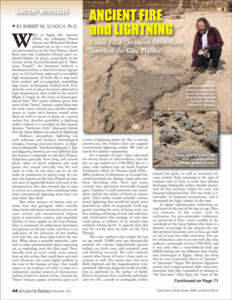
“Ancient Fire & Lightning”

by Robert M. Schoch, Ph.D


Posted on

Humans in Canterbury 600,000 Years Ago

By Tom Almeroth-Williams

Archaeological discoveries made on the outskirts of Canterbury, Kent (England) confirm the presence of early humans in southern Britain between 560,000 and 620,000 years ago, making it one of the earliest known Paleolithic sites in northern Europe.

The breakthrough, involving controlled excavations and radiometric dating, comes a century after stone tool artifacts were first uncovered at the site.


The research, led by archaeologists at the University of Cambridge, confirms that Homo heidelbergensis, an ancestor of Neanderthals, occupied southern Britain in this period (when it was still attached to Europe) and gives tantalizing evidence hinting at some of the earliest animal hide processing in European prehistory.


Located in an ancient riverbed, the Canterbury site was originally discovered in the 1920s when local laborers unearthed artifacts known as handaxes (most now in the British Museum), but by applying modern dating techniques to new excavations their age has finally been determined.


Led by Cambridge’s Department of Archaeology, the recent excavations have not only dated the original site but also identified new flint artifacts, including the very first ‘scrapers’ to be discovered there.


The researchers have dated these stone tool artifacts using infrared-radiofluorescence (IR-RF) dating, a technique which determines the point at which feldspar sand-grains were last exposed to sunlight, and thereby establishing when they were buried.


The study, published in June in the journal Royal Society Open Science, points out that early humans are known to have been present in Britain from as early as 840,000, and potentially 950,000 years ago, but that these early visits were fleeting.


Cold glacial periods repeatedly drove populations out of northern Europe, and until now there was only limited evidence of Britain being recolonized during the warm period between 560,000 and 620,000 years before present. Several sites in Suffolk are believed to display tools from this time, but these artefacts come from contexts where accurate dating methods are difficult to use.


“This is one of the wonderful things about this site in Kent”, says Dr Tobias Lauer from the University of Tübingen in Germany, who led the dating of the new site.


“The artifacts are precisely where the ancient river placed them, meaning we can say with confidence that they were made before the river moved to a different area of the valley.”


Homo heidelbergensis was a hunter gatherer known to eat diverse animal and plant foods, meaning that many of the tools may have been used to process animal carcasses, potentially deer, horse, rhino and bison; as well as tubers and other plants.

https://www.cam.ac.uk/stories/canterbury-suburbs-home-to-early-humans

AR #125

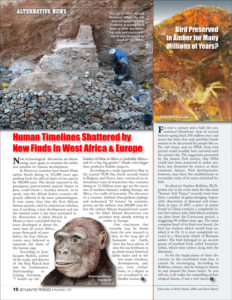
“Human Timelines Shattered by

New Finds In West Africa & Europe”

Alternative News


Posted on

Device Can Detect ET Life on Other Worlds

By Marcie Grabowski

Most biological materials, for example, amino acids, fossils, sedimentary rocks, plants, microbes, proteins and lipids, have strong organic fluorescence signals that can be detected by specialized scanning cameras. In a study published in Nature Scientific Reports recently, the research team reported that the Biofinder is so sensitive that it can accurately detect the bio-residue in fish fossils from the 34-56 million year-old Green River formation.

“The Biofinder is the first system of its kind,” said Anupam Misra, lead instrument developer and researcher at the Hawaii‘ Institute of Geophysics and Planetology at the UH Mānoa School of Ocean and Earth Science and Technology (SOEST). “At present, there is no other equipment that can detect minute amounts of bio-residue on a rock during the daytime. Additional strengths of the Biofinder are that it works from a distance of several meters, takes video and can quickly scan a large area.”


Though the Biofinder was first developed in 2012 by Misra, advances supported by the NASA PICASSO program culminated in the latest color version of the compact Biofinder.


Finding evidence of biological residue in a vast planetary landscape is an enormous challenge. So, the team tested the Biofinder’s detection abilities on the ancient Green River fish fossils and corroborated the results through laboratory spectroscopy analysis, scanning electron microscopy and fluorescence lifetime imaging microscopy.
The search for life—which may be existing or extinct—on planetary bodies is one of the major goals of planetary exploration missions conducted by NASA and other international space agencies.


“If the Biofinder were mounted on a rover on Mars or another planet, we would be able to rapidly scan large areas quickly to detect evidence of past life, even if the organism was small, not easy to see with our eyes, and dead for many millions of years,” said Misra. “We anticipate that fluorescence imaging will be critical in future NASA missions to detect organics and the existence of life on other planetary bodies.”


“The Biofinder’s capabilities would be critical for NASA’s Planetary Protection program, for the accurate and no-invasive detection of contaminants such as microbes or extraterrestrial biohazards to or from planet Earth,” said Sonia J. Rowley, the team biologist and co-author on the study.


Misra and colleagues are applying to have the opportunity to send the Biofinder on a future NASA mission.
“The detection of such biomarkers would constitute groundbreaking evidence for life outside of planet Earth,” said Misra.


https://www.soest.hawaii.edu/soestwp/announce/news/higp-developed-biofinder-advances-detection-of-extraterrestrial-life/

AR #57

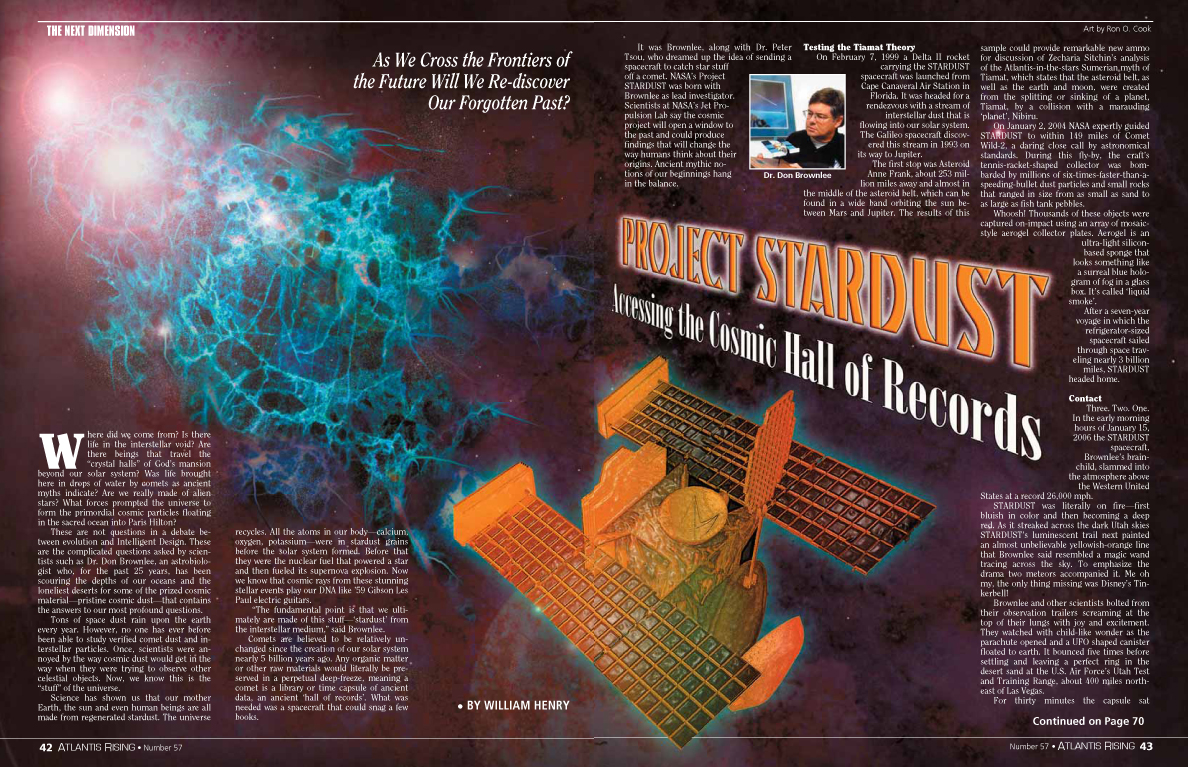
“Between Ice Ages”Project Stardust”

By William Henry