By J. Douglas Kenyon
Brought to Europe, it is believed, during the Crusades, the Shroud of Turin, Italy has been an object of veneration among the faithful ever since. Measuring 4.4 by 1.2 meters, the famous burial garment, alluded to in the New Testament, bears the subtle reversed image of a crucified man. The image, say believers, was burned into the cloth at the moment of resurrection. Whether or not that view is correct, most scientists, at least agree that, while they do not know how the image was made, it is clear that it could not have been painted or printed.
But, is the Shroud actually old enough to be direct physical evidence for—as many Christians believe—the historical death and resurrection of Jesus Christ…or not…?
Alas, in 1988, radiocarbon tests, made by laboratories in Oxford, UK; Zurich, Switzerland; and Tucson, Arizona, yielded a date of: from AD 1260 to 1390. That study was published in the journal Nature. Skeptics immediately trumpeted that the Shroud had thus been proved a medieval fraud, possibly made to boost the lucrative pilgrimage business. At that point, many believed, the long-running debate over the authenticity of the Shroud of Turin had finally been put to rest. Over 40 years later, however, the Shroud doesn’t yet appear ready to ‘rest’ from the flames of controversy.
Indeed, a new 2022 study by respected Italian scientist Liberato DeCaro, utilizing a revolutionary technique called “Wide-Angle X-Scattering” (WAXS) now declares definitively, the Shroud is at least 2,000 years old (https://www.mdpi.com/2571-9408/5/2/47). And this is not the first time that serious doubt has been cast upon the 1988 report. At least one of the scholars who participated in that study publicly conceded a big mistake had been made and that the Shroud is old enough to have been what it is advertised to be.
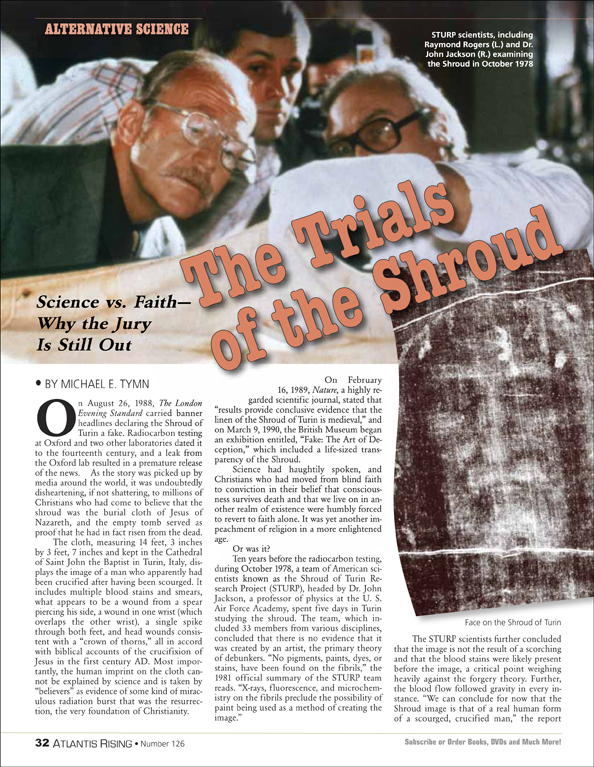
In a video recording made shortly before he died of cancer in 2005, and shown later on the Discovery Channel, Dr. Raymond Rogers revealed that the part of the shroud used for carbon-14 tests was actually dyed cotton, skillfully ‘rewoven’ into the original linen to repair a damaged section. Rogers said that indeed his own tests showed the Shroud is much older, dating to between 1,300 and three thousand years ago. Rogers had initially argued, following the 1988 study, that the cloth was a medieval hoax—an assertion for which he repented in his Discovery Channel video.
To obtain carbon for measurement, the dating of any artifact requires taking a small sample which is ultimately burned and destroyed. The amount of carbon 14 still present, decaying at a known rate, gives a reliable indicator of an object’s age. The need to destroy part of an artifact, though, has always been a strong arguments against such dating, and has inspired interest in alternative, non-destructive, testing.
In 2019 Rogers’ conclusions were corroborated by a French-Italian study (https://onlinelibrary.wiley.com/doi/full/10.1111/arcm.12467) after a Freedom-of-Information-Act (FOIA)-requested examination of the raw data used in the 1988 test and kept at the British Museum. The conclusion was, that since only pieces from the edges of the cloth had been tested, the dating was unreliable.
Another mystery in Shroud history has to do with its possible connection to the secretive chivalric order of the Knights Templar. Paleographer Barbara Frale, a long-time research scholar in the Vatican’s secret archives, and an authority on the Templars, found evidence that, during the thirteenth century—a time when most historians had been unable to account for its whereabouts—the Shroud was secretly kept and venerated by the Knights Templar (The Templars: The Secret History Revealed). It had disappeared from history during the sack of Constantinople in 1204, not to reappear until the middle of the fourteenth century. But, according to Frale, a young Frenchman Arnaut Sabbatier who entered the order in 1287, testified to being shown a linen cloth on which appeared the figure of a crucified man, and being told to venerate the image by kissing the feet three times.
Previously Frale had made headlines with her discovery in the Vatican library of the Chinon Parchment, a document revealing that Pope Clement V did not condemn the Templars for heresy as had been believed for centuries. Like the Dan Brown novel and movie, The Da Vinci Code, Frale suggested a hitherto unsuspected behind-the-scenes role in church history for the Templars, and a special significance for the Shroud in conferring religious legitimacy. There are some who believe the Shroud might, in fact, be the ‘Holy Grail,’ long reputed to be in Templar custody.
The catholic church has taken no position on the Shroud’s authenticity but, nevertheless, continues to guard it very carefully, rarely permitting public showings. It was last displayed in 2,015 and is not scheduled to be seen again until 2025.

AR #126
The Trials of the Shroud
by Michael Tymn