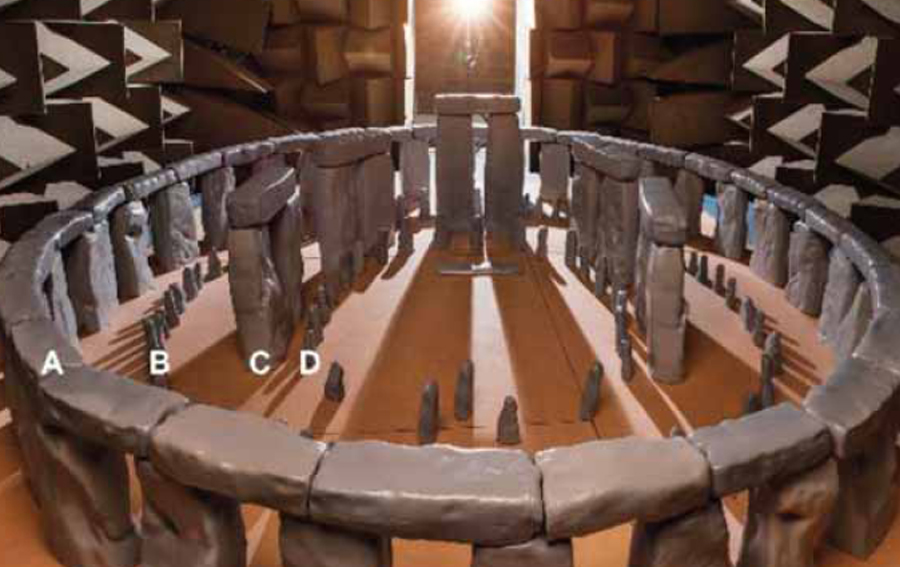
The 4000-year-old sounds of England’s Stonehenge are being heard anew—virtually speaking. By applying state-of-the-art 3-D printing and architectural modeling techniques, researchers have made new discoveries concerning the site’s acoustics. According to Trevor Cox, professor of acoustic engineering at England’s Salford University, the neolithic temple had unique properties capable of significantly altering and amplifying speech and musical sounds. (https://www.sciencedirect.com/science/article/pii/S0305440320301394)
Cox and his team make no claims for how Stonehenge may have been first used, but by carefully rebuilding—at a scale of 1:12—a faithful replica of the original structure, including all 157 of its stones, they were able to show exactly how its reverberating spaces and materials would have affected audio waves. At a minimum, the place had excellent acoustics. Previously, some researchers, like Boston University archaeoastronomer Gerald Hawkins, have demonstrated how Stonehenge may have served as a landmark or an observatory exhibiting many remarkable mathematical and astronomical properties, only to have their findings vehemently attacked by orthodoxy. Now, however, it has ceased to be controversial to argue that Stonehenge must have been built with sound in mind.
In 2012 California archaeologist Steven Waller claimed that Stonehenge created an “auditory illusion” (https://www. livescience.com/18525-sound-illusion-stonehenge.html). According to Waller, who extensively investigated the role of sound at various neolithic sites, if two nearby flutes play the same note continuously they will set up an interference pattern. His discovery was that the pattern of stones at Stonehenge corresponded precisely to the regular spacing of loud and quiet sounds which are created by the flutes.
To many, that kind of evidence, would suggest that the neolithic builders may have possessed acoustic secrets which we no longer understand, but to Waller it meant that the ancients had simply discovered an effect which they would have considered “magical.” As to why the primitive architects would then have gone to the trouble of transporting such immense stones from hundreds of miles away to bring about a desired acoustic effect, no satisfactory answer is offered.
Other scholars, such as the late John Michell, have proposed that even the movement of the stones to and about the site, suggests the possible existence of an ancient acoustic science now lost to us—one capable of some kind of levitation. From the sheer size and abundance of the giant stones involved at Stonehenge and at many other megalithic sites, it seems obvious that the physical manipulation of those stones must, somehow, have been much easier for our ancient predecessors than it is for us, their ‘scientifically advanced’ descendants.
Below are articles from our back issues that connect very directly to this content.
Available for purchase and download.
 Issue #38
The Acoustics of the Ancients