Posted on

Super-Conducting Gets Hot

Caption: Viable superconducting material created at low temperature and low pressure by University of Rochester

This image has an empty alt attribute; its file name is ai-free.png

Super conductivity is a virtually miraculous condition, where all electrical resistance in a material ceases to exist and wondrous things happen. If it were easy to achieve, many dreams of science—super efficient electric power transmission systems, vastly greater power storage devices, exponentially more powerful electric motors, magnetic levitation devices, superconducting magnetic refrigeration, and much more—would soon be reality. Until, now though, it has not been easy. Conductors must be cooled to almost absolute zero (−273.15 °C; -459.67 °F) to make it happen, so, unsurprisingly, the quest for super conductivity at temperatures any warmer has been very hard indeed, and ‘room-temperature’ superconductivity it has been said is simply out of the question.

Nevertheless, researchers now claim they have not only raised the temperature, but also lowered the pressure required to achieve superconductivity. In a historic achievement, scientists at the University of Rochester have created a superconducting material at both a temperature and pressure suitable for practical applications.


“With this material, the dawn of ambient superconductivity and applied technologies has arrived,” according to a team led by Ranga Dias, an assistant professor of mechanical engineering and of physics. In a paper in Nature, the researchers describe a nitrogen-doped lutetium hydride (NDLH) that exhibits superconductivity at 69 degrees Fahrenheit and 10 kilobars (145,000 pounds per square inch, or psi) of pressure.


Although 145,000 psi might still seem extraordinarily high (pressure at sea level is about 15 psi), strain engineering techniques routinely used in chip manufacturing, for example, incorporate materials held together by internal chemical pressures that are even higher.


Previously, the Dias team reported creating two materials—carbonaceous sulfur hydride and yttrium superhydride—that are superconducting at 58 degrees Fahrenheit/39 million psi and 12 degrees Fahreneheit/26 million psi respectively, in papers in Nature and Physical Review Letters (https://www.nature.com/articles/s41586-023-05742-0).


Given the importance of the new discovery, Dias and his team went to unusual lengths to document their research and head off criticism that developed in the wake of a previous Nature paper, which led to a retraction by the journal’s editors. According to Dias, that previous paper has now been resubmitted to Nature with new data that validates the earlier work. The new data was collected outside the lab, at the Argonne and Brookhaven National Laboratories in front of an audience of scientists who saw the superconducting transition live. A similar approach has been taken with the new paper.

AR #34

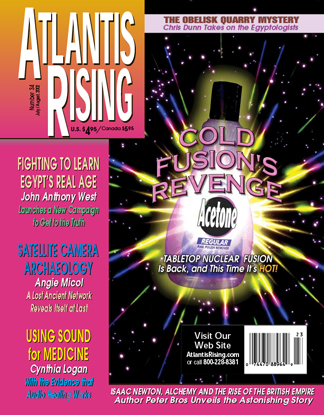
Cold Fusion’s Revenge

Posted on

Surprising Source for Chaco Canyon’s Wood

Tree-Ring Research shows a switch in wood source corresponds with the flourishing of the ancient Chacoan culture of New Mexico.

The wood in the monumental “great houses” built in Chaco Canyon by Puebloans came from two different mountain ranges, according to new research from the University of Arizona Laboratory of Tree-Ring Research.

The scientists are the first to report that before 1020, most of the wood came from the Zuni Mountains about 50 miles to the south. The species of tree used in the buildings did not grow nearby, so the trees must have been transported from distant mountain ranges.

About 240,000 trees were used to build massive structures, some five stories high and with hundreds of rooms, in New Mexico’s arid, rocky Chaco Canyon during the time period 850 to 1140. The buildings include some of the largest pre-Columbian buildings in North America.

“The casual observer will see hundreds and hundreds and hundreds of beams sticking out of the walls. There’s wood all over the place in these structures,” said lead author Christopher Guiterman. “They’re built out of stone and wood.”

To figure out where the trees for the beams had grown, Guiterman used a method known as dendroprovenance that had not been used in the American Southwest before.

By 1060, the Chacoans had switched to harvesting trees from the Chuska Mountains about 50 miles to the west.

The switch in wood sources coincides with several important developments in Chacoan culture, said Guiterman, a doctoral candidate in UA’s School of Natural Resources and the Environment.

“There’s a change in the masonry style — the architectural signature of the construction. There’s a massive increase in the amount of construction — about half of ‘downtown Chaco’ houses were built at the time the wood started coming from the Chuska Mountains,” he said.

By reviewing archaeological records, the team found other materials coming to Chaco from the Chuskas at the same time.

“There’s pottery and there’s chipped-stone tools — things like projectile points and carving devices,” he said.

The new research corroborates previous research from the UA that used the chemistry of Chaco Canyon beams to figure out that Chuska Mountain trees were a wood source.

AR #73

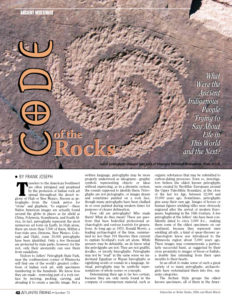
Code of the Rocks

by Frank Josephs

Posted on

Super-conducting People Movers, Proposed

The promise of superconductivity for electrical power transmission and transportation has long been held back by high costs. Now researchers from the University of Houston and Germany have demonstrated a way to cut the cost and upend both the transit and energy transport sectors by using superconductors to move people, cargo and energy along existing highway infrastructure.

The combined system would not only lower the cost of operating each system but would also provide a way to store and transport liquified hydrogen, an important future source of clean energy. The liquified hydrogen would be used to cool the superconductor guideway as it is stored and transported, reducing the need for a separate specialized pipeline system capable of cooling the fuel to 20 degrees Kelvin, or minus 424 Fahrenheit.

The concept, described in a paper published in April in the journal APL Energy, suggests a future in which air travel and traditional freight transport could become obsolete, replaced by a “super system” allowing personal and commercial vehicles to travel at speeds up to 400 miles an hour – maybe even twice that fast.

“I call it a world-changing technology,” said Zhifeng Ren, director of the Texas Center for Superconductivity at UH, who came up with the concept and is a corresponding author on the paper. “Superconductivity has had such promise to transmit electric power without power loss, to power magnetically levitating, super-fast trains and for energy storage. But it has not been economically viable, which is why it hasn’t happened at large scale yet.”

The modern era of superconductivity research began in 1987, when a team led by UH physicist Paul Chu discovered a compound which acted as a superconductor at a temperature above the boiling point of liquid nitrogen. Since then, demonstration projects have proven that superconductors can be used to power magnetically levitated trains and to transmit electrical power without energy loss, reducing waste.
Magnetically levitating trains traditionally operate on a magnetized rail, with superconductors embedded in the train undercarriage. This concept flips that, embedding superconductors into the existing highway infrastructure and adding magnets to the undercarriages of vehicles, which avoids having to cool the superconductors on each vehicle. Instead, the liquified hydrogen would cool the superconductors as it moves across the system, with liquified nitrogen and a vacuum layer used to thermally insulate the liquified hydrogen.

AR #116

The Lost Arts of Levitation

by Steve Richards

Posted on

Could the ‘Final Frontier’ of Space Exploration, be Underground?

At least 3,545 potential caves on 11 different moons and planets throughout the solar system, including the Moon, Mars and moons of Jupiter and Saturn, have been identified by astronomers. Cave formation processes have even been recognized on comets and asteroids. The discoveries in such caves could be massive. And now an international collaboration of space scientists wants to know if there life in those caves. 

Northern Arizona University (NAU) researcher Jut Wynne, assistant research professor of cave ecology, is the lead author of two new related studies, both published in a special collection of papers on planetary caves by the Journal of Geophysical Research-Planets. The first, “Fundamental Science and Engineering Questions in Planetary Cave Research,” was done by an interdisciplinary team of scientists, engineers and astronauts who produced a list of what they think are the 53 most important questions we should be asking about extra-terrestrrial caves (The second, “Planetary Caves: A Solar System View of Products and Processes,” was born from the first study). The team hopes their work will inform what will ultimately be needed to support robotic and human missions to a planetary cave—namely on the Moon and/or Mars.  

“Caves on many planetary surfaces represent one of the best environments to search for evidence of extinct or perhaps extant lifeforms,” Wynne said. “For example, as Martian caves are sheltered from deadly surface radiation and violent windstorms, they are more likely to exhibit a more constant temperature regime compared to the surface, and some may even contain water ice. This makes caves on Mars one of the most important exploration targets in the search for life.”  And not just for finding life—caves on the Moon and Mars could make good locations for astronaut shelters for both solar and galactic radiation.  

Indeed, the search for life may lead explorers in many surprising directions. U.S. and Indian astronomers, for example, have discovered that large amounts of water exist in the moon’s topsoil, which, they theorize, was formed by the reaction of hydrogen ions in the solar wind with oxygen containing compounds in the soil, or delivered by crashing comets. Acording to science writer William B. Stoecker (Atlantis Rising Magazine #79) some think the Moon’s ‘sinuous rilles;’ save for the lack of tributaries, may have been carved by water. Other astronomers argue they are collapsed lava tubes, but there are problems with such theories. Lava tubes tend to be on the surface; the rilles are canyons cut or eroded somehow below the surface. Many go uphill (neither water nor lava can flow uphill), like Schroeder’s Valley, which is 160 kilometers long, up to 1300 meters deep, and ten kilometers wide. Lava could not flow anywhere near 160 kilometers before cooling and solidifying; and even in the lower lunar gravity, a tube would collapse under its own weight even if far narrower. The rilles do not look in any way artificial, but they are clearly evidence of natural forces which we do not understand. Some have even theorized that they were gouged out by interplanetary lightning.
Using the existing infrastructure of a planet’s surface and subsurface, such as caves, may help humans get to other planets sooner than if we had to bring everything needed to survive with us. 

Here on Earth humans have been living in caves for hundreds of thousands of years. When none were available, we built our own. “As such,” said Wynne “it is only natural to assume that caves will offer similar utility as humanity expands to other worlds. While planet-wide terraforming may be an end goal, the use of large, pre-existing structures such as caves and lava tubes may be a more practical way to bootstrap the technology to the maturity needed to tackle the surface of an entire planet.”

https://news.nau.edu/space-exploration-goes-underground/

AR #70

Life in the Solar System, Then and Now

by William B. Stoecker

Posted on

Has Earth’s Core Stopped Spinning and Reversing Direction?

by Becky Ferreira

Earth’s inner core has recently stopped spinning, and may now be reversing the direction of its rotation, according to a surprising new study that probed the deepest reaches of our planet with seismic waves from earthquakes. 

The mind-boggling results suggest that Earth’s center pauses and reverses direction on a periodic cycle lasting about 60 to 70 years, a discovery that might solve longstanding mysteries about climate and geological phenomena that occur on a similar timeframe, and that affect life on our planet. 

Of course, it must be noted this is more or less the plot of the 2003 disaster film The Core, but there’s no need to worry about averting an impending apocalypse by nuking the center of Earth. While the core’s rotation influences Earth’s surface environment, scientists think this periodic spin switch is a normal part of its behavior that does not pose risks for life on our planet.

Earth’s inner core, say scientists, is a solid metal ball that is 75 percent the size of the Moon. It can spin at different speeds and directions compared to our planet because it is nestled within a liquid outer core, but scientists are not sure exactly how fast it spins or whether its speed varies over time. 

Located some 3,000 miles beneath our feet, the core experiences intense heat on par with the surface of the Sun. Because it is so remote and difficult to study, the inner core remains one of the least understood environments on our planet, though it’s clear that it plays a role in many processes that make our world habitable to life, such as the generation of Earth’s protective magnetic field, which blocks harmful radiation from reaching the surface.

Now, Yi Yang  and Xiaodong Song, a pair of researchers at Peking University’s SinoProbe Lab at School of Earth and Space Sciences, have captured “surprising observations that indicate the inner core has nearly ceased its rotation in the recent decade and may be experiencing a turning-back in a multidecadal oscillation, with another turning point in the early 1970s,” according to a study published in Nature Geoscience (https://www.nature.com/articles/s41561-022-01113-y).

“There are two major forces acting on the inner core,” Yang and Song said in an email to Motherboard. “One is the electromagnetic force. The Earth’s magnetic field is generated by fluid motion in the outer core. The magnetic field acting on the metallic inner core is expected to drive the inner core to rotate by electromagnetic coupling. The other is gravity force. The mantle and inner core are both highly heterogeneous, so the gravity between their structures tends to drag the inner core to the position of gravitational equilibrium, so called gravitational coupling.”

“If the two forces are not balanced out, the inner core will accelerate or decelerate,” they added. “Both the magnetic field and the Earth’s rotation have a strong periodicity of 60-70 years. We believe that the proposed 70-year oscillation of the inner core is driven by the electromagnetic and gravitational forces.”
Song has spent decades trying to unravel the mysteries of the inner core by studying seismic waves that pass through this distant region. He was part of the team that first reported evidence of the inner core’s rotation in 1996 by measuring slight time (or “temporal”) changes in these waves, which are generated by earthquakes. 

However, the origin of the temporal changes has been a matter of debate within the geoscience community ever since, as some scientists think the wave patterns arise from phenomena at the boundary between the outer and inner core.  

“Some researchers are still arguing that the temporal changes do not come from the inner-core rotation, but from localized deformation at the inner core boundary,” Yang and Song said. With their new study, the pair “tried to gather more data over a longer duration to test different models.” 

To that end, the team studied seismic waves that passed through the inner core made by earthquakes that occurred since the 1960s. In particular, they looked for “doublet” events, which are “repeating earthquakes with nearly identical waveforms at common receivers,” according to the study. By analyzing the slight temporal changes between these doublets, Yang and Song were able to probe the rotation of the inner core.

https://www.vice.com/en/article/xgyje7/earths-core-has-stopped-and-may-be-reversing-direction-study-says

AR #129

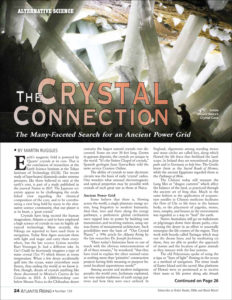
The Crystal Connection

by Martin Ruggles

Posted on

Cities on Asteroids? It Could Work—in Theory

Rochester University scientists use physics and engineering principles to show how asteroids could be future viable space habitats.

This past year, Jeff Bezos launched himself into space, while Elon Musk funded a space flight for a non-astronaut crew. Space collaborations between government and private entities, including Musk’s SpaceX and Bezos’s Blue Origin have become increasingly common. But with the recent emergence of the so-called “New Space” movement, aerospace companies are working to develop low-cost access to space for everyone, not only billionaires.
For a future beyond Earth, however, humans need places to accommodate homes, buildings, and other structures for millions of people to live and work.

Right now space cities exist only in science fiction. But are space cities feasible in reality? And, if so, how?
According to new research from University of Rochester scientists, our future may lie in asteroids (https://www.frontiersin.org/articles/10.3389/fspas.2021.645363/full).

In what they deem a “wildly theoretical” paper published in the journal Frontiers in Astronomy and Space Sciences, the researchers, outline a plan for creating large cities on asteroids.

In 1972 NASA commissioned physicist Gerard O’Neill to design a space habitat that could feasibly allow humans to live in space. O’Neill and his colleagues worked out a plan for “O’Neill cylinders,” spinning space metropolises consisting of two cylinders rotating in opposite directions, with a rod connecting the cylinders at each end. The cylinders would rotate fast enough to provide artificial gravity on their inner surface but slow enough that people living in them would not experience motion sickness.

Since then, TV shows and movies including Star Trek and books such as Orson Scott Card’s 1985 novel Ender’s Game have depicted O’Neill cylinder-like habitats populated with human beings. Both Bezos and Musk have referenced O’Neill cylinders in their visions for future space habitats.

However, while O’Neill cylinders offer a solution to space’s lack of gravity, getting the necessary building supplies from Earth to space to create the O’Neill cylinders would be difficult and cost prohibitive.

Asteroids are rocky bodies orbiting the sun, leftover from the formation of the solar system approximately 4.6 billion years ago. Scientists estimate there are about 1,000 asteroids larger than one mile across traveling in our solar system.
But asteroids have several major drawbacks, the researchers found: the rock that comprises asteroids is not strong enough to handle getting even one-third of Earth’s gravity from spinning. Once an asteroid was set into rotation, it would merely fracture and break. Moreover, most asteroids are not even solid rock but “rubble piles”—clusters of loose boulders, stones, and sand held together by the weak mutual gravity of space. If the researchers wanted to make space habitats out of these asteroids, they’d have to figure out how to work with rubble piles.

The researchers imagine covering an asteroid in a flexible, mesh bag made of ultralight and high-strength carbon nanofibers—tubes made of carbon, each just a few atoms in diameter. The bag would envelope and support the entire spinning mass of the asteroid’s rubble and the habitat within, while also supporting its own weight as it spins.

Everything the researchers imagine in their study—from the motors needed to spin up the asteroid, to the carbon-nanofiber bag—are technologies people are currently either using or developing.

Pictures & Captions: https://www.rochester.edu/newscenter/cities-on-asteroids-it-could-work-in-theory-543862/

AR #52

Perfect Lunar Base

Posted on

How to Detect Giant Alien Spacecraft

by Bob Yirka , Phys.org

A team of physicists affiliated with several institutions in the U.S. has collaborated on a paper that discusses the possibility of using the Laser Interferometer Gravitational Wave Observatory (LIGO) to search for evidence of aliens piloting huge spacecraft around the Milky Way. They group has posted their paper on the arXiv preprint server (https://arxiv.org/abs/2212.02065).

Over the past several decades, astrophysicists and sci-fi enthusiasts alike have grown increasingly frustrated with mankind’s inability to detect the presence of life anywhere in the universe other than planet Earth. Scientists have noted that based on the billions of planets that have been found in habitable zones around the universe, and the fact that life does exist in one place, on Earth, there should be life somewhere else, too.

The problem, now referred to as the Fermi paradox, is that scientists have yet to find even the tiniest shred of evidence for it. Prominent scientists have increasingly begun calling for new and more exotic ways to search.

In this new effort, the researchers note that science has advanced to the point that gravity waves can be detected by technology such as LIGO. They further suggest that it is not beyond the realm of possibility that aliens piloting spacecraft could leave gravity waves in their wake that could be detected here on Earth using such technology.

Intrigued by their own idea, the researchers imagined the factors that might be involved for such a scenario to unfold. First, they factored the size of such a craft. They found it would have to be really big to generate gravity waves strong enough to reach Earth—perhaps the size of Jupiter.

It would also have to be moving really fast—their calculations showed approximately 1/10 the speed of light. And it would have to be reasonably close—say about 326,000 light-years from Earth. They note that under such conditions, if they were to arise, researchers at LIGO should be able to spot the gravity waves generated.

The researchers also note that if aliens are using warp drives, scientists on Earth should be able to spot them, too, using the same technology, because such a craft would also generate gravity waves.

Referenced article: https://phys.org/news/2022-12-team-physicists-ligo-giant-alien.html
Research paper: https://arxiv.org/abs/2212.02065

AR #114

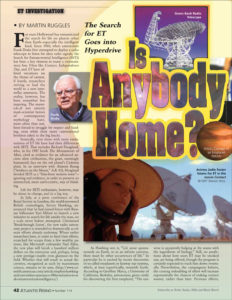
Is Anybody Home?

by Martin Ruggles

Posted on

Enormous Batch of JFK Records Released

by Zach Schonfeld

The National Archives has released thousands of records related to the assassination of former President John F. Kennedy. The release of 12,879 new files, the largest dump since 2018, comes nearly six decades after Kennedy was shot and killed in Dallas, becoming the fourth U.S. president to have been assassinated while in office.

Lawmakers in 1992 passed legislation requiring all remaining government records about the assassination to be released by Oct. 2017, unless they posed certain risks to national defense or intelligence, but former President Trump and Biden both issued extensions.

That set off a legal challenge filed by the Mary Ferrell Foundation, a nonprofit that curates an online collection of the assassination records, arguing the extensions were unlawful based on the 1992 legislation.

Biden issued the most recent extension, which lasted one year, arguing that the coronavirus pandemic impeded agencies’ ability to review the records by the earlier deadline.

The president’s order on Thursday stated that almost 16,000 records remained redacted, and Biden approved the release of more than 70 percent of them.

But an unspecified “limited” number of records that remain the subject of review were not included in the batch, and Biden’s order gives federal agencies and the National Archives until May 1, 2023, to make recommendations about whether they must still be kept private.

Biden ordered the remaining records to be publicly released by June 30, 2023, unless they meet narrow exceptions.
“Agencies shall not propose to continue redacting information unless the redaction is necessary to protect against an identifiable harm to the military defense, intelligence operations, law enforcement, or the conduct of foreign relations that is of such gravity that it outweighs the public interest in disclosure,” Biden’s order states.

The National Archives had released various batches of documents in recent years, with the most recent dump of 1,491 files being published exactly one year ago. 

The Archives had previously released roughly 55,000 total documents since the deadline originally imposed by Congress.

Referenced story link:
https://thehill.com/homenews/administration/3776939-national-archives-releases-thousands-of-jfk-assassination-records/

AR #88

JFK Sought UFO Files

Posted on

Is the Universe a Hologram?

by Anil Ananthaswamy, Scientific American

Twenty-five years ago, a conjecture shook the world of theoretical physics. It had the aura of revelation. “At first, we had a magical statement … almost out of nowhere,” says Mark Van Raamsdonk, a theoretical physicist at the University of British Columbia, Vancouver. The idea, put forth by Juan Maldacena of the Institute for Advanced Study in Princeton, N.J., hinted at something profound: that our universe could be a hologram. Much like a 3-D hologram emerges from the information encoded on a 2-D surface, our universe’s 4-D spacetime could be a holographic projection of a lower-dimensional reality.

Specifically, Maldacena showed that a five-dimensional theory of a type of imaginary spacetime called anti–de Sitter space (AdS) that included gravity could describe the same system as a lower-dimensional quantum field theory of particles and fields in the absence of gravity, called a conformal field theory (CFT). In other words, he found two different theories that could both describe the same physical system, showing that the theories were, in a sense, equivalent—even though they each included different numbers of dimensions, and one factored in gravity where the other didn’t. Maldacena then surmised that this AdS/CFT duality would hold for other pairs of theories, with one having a single extra dimension than the other, possibly even those describing 4-D spacetime like ours.

The conjecture was both intriguing and shocking. How could a theory that included gravity be the same as a theory that had no place for gravity? How could they describe the same universe? But the duality has largely held up. In essence, it argues that the goings-on inside some volume of spacetime that has gravity can be understood by studying the quantum-mechanical behavior of particles and fields at that volume’s surface, using a theory with one less dimension, one in which gravity plays no role. “Sometimes some things are easier to understand in one description than the other, and knowing that you’re really talking about the same physics is very powerful,” says Netta Engelhardt, a theoretical physicist at the Massachusetts Institute of Technology.

In the 25 years since Maldacena mooted the idea, physicists have used this power to address questions about whether or not black holes destroy information, to better understand an early epoch in the our universe’s history called inflation, and to arrive at an astonishing conclusion that spacetime may not be fundamental, but something that emerges from quantum entanglement in a lower-dimensional system. Granted, all of these advances involve the theoretically plausible spacetime of anti–de Sitter space, which is not the de Sitter space that describes our universe, but physicists are optimistic that they’ll one day arrive at a duality that works for both.  If that were to happen, the idea could help develop a theory of quantum gravity, one that would combine Einstein’s general relativity with quantum mechanics. It would also imply that our universe is a hologram in truth.

Referenced article
https://www.scientificamerican.com/article/is-our-universe-a-hologram-physicists-debate-famous-idea-on-its-25th-anniversary/?

AR #106

The Multiverse Consideration

by Patrick Marsolek

Posted on

Mars More Active than Once Believed

Enormous Volcanic Plume Is Pushing Mars Surface Upward. By Daniel Stolte

In a study published in Nature Astronomy, scientists from the University of Arizona challenge current views of Martian geodynamic evolution with a report on the discovery of an active mantle plume pushing the surface upward and causing earthquakes and volcanic eruptions. The finding suggests that the planet’s deceptively quiet surface may hide a more tumultuous interior than previously thought. (https://www.nature.com/articles/s41550-022-01836-3)

On Earth, shifting tectonic plates reshuffle the planet’s surface and make for a dynamic interior, so the absence of such processes on Mars led many to think of it as a dead planet, where not much happened in the past 3 billion years.
“Our study presents multiple lines of evidence that reveal the presence of a giant active mantle plume on present-day Mars,” said Adrien Broquet, a postdoctoral research associate in the UArizona Lunar and Planetary Laboratory and co-author of the study with Jeff Andrews-Hanna, an associate professor of planetary science at the LPL.


Mantle plumes are large blobs of warm and buoyant rock that rise from deep inside a planet and push through its intermediate layer – the mantle – to reach the base of its crust, causing earthquakes, faulting and volcanic eruptions. The island chain of Hawaii, for example, formed as the Pacific plate slowly drifted over a mantle plume.”We have strong evidence for mantle plumes being active on Earth and Venus, but this isn’t expected on a small and supposedly cold world like Mars,” Andrews-Hanna said. “Mars was most active 3 to 4 billion years ago, and the prevailing view is that the planet is essentially dead today.”


“A tremendous amount of volcanic activity early in the planet’s history built the tallest volcanoes in the solar system and blanketed most of the northern hemisphere in volcanic deposits,” Broquet said. “What little activity has occurred in recent history is typically attributed to passive processes on a cooling planet.”


The researchers were drawn to a surprising amount of activity in an otherwise nondescript region of Mars called Elysium Planitia, a plain within Mars’ northern lowlands close to the equator. Unlike other volcanic regions on Mars, which haven’t seen major activity for billions of years, Elysium Planitia experienced large eruptions over the past 200 million years.


“Previous work by our group found evidence in Elysium Planitia for the youngest volcanic eruption known on Mars,” Andrews-Hanna said. “It created a small explosion of volcanic ash around 53,000 years ago, which in geologic time is essentially yesterday.”


Volcanism at Elysium Planitia originates from the Cerberus Fossae, a set of young fissures that stretch for more than 800 miles across the Martian surface. Recently, NASA’s InSight team found that nearly all Martian quakes, or marsquakes, emanate from this one region. Although this young volcanic and tectonic activity had been documented, the underlying cause remained unknown.


On Earth, volcanism and earthquakes tend to be associated with either mantle plumes or plate tectonics, the global cycle of drifting continents that continually recycles the crust.


“We know that Mars does not have plate tectonics, so we investigated whether the activity we see in the Cerberus Fossae region could be the result of a mantle plume,” Broquet said.


Mantle plumes, which can be viewed as analogous to hot blobs of wax rising in lava lamps. give away their presence on Earth through a classical sequence of events. Warm plume material pushes against the surface, uplifting and stretching the crust. Molten rock from the plume then erupts as flood basalts that create vast volcanic plains.
When the team studied the features of Elysium Planitia, they found evidence of the same sequence of events on Mars. The surface has been uplifted by more than a mile, making it one of the highest regions in Mars’ vast northern lowlands. Analyses of subtle variations in the gravity field indicated that this uplift is supported from deep within the planet, consistent with the presence of a mantle plume.


Other measurements showed that the floor of impact craters is tilted in the direction of the plume, further supporting the idea that something pushed the surface up after the craters formed. Finally, when researchers applied a tectonic model to the area, they found that the presence of a giant plume, 2,500 miles wide, was the only way to explain the extension responsible for forming the Cerberus Fossae.


“In terms of what you expect to see with an active mantle plume, Elysium Planitia is checking all the right boxes,” Broquet said, adding that the finding poses a challenge for models used by planetary scientists to study the thermal evolution of planets. “This mantle plume has affected an area of Mars roughly equivalent to that of the continental United States. Future studies will have to find a way to account for a very large mantle plume that wasn’t expected to be there.


“We used to think that InSight landed in one of the most geologically boring regions on Mars – a nice flat surface that should be roughly representative of the planet’s lowlands,” Broquet added. “Instead, our study demonstrates that InSight landed right on top of an active plume head.”


The presence of an active plume will affect interpretations of the seismic data recorded by InSight, which must now take into account the fact that this region is far from normal for Mars.


“Having an active mantle plume on Mars today is a paradigm shift for our understanding of the planet’s geologic evolution,” Broquet said, “similar to when analyses of seismic measurements recorded during the Apollo era demonstrated the moon’s core to be molten.”


Their findings could also have implications for life on Mars, the authors say. The studied region experienced floods of liquid water in its recent geologic past, though the cause has remained a mystery. The same heat from the plume that is fueling ongoing volcanic and seismic activity could also melt ice to make the floods – and drive chemical reactions that could sustain life deep underground.


“Microbes on Earth flourish in environments like this, and that could be true on Mars, as well,” Andrews-Hanna said, adding that the discovery goes beyond explaining the enigmatic seismic activity and resurgence in volcanic activity. “Knowing that there is an active giant mantle plume underneath the Martian surface raises important questions regarding how the planet has evolved over time. “We’re convinced that the future has more surprises in store.”

https://news.arizona.edu/story/giant-mantle-plume-reveals-mars-more-active-previously-thought

AR #80

The Case for Life on Mars Gets Stronger