Posted on

Researchers Say they Know How the Universe Began

This image has an empty alt attribute; its file name is ai-free.png

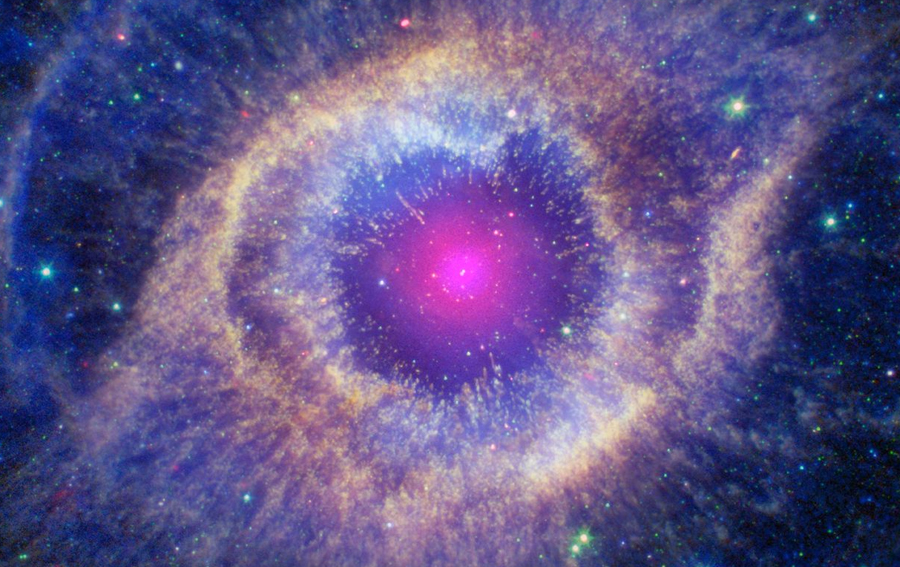
A team of researchers has analyzed more than one million galaxies to explore the origin of the present-day cosmic structures, reports a recent study published in Physical Review D.
Until today, precise observations and analyses of the cosmic microwave background (CMB) and large-scale structure (LSS) have led to the establishment of the standard framework of the universe, the so-called ΛCDM model, where cold dark matter (CDM) and dark energy (the cosmological constant, Λ) are significant characteristics.
This model suggests that primordial fluctuations were generated at the beginning of the universe, or in the early universe, which acted as triggers, leading to the creation of all things in the universe including stars, galaxies, galaxy clusters, and their spatial distribution throughout space. Although they are very small when generated, fluctuations grow with time due to the gravitational pulling force, eventually forming a dense region of dark matter, or a halo. Then, different halos repeatedly collided and merged with one another, leading to the formation of celestial objects such as galaxies (https://journals.aps.org/prd/abstract/10.1103/PhysRevD.108.083533).
The researchers simultaneously analyzed the spatial distribution and shape pattern of approximately one million galaxies from the Sloan Digital Sky Survey (SDSS), the world’s largest survey of galaxies today.
As a result, they successfully constrained statistical properties of the primordial fluctuations that seeded the formation of the structure of the entire universe. A statistically significant alignment of the orientations of two galaxies’ shapes more than 100 million light years apart. Their result showed correlations exist between distant galaxies whose formation processes are apparently independent and causally unrelated.
The methods and results of this study will allow researchers in the future to further test inflation theory. Details of this study were published on October 31 in Physical Review D as an Editors’ Suggestion.

AR #75

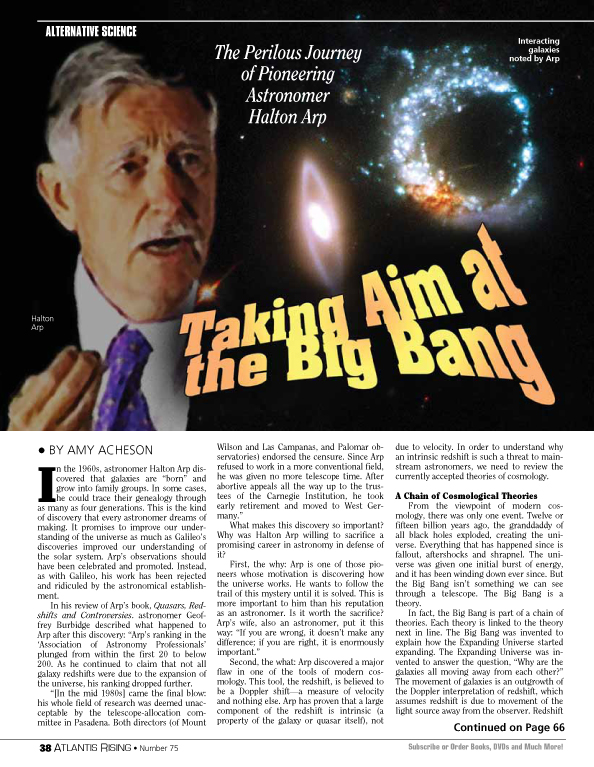
Taking Aim at the Big Bang
Posted on

Is the Universe a Hologram?

by Anil Ananthaswamy, Scientific American

Twenty-five years ago, a conjecture shook the world of theoretical physics. It had the aura of revelation. “At first, we had a magical statement … almost out of nowhere,” says Mark Van Raamsdonk, a theoretical physicist at the University of British Columbia, Vancouver. The idea, put forth by Juan Maldacena of the Institute for Advanced Study in Princeton, N.J., hinted at something profound: that our universe could be a hologram. Much like a 3-D hologram emerges from the information encoded on a 2-D surface, our universe’s 4-D spacetime could be a holographic projection of a lower-dimensional reality.

Specifically, Maldacena showed that a five-dimensional theory of a type of imaginary spacetime called anti–de Sitter space (AdS) that included gravity could describe the same system as a lower-dimensional quantum field theory of particles and fields in the absence of gravity, called a conformal field theory (CFT). In other words, he found two different theories that could both describe the same physical system, showing that the theories were, in a sense, equivalent—even though they each included different numbers of dimensions, and one factored in gravity where the other didn’t. Maldacena then surmised that this AdS/CFT duality would hold for other pairs of theories, with one having a single extra dimension than the other, possibly even those describing 4-D spacetime like ours.

The conjecture was both intriguing and shocking. How could a theory that included gravity be the same as a theory that had no place for gravity? How could they describe the same universe? But the duality has largely held up. In essence, it argues that the goings-on inside some volume of spacetime that has gravity can be understood by studying the quantum-mechanical behavior of particles and fields at that volume’s surface, using a theory with one less dimension, one in which gravity plays no role. “Sometimes some things are easier to understand in one description than the other, and knowing that you’re really talking about the same physics is very powerful,” says Netta Engelhardt, a theoretical physicist at the Massachusetts Institute of Technology.

In the 25 years since Maldacena mooted the idea, physicists have used this power to address questions about whether or not black holes destroy information, to better understand an early epoch in the our universe’s history called inflation, and to arrive at an astonishing conclusion that spacetime may not be fundamental, but something that emerges from quantum entanglement in a lower-dimensional system. Granted, all of these advances involve the theoretically plausible spacetime of anti–de Sitter space, which is not the de Sitter space that describes our universe, but physicists are optimistic that they’ll one day arrive at a duality that works for both.  If that were to happen, the idea could help develop a theory of quantum gravity, one that would combine Einstein’s general relativity with quantum mechanics. It would also imply that our universe is a hologram in truth.

Referenced article
https://www.scientificamerican.com/article/is-our-universe-a-hologram-physicists-debate-famous-idea-on-its-25th-anniversary/?

AR #106

The Multiverse Consideration

by Patrick Marsolek

Posted on

Is the Universe Conscious?

Things Might not be as ‘Random’ as Science Once Told Us

The “hard problem” for science is not getting easier. Artificial intelligence, notwithstanding, ‘consciousness’ remains a mystery, and we should not be surprised that science struggles even to define it, to say nothing of explain it.

Considered by top physicists the primary unsolved scientific puzzle of our time, ‘consciousness,’ has thus far defied all efforts to understand it, and even though some consider it only an illusion, it is one experienced, to a greater or lesser degree, by all thinking people. The go-to position for mainstream science is that—illusion or not—consciousness is just a function of the brain, and without the brain there would be no consciousness, whatever it is.

Some emphatically disagree and they are not without evidence.

Beginning in the 1990s the Global Consciousness Project, for instance, set out to investigate whether there might be previously unknown inter connections between the unconscious minds of people the world over. Forty electronic devices designed to produce a random series of ones and zeroes (like dice with only  ‘yeses’ and ‘nos’) were placed around the world and their output was tracked over the internet. The theory was that statistically the aggregate results should provide a virtually equal number of ones and zeroes. Any departure from that pattern could be considered an anomaly which could be measured. To the amazement of researchers, such anomalies did begin to occur and were usually associated with major world events including holidays like new year. Not only did major spikes show up along with events like the funeral of princess Diane and 9/11 but, indeed, the spikes actually preceded the events, often by several hours. The attack of 9/11, for instance showed up four hours before it happened. (https://noetic.org/research/global-consciousness-project/)

In 2012, Dimitri Krioukov, a professor at the University of California, San Diego published a study in Nature’s Scientific Reports which suggested that different kinds of networks evolve in similar ways. In an interview with the web site Space.com Krioukov said the Universe (what some once called the ‘macrocosm’) really grows like a brain, building its networks as it grows, with the electrical firing between brain cells ‘mirrored’ in the shape of expanding galaxies. Krioukov was careful to add that he didn’t mean the universe was ‘thinking,’ but he did concede, “for a physicist it is an immediate signal that there is something missing in our understanding of how the universe works.” That is, of course, what some might call a ‘no-brainer.’ (https://www.nature.com/articles/srep00793)

Gregory Matloff, a veteran physicist at New York City College of Technology published a paper in 2017 arguing that humans may be very much like the rest of the universe in both substance and in spirit. A “proto-consciousness field” could extend through all of space, he argued. Stars, in fact, may be thinking entities that deliberately control their paths. Put more bluntly, the entire cosmos may be self-aware. That view is all part of a growing movement called ‘panpsychism’ and it’s the ‘in’ thing in some very exclusive scientific circles. Much as the ‘Gaia hypothesis’ once considered the planet Earth to be a living breathing conscious being, the panpsychist concept would apply to entire galaxies, and even the whole universe. Or, as, the ancients might say: ‘as above, so below.’ (http://www. gregmatloff.com/Edge%20Science%20Matloff-ES29.pdf) This, of course, has for eons been basic to enlightened awareness. For science, though, it is better late than never.

Below are articles from our back issues that connect very directly to this content.
Available for purchase and download.

Issue #112
The Coming of the Clones

From the member archives
Intelligent Design – the Evidence