Posted on

Researchers Say they Know How the Universe Began

This image has an empty alt attribute; its file name is ai-free.png

A team of researchers has analyzed more than one million galaxies to explore the origin of the present-day cosmic structures, reports a recent study published in Physical Review D.
Until today, precise observations and analyses of the cosmic microwave background (CMB) and large-scale structure (LSS) have led to the establishment of the standard framework of the universe, the so-called ΛCDM model, where cold dark matter (CDM) and dark energy (the cosmological constant, Λ) are significant characteristics.
This model suggests that primordial fluctuations were generated at the beginning of the universe, or in the early universe, which acted as triggers, leading to the creation of all things in the universe including stars, galaxies, galaxy clusters, and their spatial distribution throughout space. Although they are very small when generated, fluctuations grow with time due to the gravitational pulling force, eventually forming a dense region of dark matter, or a halo. Then, different halos repeatedly collided and merged with one another, leading to the formation of celestial objects such as galaxies (https://journals.aps.org/prd/abstract/10.1103/PhysRevD.108.083533).
The researchers simultaneously analyzed the spatial distribution and shape pattern of approximately one million galaxies from the Sloan Digital Sky Survey (SDSS), the world’s largest survey of galaxies today.
As a result, they successfully constrained statistical properties of the primordial fluctuations that seeded the formation of the structure of the entire universe. A statistically significant alignment of the orientations of two galaxies’ shapes more than 100 million light years apart. Their result showed correlations exist between distant galaxies whose formation processes are apparently independent and causally unrelated.
The methods and results of this study will allow researchers in the future to further test inflation theory. Details of this study were published on October 31 in Physical Review D as an Editors’ Suggestion.

AR #75

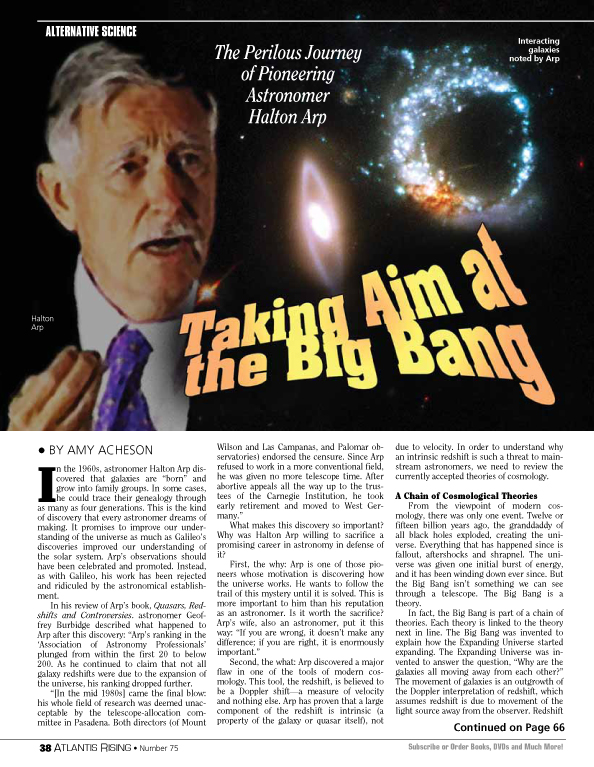
Taking Aim at the Big Bang
Posted on

James Webb Telescope Challenges Big Bang Theory

In a posthumous presentation, the late astro-physicist Wal Thornhill has deconstructed the First Deep Field Image from the James Webb Space Telescope released on July 11, 2022. It’s a composite of different wavelengths totaling 12.5 hours—well beyond Hubble’s deepest fields, which took weeks.

Focused on a massive galaxy cluster, the center of the image is surrounded by stretched out curved objects. The Standard Model, propounded by today’s scientiific establishement, describes these curved objects as distant galaxies “gravitationally lensed” making them appear larger and brighter. In the Electric Universe Model, for which Thornhill and colleague Stuart Talbott are the primary theorists, the curved object effect is due to refraction through the neutrino sea aether that is denser around the massive galaxy cluster.

According to Big Bang theory, the earliest galaxies have not had time to evolve and grow by accretion, collisions, mergers, or cannibalizing smaller galaxies. The reddest objects should exhibit the least amount of smoothness and symmetric structure—but that is the opposite of what is observed—including the curved “lensed” galaxies.

Thornhill’s EU Model expects to see galaxies that get smaller and fainter, some bluer, some redder, to the limits of the telescope’s observational power—and that is exactly what Webb’s First Deep Field shows. Thornhill predicted this will be further confirmed when forthcoming ultra deep field images—after weeks of Webb observation—detect additional faint galaxies that simply show more of the same.

In the Electric Universe theory, space is not expanding. The Universe is of unknown age and unknown extent, possibly infinite. According to science reporter Steven Parsons, writing for Atlantis Rising Magazine, “By breaking from the pack and looking at observed facts with fresh eyes, Wal Thornhill has become convinced that planets and stars function in an electrically dynamic environment.” The Venusian tail, discovered last year, retains its rope-like or filamentary structure across 45 million kilometers because it is a current carrying plasma. These plasma structures, “Birkeland currents,” are well known to plasma physicists but remain unrecognized by astronomers. The very existence of Birkeland currents in the solar system demonstrates the existence of a flow of electric current in the plasma which fills the solar system. And this opens up a whole new way of seeing things.

Thornhill says that stars do not produce all of their light and heat by thermo-nuclear processes. Instead, our Sun and all other stars resemble great spheres of lightning. These spheres receive energy externally rather than from nuclear fusion at their core, he says. The accepted theory that stars produce energy by nuclear fusion suits the mindset of the atomic era but does not conform to actual observations.

.)

AR #102

Big Bang or Not

by William B. Stoecker

Posted on

Ghost Light in Galaxies Very Old

In giant clusters of hundreds or thousands of galaxies, innumerable stars wander among the galaxies like lost souls, emitting a ghostly haze of light. These stars are not gravitationally tied to any one galaxy in a cluster.

The nagging question for astronomers has been: how did the stars get so scattered throughout the cluster in the first place? Several competing theories include the possibility that the stars were stripped out of a cluster’s galaxies, or they were tossed around after mergers of galaxies, or they were present early in a cluster’s formative years many billions of years ago.

A recent infrared survey from NASA’s Hubble Space Telescope, which looked for this so-called “intracluster light,” sheds new light on the mystery. The new Hubble observations suggest that these stars have been wandering around for billions of years, and are not a product of more recent dynamical activity inside a galaxy cluster that would strip them out of normal galaxies.

The survey included 10 galaxy clusters as far away as nearly 10 billion light-years. These measurements must be made from space because the faint intracluster light is 10,000 times dimmer than the night sky as seen from the ground.
The survey reveals that the fraction of the intracluster light relative to the total light in the cluster remains constant, looking over billions of years back into time. “This means that these stars were already homeless in the early stages of the cluster’s formation,” said James Jee of Yonsei University in Seoul, South Korea. His results are being published in Nature magazine (https://www.nature.com/articles/s41586-022-05396-4).

Stars can be scattered outside of their galactic birthplace when a galaxy moves through gaseous material in the space between galaxies, as it orbits the center of the cluster. In the process, drag pushes gas and dust out of the galaxy. However, based on the new Hubble survey, Jee rules out this mechanism as the primary cause for the intracluster star production. That’s because the intracluster light fraction would increase over time to the present if stripping is the main player. But that is not the case in the new Hubble data, which show a constant fraction over billions of years.
Intracluster light was first detected in the Coma cluster of galaxies in 1951 by Fritz Zwicky, who reported that one of his most interesting discoveries was observing luminous, faint intergalactic matter in the cluster. Because the Coma cluster, containing at least 1,000 galaxies, is one of the nearest clusters to Earth (330 million light-years), Zwicky was able to detect the ghost light even with a modest 18-inch telescope.

NASA’s James Webb Space Telescope’s near-infrared capability and sensitivity will greatly extend the search for intracluster stars deeper into the universe, and therefore should help solve the mystery.

Pictures and Captions
https://www.nasa.gov/feature/goddard/2023/hubble-finds-that-ghost-light-among-galaxies-stretches-far-back-in-time

AR #111

The Universe had no beginning, quantum calculations reveal