The 2019 Notre Dame fire in Paris presented archaeologists with a unique opportunity to peer into the cathedral’s history.
Parts of the landmark that were concealed for centuries are now being picked apart and put back together, providing a window into the architectural innovations that once made this 32-meter-high (105 feet) building the tallest cathedral in its age, thanks to the iron that runs through the majestic structure’s veins.
Archaeologists have uncovered thousands of metal staples in various parts of the cathedral, some dating back to the early 1160s.
The findings suggest the extensive use of iron in masonry is not as modern as experts once assumed. Medieval builders working on Notre Dame were employing the architectural technique long before restoration works started in the 19th century.
“Notre Dame is now unquestionably the first known Gothic cathedral where iron was massively used to bind stones as a proper construction material,” archaeologists working in Paris conclude.
The team estimates that the iron fixtures found at Notre Dame were designed up to two decades before France’s Soisson cathedral was built and four decades before the Bourges cathedral came to be. Until now, both these gothic buildings were considered the first examples of systemic iron masonry.
The architect that was initially in charge of Notre Dame’s construction was clearly ahead of the game.
The study was published in PLOS One. https://journals.plos.org/plosone/article?id=10.1371/journal.pone.0280945
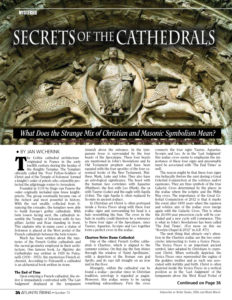
The Gothic cathedral architecture originated in France in the early twelfth century during the heyday of the Knights Templar. The Templars officially called the ‘Poor Fellow-Soldiers of Christ and of the Temple of Solomon’ formed a knight’s order of priests who ostensibly protected the pilgrimage routes to Jerusalem.
Founded in 1118 by Hugo van Payens the order originally included nine brave knight-priests. The group eventually became one of the richest and most powerful in history. With the vast wealth, collected from financing the crusades, the templars were able to build Europe’s gothic cathedrals. With twin towers facing west, the cathedrals resemble the Temple of Solomon with its two pillars Jachin and Boaz standing in front. This explains why in many cases a statue of Solomon is placed at the West portal of the French cathedrals between the twin towers.
Much has been written about the mysteries of the French Gothic cathedrals and the sacred geometry employed in their architecture. One famous book, Le Mystère des Cathédrales was written in 1929 by Fulcanelli (1839 – 1953), the mysterious French alchemist. According to Fulcanelli a cathedral is an alchemical book written in stone.

AR #73
Secrets of the Cathedrals
by Jan Wicherink