Could History Be Repeating Itself?

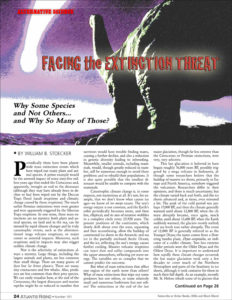
The end of the last Ice Age also marked the end for more than three dozen genera of large mammals in North America, from mammoths and mastodons to bison and saber-toothed cats. Details concerning the precise timing and circumstances, however, have remained murky ever since.
A team of scientists recently focused on the famous Rancho La Brea Tar Pits in southern California in their quest to provide answers to these questions, resulting in the most exact and detailed timeline for the extinctions that happened during the latter part of the Pleistocene period in North America, along with some foreboding insight into the area’s present and future. Their work is featured on the August 18, 2023 cover of Science (https://www.science.org/doi/10.1126/science.abo3594).
Texas A&M University archaeologist Dr. Michael Waters, along with roughly a dozen fellow researchers examined the timing and cause of the extinction of a variety of large mammals, known as megafauna, that got stuck in tar at Rancho La Brea, ensuring the preservation of their bones. The team used the radiocarbon dating method to date 169 bones from seven different animals — bison, horse, camel and ground sloths as well as the carnivores that ate them, including the saber-toothed cat, dire wolf and American lion. They also compared those findings to regional pollen and charcoal records along with continent-wide data on human and large mammal populations.
Armed with their new data, the researchers subsequently used time-series modeling to produce the most detailed chronobiology to date, showing the relationships between climate and vegetation change, fire activity, human demographics and megafauna extinctions — groundbreaking results they report in the world-leading academic journal.
Waters says the team’s findings reveal that Ice Age mammal populations in southern California were steady from 15,000 to around 13,250 years ago. Afterward, there was a sharp decline in the population of the seven animals studied, and they all became extinct between 13,070 to 12,900 years ago.
In an interesting modern-day parallel, this extinction event corresponds with a change in the environment from 13,300 to 12,900 years ago marked by warming and drying that made the land more vulnerable to fires in southern California. Charcoal records show that fires increased around 13,500 years ago and peaked between 13,200 and 12,900 years ago. Studies show that humans arrived in North America’s Pacific coast 16,000 to 15,000 years ago and lived alongside the megafauna for 2,000 to 3,000 years before their extinction.
While humans hunted animals during this period, Waters says the impact of hunting on the demise of the megafauna likely was minor because of the low population of humans on the landscape. However, the fires would have been devastating, resulting in the loss of habitat causing the rapid decline and extinction of the megafauna in southern California. The study suggests these fires were ignited by humans, which had increased in number by that time.
“Fire is a way that small numbers of humans can have a large impact over a broad area,” said Waters, who also cautions that climate changes observed in present-day California are similar to those of the late Pleistocene.
“This study has implications for the changes we see in southern California today,” Waters added. “The temperatures are rising, and the area is drying. We also see a dramatic increase in fires. It appears that history may be repeating itself.”
While Waters acknowledges that this is the story of extinction at Rancho La Brea, he says it has the potential to offer insights into when extinctions happened across all of North America.
“Mammoths and mastodons survived in many parts of North America until around 12,700 years ago,” he added. “These animals were hunted by the Clovis people between about 13,000 and 12,700 years ago. We are now dating megafauna remains from other locations to give a broader understanding of the Rancho La Brea research in the context of North America.”
The museum at La Brea Tar Pits holds the world’s largest collection of fossils from the Ice Age and has been central to the study of animal and plant life at the end of the Pleistocene epoch for more than a century. Its naturally occurring asphalt pools entrapped and preserved the bones of thousands of individual animals representing dozens of megafaunal species during the last 60,000 years, enabling scientists to determine when different species disappeared from the ecosystem and why.
The team’s research was supported by the National Science Foundation and various Texas A&M-specific grants, such as the CSFA and the North Star Archaeological Research Fund.
y.

AR #101
Facing the Extinction Threat
by William B. Stoecker