Posted on

Storms on Saturn Last for Hundreds of Years

This image has an empty alt attribute; its file name is ai-free.png

The largest storm in the solar system, a 10,000-mile-wide anticyclone called the Great Red Spot, has decorated Jupiter’s surface for hundreds of years. A new study now shows that Saturn — though much blander and less colorful than Jupiter — also has long-lasting megastorms with impacts deep in the atmosphere that persist for centuries.

The study was conducted by astronomers from the University of California, Berkeley, and the University of Michigan, Ann Arbor, who looked at radio emissions from the planet, which come from below the surface, and found long-term disruptions in the distribution of ammonia gas. The study was just published in the journal Science Advances, https://www.science.org/doi/10.1126/sciadv.adg9419).

Megastorms occur approximately every 20 to 30 years on Saturn and are similar to hurricanes on Earth, although significantly larger. But unlike Earth’s hurricanes, no one knows what causes megastorms in Saturn’s atmosphere, which is composed mainly of hydrogen and helium with traces of methane, water and ammonia.

“Understanding the mechanisms of the largest storms in the solar system puts the theory of hurricanes into a broader cosmic context, challenging our current knowledge and pushing the boundaries of terrestrial meteorology,” said lead author Cheng Li, a former 51 Peg b Fellow at UC Berkeley who is now an assistant professor at the University of Michigan.

Imke de Pater, a UC Berkeley professor emerita of astronomy and of earth and planetary sciences, has been studying gas giants for over four decades to better understand their composition and what makes them unique, employing the Karl G. Jansky Very Large Array in New Mexico to probe the radio emissions from deep inside the planet.

“At radio wavelengths, we probe below the visible cloud layers on giant planets. Since chemical reactions and dynamics will alter the composition of a planet’s atmosphere, observations below these cloud layers are required to constrain the planet’s true atmospheric composition, a key parameter for planet formation models,” she said. “Radio observations help characterize dynamical, physical and chemical processes including heat transport, cloud formation and convection in the atmospheres of giant planets on both global and local scales.” As reported in the new study, de Pater, Li and UC Berkeley graduate student Chris Moeckel found something surprising in the radio emissions from the planet: anomalies in the concentration of ammonia gas in the atmosphere, which they connected to the past occurrences of megastorms in the planet’s northern hemisphere.

According to the team, the concentration of ammonia is lower at midaltitudes, just below the uppermost ammonia-ice cloud layer, but has become enriched at lower altitudes, 100 to 200 kilometers deeper in the atmosphere. They believe that the ammonia is being transported from the upper to the lower atmosphere via the processes of precipitation and reevaporation. What’s more, that effect can last for hundreds of years. The study further revealed that although both Saturn and Jupiter are made of hydrogen gas, the two gas giants are remarkably dissimilar. While Jupiter does have tropospheric anomalies, they have been tied to its zones (whitish bands) and belts (darkish bands) and are not caused by storms like they are on Saturn. The considerable difference between these neighboring gas giants is challenging what scientists know about the formation of megastorms on gas giants and other planets and may inform how they’re found and studied on exoplanets in the future.

AR #74

Crystal Saturn?

by Barton Ruggles
Posted on

Timing of Massive Ice Age Extinction Event Scrutinized

Could History Be Repeating Itself?

This image has an empty alt attribute; its file name is ai-free.png

The end of the last Ice Age also marked the end for more than three dozen genera of large mammals in North America, from mammoths and mastodons to bison and saber-toothed cats. Details concerning the precise timing and circumstances, however, have remained murky ever since.

A team of scientists recently focused on the famous Rancho La Brea Tar Pits in southern California in their quest to provide answers to these questions, resulting in the most exact and detailed timeline for the extinctions that happened during the latter part of the Pleistocene period in North America, along with some foreboding insight into the area’s present and future. Their work is featured on the August 18, 2023 cover of Science (https://www.science.org/doi/10.1126/science.abo3594).

Texas A&M University archaeologist Dr. Michael Waters, along with roughly a dozen fellow researchers examined the timing and cause of the extinction of a variety of large mammals, known as megafauna, that got stuck in tar at Rancho La Brea, ensuring the preservation of their bones. The team used the radiocarbon dating method to date 169 bones from seven different animals — bison, horse, camel and ground sloths as well as the carnivores that ate them, including the saber-toothed cat, dire wolf and American lion. They also compared those findings to regional pollen and charcoal records along with continent-wide data on human and large mammal populations.

Armed with their new data, the researchers subsequently used time-series modeling to produce the most detailed chronobiology to date, showing the relationships between climate and vegetation change, fire activity, human demographics and megafauna extinctions — groundbreaking results they report in the world-leading academic journal.

Waters says the team’s findings reveal that Ice Age mammal populations in southern California were steady from 15,000 to around 13,250 years ago. Afterward, there was a sharp decline in the population of the seven animals studied, and they all became extinct between 13,070 to 12,900 years ago.

In an interesting modern-day parallel, this extinction event corresponds with a change in the environment from 13,300 to 12,900 years ago marked by warming and drying that made the land more vulnerable to fires in southern California. Charcoal records show that fires increased around 13,500 years ago and peaked between 13,200 and 12,900 years ago. Studies show that humans arrived in North America’s Pacific coast 16,000 to 15,000 years ago and lived alongside the megafauna for 2,000 to 3,000 years before their extinction.

While humans hunted animals during this period, Waters says the impact of hunting on the demise of the megafauna likely was minor because of the low population of humans on the landscape. However, the fires would have been devastating, resulting in the loss of habitat causing the rapid decline and extinction of the megafauna in southern California. The study suggests these fires were ignited by humans, which had increased in number by that time.
“Fire is a way that small numbers of humans can have a large impact over a broad area,” said Waters, who also cautions that climate changes observed in present-day California are similar to those of the late Pleistocene.
“This study has implications for the changes we see in southern California today,” Waters added. “The temperatures are rising, and the area is drying. We also see a dramatic increase in fires. It appears that history may be repeating itself.”

While Waters acknowledges that this is the story of extinction at Rancho La Brea, he says it has the potential to offer insights into when extinctions happened across all of North America.

“Mammoths and mastodons survived in many parts of North America until around 12,700 years ago,” he added. “These animals were hunted by the Clovis people between about 13,000 and 12,700 years ago. We are now dating megafauna remains from other locations to give a broader understanding of the Rancho La Brea research in the context of North America.”

The museum at La Brea Tar Pits holds the world’s largest collection of fossils from the Ice Age and has been central to the study of animal and plant life at the end of the Pleistocene epoch for more than a century. Its naturally occurring asphalt pools entrapped and preserved the bones of thousands of individual animals representing dozens of megafaunal species during the last 60,000 years, enabling scientists to determine when different species disappeared from the ecosystem and why.

The team’s research was supported by the National Science Foundation and various Texas A&M-specific grants, such as the CSFA and the North Star Archaeological Research Fund.

y.

AR #101

Facing the Extinction Threat

by William B. Stoecker

Posted on

Tracking Ancient Weather on Mars

New Evidence Reveals Frequent Wet and Dry Changes

This image has an empty alt attribute; its file name is ai-free.png

New observations of mud cracks made by the Curiosity rover show that high-frequency, wet-dry cycling occurred in early Martian surface environments, indicating that the red planet may have once seen seasonal weather patterns or even flash floods. The research has now been published in the journal Nature (https://www.nature.com/articles/s41586-023-06220-3).

The presence of long-term wet environments, such as evidence of ancient lakes on Mars, is well-documented, but far less is known about short-term climate fluctuations.

After years of exploring terrain largely comprised of silicates, the rover entered a new area filled with sulfates, marking a major environment transition. In this new environment, the research team found a change in mud crack patterns, signifying a change in the way the surface would have dried. This indicates that water was still present on the surface of Mars episodically, meaning water could have been present for a time, evaporated, and repeated until polygons, or mud cracks, formed.

“These exciting observations of mature mud cracks are allowing us to fill in some of the missing history of water on Mars. How did Mars go from a warm, wet planet to the cold, dry place we know today? These mud cracks show us that transitional time, when liquid water was less abundant but still active on the Martian surface,” said Nina Lanza, principal investigator of the ChemCam instrument onboard the Curiosity rover. “These features also point to the existence of wet-dry environments that on Earth are extremely conducive to the development of organic molecules and potentially life. Taken as a whole, these results a giving us a clearer picture of Mars as a habitable world.”

The presence of long-term wet environments, such as evidence of ancient lakes on Mars, is well-documented, but far less is known about short-term climate fluctuations.

After years of exploring terrain largely comprised of silicates, the rover entered a new area filled with sulfates, marking a major environment transition. In this new environment, the research team found a change in mud crack patterns, signifying a change in the way the surface would have dried. This indicates that water was still present on the surface of Mars episodically, meaning water could have been present for a time, evaporated, and repeated until polygons, or mud cracks, formed.

“A major focus of the Curiosity mission, and one of the main reasons for selecting Gale Crater, is to understand the transition of a ‘warm and wet’ ancient Mars to a ‘cold and dry’ Mars we see today,” said Patrick Gasda of the Laboratory’s Space Remote Sensing and Data Science group and coauthor of the paper. “The rover’s drive from clay lakebed sediments to drier non-lakebed and sulfate-rich sediments is part of this transition.”

On Earth, initial mud cracks in mud form a T-shaped pattern, but subsequent wetting and drying cycles cause the cracks to form more of a Y-shaped pattern, which is what Curiosity observed. Additionally, the rover found evidence that the mud cracks were only a few centimeters deep, which could mean that wet-dry cycles were seasonal, or may have even occurred more quickly, such as in a flash flood. 

These findings could mean that Mars once had an Earth-like wet climate, with seasonal or short-term flooding, and that Mars may have been able to support life at some point.

AR #71

Water Ice on Mars

Posted on

Could a Sun ‘Umbrella,’ Fix Climate Change?

This image has an empty alt attribute; its file name is ai-free.png

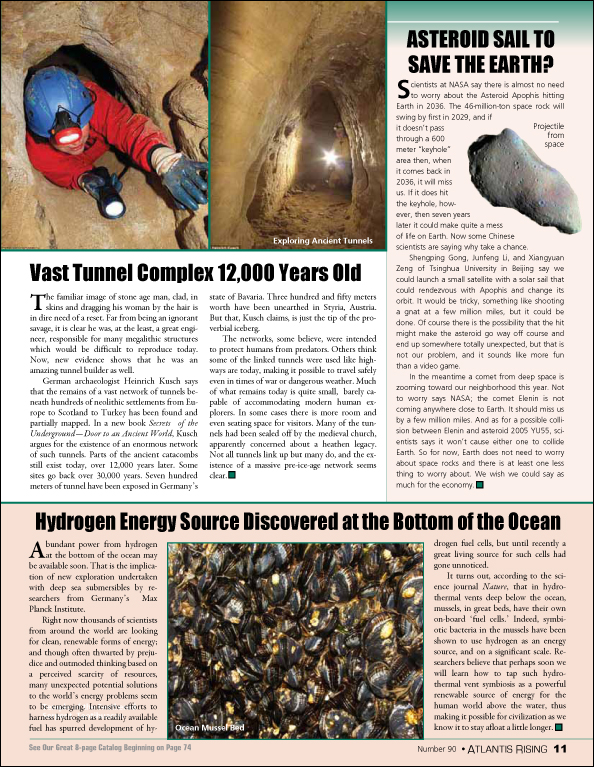
Earth is rapidly warming say some scientists, and now they are developing a variety of approaches to reduce the effects of climate change. István Szapudi, an astronomer at the University of Hawaiʻi Institute for Astronomy, has proposed a novel approach—a solar shield to reduce the amount of sunlight hitting Earth, combined with a tethered, captured asteroid as a counterweight. Engineering studies using this approach they claim could start now to create a workable design that could mitigate climate change within decades.

The paper, “Solar radiation management with a tethered sun shield,” is published in Proceedings of the National Academy of Sciences https://www.pnas.org/doi/10.1073/pnas.2307434120).

One of the simplest approaches to reducing the global temperature is to shade the Earth from a fraction of the Sun’s light. This idea, called a solar shield, has been proposed before, but the large amount of weight needed to make a shield massive enough to balance gravitational forces and prevent solar radiation pressure from blowing it away makes even the lightest materials prohibitively expensive. Szapudi’s creative solution consists of two innovations: a tethered counterweight instead of just a massive shield, resulting in making the total mass more than 100 times less, and the use of a captured asteroid as the counterweight to avoid launching most of the mass from Earth.

“In Hawaiʻi, many use an umbrella to block the sunlight as they walk about during the day. I was thinking, could we do the same for Earth and thereby mitigate the impending catastrophe of climate change?” Szapudi said.

Szapudi began with the goal of reducing solar radiation by 1.7%, an estimate of the amount needed to prevent a catastrophic rise in global temperatures. He found that placing a tethered counterbalance toward the Sun could reduce the weight of the shield and counterweight to approximately 3.5 million tons, about one hundred times lighter than previous estimates for an untethered shield.

While this number is still far beyond current launch capabilities, only 1% of the weight—about 35,000 tons—would be the shield itself, and that is the only part that needs to be launched from Earth. With newer, lighter materials, the mass of the shield can be reduced even further. The remaining 99% of the total mass would be asteroids or lunar dust used as a counterweight. Such a tethered structure would be faster and cheaper to build and deploy than other shield designs.

Today’s largest rockets can only lift about 50 tons to low Earth orbit, so this approach to solar radiation management would be challenging. Szapudi’s approach brings the idea into the realm of possibility, even with today’s technology, whereas prior concepts were completely unachievable. Also, developing a light-weight but strong graphene tether connecting the shield with the counterweight is crucial.

AR #90

Asteroid Sail to Save the Earth?

Posted on

HAARP is Back and Aiming at Jupiter

Gakona, Alaska’s massive ionosphere-trained antenna array has returned to the spotlight, with the biggest target yet, in its sights—the planet Jupiter, by way of Earth’s moon.

Back in the 1990s the High-frequency Active Auroral Research Program (HAARP) was launched, ostensibly as an ionospheric research program funded by the U.S. Air Force, U.S. Navy, the University of Alaska Fairbanks, and the Defense Advanced Research Projects Agency (DARPA). In Angels Don’t Play this HAARP, the best-selling book by Atlantis Rising Magazine columnist Jeane Manning and Dr. Nick Begich, argued that HAARP might actually be an attempt to weaponize weather utilizing advanced psychotronic (parapsychological) technology. Manning and Begich were not alone in their opinion.


According to Wikipedia, one Russian military journal even wrote that such ionospheric testing would “trigger a cascade of electrons that could flip Earth’s magnetic poles.”
The Alaska state legislature and the European Parliament held hearings about HAARP, the latter citing environmental concerns.


Former Governor of Minnesota, ex-professional wrestler, and documentary maker Jesse Ventura questioned whether the government was using the site to manipulate the weather or to bombard people with mind-controlling radio waves. An Air Force spokeswoman said Ventura made an official request to visit the research station but was rejected. “He and his crew showed up at HAARP anyway and were denied access,” she said.


In 10 days worth of unprecedented experiments in October, 2022, researchers attempted what they called a ‘Jupiter bounce,’or “Interplanetary Ionosonde.” According to a statement from the University of Alaska Fairbanks, the experiment was “the largest active remote sensing operation in history,” and was intended to test HAARP’s ability to bounce signals off  the ionosphere of Jupiter, and also to determine how well receivers at the University of New Mexico’s Long Wavelength Array could receive such reflected signals.
The stated purpose was to test the coordination of military and scientific facilities intended for eventual study of near-Earth asteroids, especially those that could be a hazard to Earth.


Knowing an asteroid’s composition can influence the type of defense to be used, the statement said.


The experiment consisted of transmitting a signal from HAARP to the moon and receiving the reflected signal at the California and New Mexico sites. 


The possibility of ‘psychotronics’ manipulation first made news in the 1970s, when many reports surfaced suggesting that the U.S. government had developed, and actually deployed, psychotronic weapons that made mind control of targeted individuals, and even large groups, possible. Much research, and even news reports argued for the seriousness of the topic, but the idea was relentlessly ridiculed by the mainstream media, and has since been relagated to the realm of fringe conspiracy theory—not to be taken seriously by the public. Still, there were many, including the Princeton University Anomalies Lab, the Stanford Research Institute, the Institute of Noetic Sciences, and others, who took the subject very seriously and devoted considerable research to it.


According to NASA, HAARP consists of 180 antennas designed to transmit signals into the ionosphere, which extends from 30 miles (48 kilometers) to 600 miles (965 km) above sea level and is seen as the area where Earth’s atmosphere meets space. The ionosphere plays an important role in radio transmission, as it reflects radio waves. Many satellites occupy this region of the atmosphere, which is heavily influenced by solar weather.

AR #65

Weather Goes to War

Posted on

The Sound of Martian Dust Devils

When the rover Perseverance landed on Mars, it was equipped with the first working microphone on the planet’s surface. Scientists have used it to make the first-ever audio recording of an extraterrestrial whirlwind.

The study was published in Nature Communications by planetary scientist Naomi Murdoch and a team of researchers at the National Higher French Institute of Aeronautics and Space and NASA. Roger Wiens, professor of earth, atmospheric and planetary sciences in Purdue University’s College of Science, leads the instrument team that made the discovery. He is the principal investigator of Perseverance’s SuperCam, a suite of tools that comprise the rover’s “head” that includes advanced remote-sensing instruments with a wide range of spectrometers, cameras and the microphone (https://www.nature.com/articles/s41467-022-35100-z).


“We can learn a lot more using sound than we can with some of the other tools,” Wiens said. “They take readings at regular intervals. The microphone lets us sample, not quite at the speed of sound, but nearly 100,000 times a second. It helps us get a stronger sense of what Mars is like.”


The microphone is not on continuously; it records for about three minutes every couple of days. Getting the whirlwind recording, Wiens said, was lucky, though not necessarily unexpected. In the Jezero Crater, where Perseverance landed, the team has observed evidence of nearly 100 dust devils – tiny tornadoes of dust and grit – since the rover’s landing. This is the first time the microphone was on when one passed over the rover.


The sound recording of the dust devil, taken together with air pressure readings and time-lapse photography, help scientists understand the Martian atmosphere and weather.


“We could watch the pressure drop, listen to the wind, then have a little bit of silence that is the eye of the tiny storm, and then hear the wind again and watch the pressure rise,” Wiens said. It all happened in a few seconds. “The wind is fast — about 25 miles per hour, but about what you would see in a dust devil on Earth. The difference is that the air pressure on Mars is so much lower that the winds, while just as fast, push with about 1% of the pressure the same speed of wind would have back on Earth. It’s not a powerful wind, but clearly enough to loft particles of grit into the air to make a dust devil.”


The information indicates that future astronauts will not have to worry about gale-force winds blowing down antennas or habitats — so future Mark Watneys won’t be left behind — but the wind may have some benefits. The breezes blowing grit off the solar panels of other rovers — especially Opportunity and Spirit — may be what helped them last so much longer (https://en.wikipedia.org/wiki/The_Martian_(Weir_novel)?).


“Those rover teams would see a slow decline in power over a number of days to weeks, then a jump. That was when wind cleared off the solar panels,” Wiens said.


The lack of such wind and dust devils in the Elysium Planitia where the InSIght mission landed may help explain why that mission is winding down.


“Just like Earth, there is different weather in different areas on Mars,” Wiens said. “Using all of our instruments and tools, especially the microphone, helps us get a concrete sense of what it would be like to be on Mars.”  

https://www.purdue.edu/newsroom/releases/2022/Q4/scientists-get-first-ever-sound-recording-of-dust-devils-tiny-tornadoes-of-dust,-grit-on-mars.html


AR #69

Sound as the Sculptor of Life

by Jeff Volk

Posted on

Chaos Theory and Controlling the Weather

Researchers have used computer simulations to show that weather phenomena such as sudden downpours could potentially be modified by making small adjustments to certain variables in the weather system. They did this by taking advantage of a system known as a “butterfly attractor” in chaos theory, where a system can have one of two states—like the wings of a butterfly—and that it switches back and forth between the two states depending on small changes in certain conditions.

While weather predictions have reached levels of high accuracy thanks to methods such as supercomputer-based simulations and data assimilation, where observational data is incorporated into simulations, scientists have long hoped to be able to control the weather. Research in this area has intensified due to climate change, which has led to more extreme weather events such as torrential rain and storms.


There are methods at present for weather modification, but they have had limited success. Seeding the atmosphere to induce rain has been demonstrated, but it is only possible when the atmosphere is already in a state where it might rain. Geoengineering projects have been envisioned, but have not been carried out due to concerns about what unpredicted long-term effects they might have.


As a promising approach, a team of researchers from the Japanese RIKEN Center for Computational Science have looked to chaos theory to create realistic possibilities for mitigating weather events such as torrential rain. Specifically, they have focused on a phenomenon known as a butterfly attractor, proposed by mathematician and meteorologist Edward Lorentz, one of the founders of modern chaos theory. Essentially, this refers to a system that can adopt one of two orbits that look like the wings of a butterfly, but can change the orbits randomly based on small fluctuations in the system.


To perform the work, the RIKEN team ran one weather simulation, to serve as the control of “nature” itself, and then ran other simulations, using small variations in a number of variables describing the convection—how heat moves through the system—and discovered that small changes in several of the variables together could lead to the system being in a certain state once a certain amount of time elapsed.


According to Takemasa Miyoshi of the RIKEN Center for Computational Science, who led the team, “This opens the path to research into the controllability of weather and could lead to weather control technology.


The work, published in Nonlinear Processes of Geophysics. ( https://npg.copernicus.org/articles/29/133/2022/).


AR #55

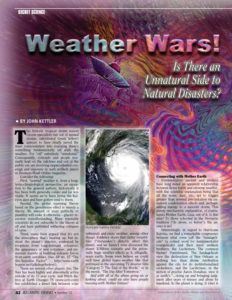
Weather Wars

by John Kettler