Posted on

Scent of the Afterlife in Ancient Egyptian Mummification Balms

This image has an empty alt attribute; its file name is ai-free.png

In an innovative endeavor to create a sensory bridge to the ancient past, a team of researchers has recreated one of the scents used in the mummification of an important Egyptian woman more than 3500 years ago.

Coined ‘the scent of eternity’, the ancient aroma will be presented at the Moesgaard Museum in Denmark in an upcoming exhibition, offering visitors a unique sensory experience: to encounter firsthand an ambient smell from antiquity – and catch a whiff of the ancient Egyptian process of mummification.
The team’s research centered on the mummification substances used to embalm the noble lady Senetnay in the 18th dynasty, circa 1450 BCE. The researchers utilized advanced analytical techniques – including Gas Chromatography-Mass Spectrometry, High-Temperature Gas Chromatography-Mass Spectrometry, and Liquid Chromatography-Tandem Mass Spectrometry – to reconstruct the substances that helped to preserve and scent Senetnay for eternity.

“We analyzed balm residues found in two canopic jars from the mummification equipment of Senetnay that were excavated over a century ago by Howard Carter from Tomb KV42 in the Valley of the Kings,” says researcher Barbarra Huber. Today, the jars are housed in the Museum August Kestner in Hannover, Germany. The team found that the balms contained a blend of beeswax, plant oil, fats, bitumen, Pinaceae resins (most likely larch resin), a balsamic substance, and dammar or Pistacia tree resin.


Among those imported ingredients were larch tree resin, which likely came from the northern Mediterranean, and possibly dammars, which come exclusively from trees in Southeast Asian tropical forests. If the presence of dammar resin is confirmed, as in balms recently identified from Saqqara dating to the 1st millennium BCE, it would suggest that the ancient Egyptians had access to this Southeast Asian resin via long-distant trade almost a millennium earlier than previously known.

AR #69

Lincoln and the Afterlife

by Susan Martinez, Ph.D.

Posted on

Tracking Lost Ancient Trade Routes with Gemstones

This image has an empty alt attribute; its file name is ai-free.png

Since ancient times, gemstones have been mined and traded across the globe, sometimes traveling continents from their origin. Gems are geologically defined as minerals celebrated for beauty, strength, and rarity. Their unique elemental composition and atomic orientation act as a fingerprint, enabling researchers to uncover the stones’ past, and with it, historical trade routes.

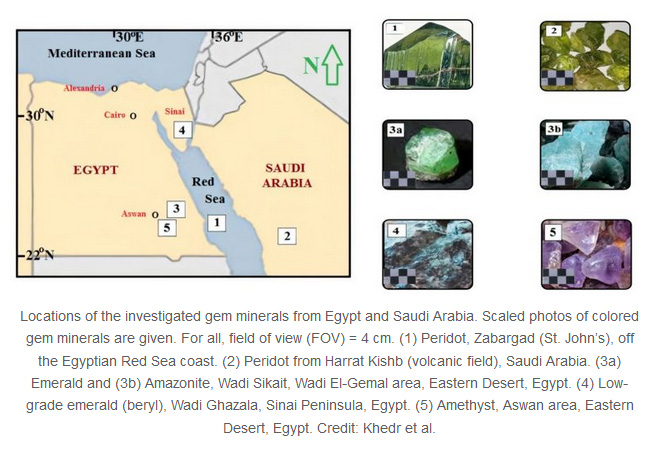
In new research published in AIP Advances, researcher explain how they employed three modern spectroscopic techniques to rapidly analyze gems found in the Arabian-Nubian Shield and compare them with similar gems from around the world (https://pubs.aip.org/aip/adv/article/13/8/085023/2907404/Thermodynamics-of-mechanopeptide-sidechains?searchresult=1). Using laser-induced breakdown spectroscopy (LIBS), Fourier transform infrared (FTIR) spectroscopy, and Raman spectroscopy, the authors identified elements that influence gems’ color, differentiated stones found within and outside the region, and distinguished natural from synthetic.


The Arabian-Nubian Shield is an exposure of mineral deposits that sandwiches the Red Sea in current-day Egypt and Saudi Arabia. The deposits date back to the Earth’s earliest geological age, and the precious metals and gemstones have been harvested for thousands of years.

“We showed the main spectroscopic characteristics of gemstones from these Middle East localities to distinguish them from their counterparts in other world localities,” said author Adel Surour. “This includes a variety of silicate gems such as emerald from the ancient Cleopatra’s mines in Egypt, in addition to amethyst, peridot, and amazonite from other historical sites, which mostly date to the Roman times.”

The various spectroscopic techniques they employed revealed different information about the stones. LIBS quickly characterizes chemical composition, while FTIR determines functional groups connected to the structure and indicates the presence of water and other hydrocarbons. Even for chemically identical materials, Raman spectroscopy shows the unique crystalline structure of the gems’ atoms.

The authors identified that iron content correlates to amethysts’ signature purple hue, and other elements such as copper, chromium, and vanadium are also responsible for colorization. A signature water peak exposes lab-grown synthetic gems, which are useful for scientific purposes and identical to natural gems but are less expensive.
Crystalline structure differentiated amazonite beads from Mexico, Jordan, and Egypt.

“Gemstones such as emerald and peridot have been mined since antiquity,” Surour said. “Sometimes, some gemstones were brought by sailors and traders to their homelands. For example, royal crowns in Europe are decorated with peculiar gemstones that originate from either Africa or Asia. We need to have precise methods to distinguish the source of a gemstone and trace ancient trade routes in order to have correct information about the original place from which it was mined.”

AR #71

Enigma of the Crystal Skulls

by David H. Childress

Posted on

Why was Roman concrete so durable?

An unexpected ancient manufacturing strategy may hold the key to designing concrete that lasts for millennia.

The ancient Romans were masters of engineering, constructing vast networks of roads, aqueducts, ports, and massive buildings, whose remains have survived for two millennia. Many of these structures were built with concrete: Rome’s famed Pantheon, which has the world’s largest unreinforced concrete dome and was dedicated in A.D. 128, is still intact, and some ancient Roman aqueducts still deliver water to Rome today. Meanwhile, many modern concrete structures have crumbled after a few decades.

Researchers have spent decades trying to figure out the secret of this ultradurable ancient construction material, particularly in structures that endured especially harsh conditions, such as docks, sewers, and seawalls, or those constructed in seismically active locations.

Now, a team of investigators from MIT, Harvard University, and laboratories in Italy and Switzerland, has made progress in this field, discovering ancient concrete-manufacturing strategies that incorporated several key self-healing functionalities. The findings are published in the journal Science Advances, in a paper by MIT professor of civil and environmental engineering Admir Masic et al (https://www.science.org/doi/10.1126/sciadv.add1602).

For many years, researchers have assumed that the key to the ancient concrete’s durability was based on one ingredient: pozzolanic material such as volcanic ash from the area of Pozzuoli, on the Bay of Naples. This specific kind of ash was even shipped all across the vast Roman empire to be used in construction, and was described as a key ingredient for concrete in accounts by architects and historians at the time.

Under closer examination, these ancient samples also contain small, distinctive, millimeter-scale bright white mineral features, which have been long recognized as a ubiquitous component of Roman concretes. These white chunks, often referred to as “lime clasts,” originate from lime, another key component of the ancient concrete mix. “Ever since I first began working with ancient Roman concrete, I’ve always been fascinated by these features,” says Masic. “These are not found in modern concrete formulations, so why are they present in these ancient materials?”

Previously disregarded as merely evidence of sloppy mixing practices, or poor-quality raw materials, the new study suggests that these tiny lime clasts gave the concrete a previously unrecognized self-healing capability. “The idea that the presence of these lime clasts was simply attributed to low quality control always bothered me,” says Masic. “If the Romans put so much effort into making an outstanding construction material, following all of the detailed recipes that had been optimized over the course of many centuries, why would they put so little effort into ensuring the production of a well-mixed final product? There has to be more to this story.”

Upon further characterization of these lime clasts, using high-resolution multiscale imaging and chemical mapping techniques pioneered in Masic’s research lab, the researchers gained new insights into the potential functionality of these lime clasts.

Historically, it had been assumed that when lime was incorporated into Roman concrete, it was first combined with water to form a highly reactive paste-like material, in a process known as slaking. But this process alone could not account for the presence of the lime clasts. Masic wondered: “Was it possible that the Romans might have actually directly used lime in its more reactive form, known as quicklime?”

Studying samples of this ancient concrete, he and his team determined that the white inclusions were, indeed, made out of various forms of calcium carbonate. And spectroscopic examination provided clues that these had been formed at extreme temperatures, as would be expected from the exothermic reaction produced by using quicklime instead of, or in addition to, the slaked lime in the mixture. Hot mixing, the team has now concluded, was actually the key to the super-durable nature.

“The benefits of hot mixing are twofold,” Masic says. “First, when the overall concrete is heated to high temperatures, it allows chemistries that are not possible if you only used slaked lime, producing high-temperature-associated compounds that would not otherwise form. Second, this increased temperature significantly reduces curing and setting times since all the reactions are accelerated, allowing for much faster construction.”

Pictures and captions:
https://www.science.org/doi/10.1126/sciadv.add1602

https://news.mit.edu/2023/roman-concrete-durability-lime-casts-0106

AR #79

Romans in America

by Frank Joseph

Posted on

Enigma of the Long Skulls

Societies around the world portray distinct characteristics that define the language spoken, and the customs and traditions that are passed from generation to generation, each of these can provide insights into a cultural group. There are, however, a number of universal customs that are practiced on each continent around the globe. They include circumcision, death and burial rituals, and cranial deformation. These traditions originated in our remote past, their purpose and meaning seemingly lost to the sands of time.

It was once believed that head modifications developed in Egypt and then spread around the world. Researchers have concluded that this phenomenon was not isolated to one geographic area and then disseminated out into the surrounding areas. Instead, this bizarre hallmark of ancient societies sprang up around the world in different cultural groups independently. Many have come to believe it to be an inherent step in the evolution of a group’s culture.

Cranial deformation is a distinct and painful tradition. The objective of cranial deformation is to elongate the shape of the head. This procedure, once performed, cannot be reversed. More importantly, individuals who have had the procedure performed, unlike circumcision, cannot conceal it. It is a permanent visible marker that identifies not only a cultural group but also select individuals within that society. When a child is born, the infant’s head is fashioned or molded into a unique long and slender shape. The simplest method a caregiver employed was to put pressure on, or gently massage, the child’s head daily until the desired shape was achieved. The second method constrained the child’s head in a mechanical device, which, over time, would produce the desired elongated shape. Head modifications were always performed during infancy, when the cranial bones were still tender and pliable and the sutures between the cranial bones are unfixed. This allowed shaping or reshaping the head. But why would a mother or caregiver subject her child to such a painful and ongoing process?

Skulls displaying clear signs of cranial deformation surfaced in the archaeological record of the early Neolithic Era starting around 10,000 BCE. The practice of head modifications during the Neolithic era (prior to 5000 BCE) appears episodic. This may be due to the number of individuals whose heads were modified, or, could be tied to the limited number of remains that have been unearthed. Some of the earliest examples of elongated skulls discovered were unearthed in southeastern Australia in Coobool Creek and Kow Swamp. Remarkably, finds that date to about the same time were also found in the Shanidar Cave in Iraq. In the eastern highlands of Brazil, a skull was recovered from Confins Cave that dates back to 7566 BCE.

Starting around 5000 BCE, the tradition of skull modification appears to have expanded. This assumption is based upon the increased number of remains with elongated skulls recovered. Some researchers believe that the convention of cranial manipulation mushroomed as early hunter-gatherer societies began to coalesce into urban environments. Figurines with deformed crania also begin to appear in the archaeological record, further supporting the antiquity and distribution of this custom.

In the modern world, the tradition of cranial deformation is often associated with ancient indigenous cultures and not with advanced western civilizations. If it was practiced in the Western world, one might assume that it occurred sometime in our remote past

AR #103

Enigma of the Long Skulls

Posted on

Digging up Arthur’s Stone

Popular British writer Graham Philips (The Lost Tomb of King Arthur), is one of the leading authorities on the historical origins of the Camelot stories. He also believes it all happened in the fifth-century Iron Age, not the middle ages as represented by the grail romances. Philips now argues that the bones of King Arthur himself will be found in Shropshire, and he is campaigning to have a specific site there dug up by archaeologists (Atlantis Rising Magazine #119, “The Quest for King Arthur’s Lost Tomb,” by Graham Phillips).

Meanwhile, archaeologists from The University of Manchester have just started to dig at a 5,000-year-old tomb which many think is linked to King Arthur, hoping to explain some of the mysteries of a previously unexcavated neolithic chambered tomb known as ‘Arthur’s Stone.’ Investigators are coordinating with English Heritage, the agency in charge of the site. Similar examples in the area have been found to contain partial skeletal remains, together with flint flakes, arrowheads and pottery.

All that remains of the ‘Arthur’s Stone’ site, apparently, are the large stones of an inner chamber, which partially form a mound whose original size and shape are unknown. Formed from nine upright stones, the chamber is topped by an enormous capstone estimated to weigh more than 25 tons. Like many prehistoric monuments in western England and Wales, this tomb has been associated, since before the 13th century, with King Arthur. According to legend, it was here that Arthur dispatched a giant who left the impression of his elbows on one of the stones (https://www.manchester.ac.uk/discover/news/tomb-linked-to-king-arthur/).
In recent times, author C.S. Lewis is thought to have been inspired by ‘Arthur’s Stone’ when he imagined the kingdom of Narnia—providing the stone table upon which Aslan the Lion is sacrificed in The Lion, The Witch, and The Wardrobe.

Whether or not this story or many others is grounded in historical fact, however, is probably not the most important point for most of us today. The enduring popularity of the Grail Romances, seems more related to the role they continue to play in our imagination. Like disputes over the literal truth of the Bible, and other holy books, the most important thing for most of us probably has more to do with what the stories have come to mean symbolically. It seems ironic that as our connection to ideals like chivalry enshrined in the myths, are apparently fading away, the need to uncover the true facts of the underlying story becomes even greater.

AR #119

The Quest for King Arthur’s Lost Tomb

Posted on

Palmyra’s Unknown God

In 2015 the terrorist army calling itself the ‘Islamic State in Iraq and the Levant’, or ‘ISIS’ captured the historic Syrian desert city of Palmyra and soon began to trash its ancient ruins which included carved references to an anonymous deity mentioned in numerous Aramaic inscriptions as “lord of the universe.” Ironically, whatever, the terrorists intended for this ‘unknown’ god, he and other pre-Islamic religious figures found in Palmyra have recently emerged from obscurity, at least among scholars.

Aleksandra Kubiak-Schneider, a postdoctoral researcher at the University of Wrocław in Poland, compared the inscriptions from Palmyra to others throughout Mesopotamia from the first millennium BC and discovered that the gods worshiped in Mesopotamia were referred to by names similar to the anonymous god from Palmyra like, “Bel-Marduk”—the supreme god of Babylon—who was also referred to as “merciful.” The phrase “lord of the world”—a title similar to “lord of the universe” was sometimes used to indicate “Baalshamin,” a sky god. The anonymous “god” mentioned in the Palmyra inscriptions she says was not a single god, but rather multiple deities including Bel-Marduk and Baalshamin. She also contends that the reason people did not mention the names of such deities, was to signify respect. 


The Palmyra story is reminicent of the Unknown God or Agnostos Theos mentioned in the New Testament. According to the Book of Acts, when the apostle Paul visited Athens, he saw an altar with an inscription dedicated to the ‘unknown god’, and, when invited to speak to the Athenian elite at the Areopagus, he contrasted this “unknown god” with his own.


To some, the attempt to wipe out the “idolatry” of ‘infidels,’ implies severe psychological dysfunction and a hysterical, defensive, need to rid the world of any knowledge of the very existence of earlier times to induce, and reinforce, what some have termed collective amnesia (“Fighting to Forget,” by Martin Ruggles, Atlantis Rising Magazine #113).


Our world today, it has been argued, is the product of a series of forgotten catastrophes. Like the ancient priests of Sais, whose story to the Greek lawgiver Solon, is the basis of Plato’s account of Atlantis, modern ‘catastrophists’ tell us that the story of humanity is a cycle of great ascents, followed by cataclysmic falls, and ensuing great forgetings—also known as ‘amnesia.’ Palmyra was not the first or the last time that one religion has tried to repress another, but it may have been the first where the attempt was put on display in real time for the entire world see.

AR #111

Catastrophism Reconsidered

Posted on

Otzi Still Making Points

The story of Otzi, the ‘Ice Man,’ is well known. In 1991, two Alpine hikers on the border of Austria, at around 10,500 feet, discovered, as they approached the edge of a receding glacier, a partially exposed body in the ice. The autopsy revealed, amazingly, that the corpse was the remains of a prehistoric man. The “Ice Man,” it turned out, lived around 5300 years ago.

The story of Otzi and his well preserved belongings soon became a worldwide sensation. Recently, however, research by Norwegian archaeologists has cast doubt on the reliability of the familiar Otzi narrative (https://sciencenorway.no/archaeology-stone-age/new-research-on-5300-year-old-otzi-suggests-there-could-be-more-ice-mummies-out-there/2105033).


Veteran glacial archaeologist Lars Pilø thinks Otzi was refrozen more than once and was not as unique as previously believed. Pilø’s views are the subject of Secrets of the Ice a new documentary on Norwegian TV (https://secretsoftheice.com/).


One the most curious angles on the Otzi story, not mentioned by current accounts was covered in Atlantis Rising Magazine #94 by science writer Patrick Marsolek, significant evidence in the body of the Ice Man, indicating that he was being treated with the ancient Chinese medical practice of acupuncture.


X-ray scanning of Otzi’s body revealed that he suffered from arthritis in his hip joints, knees, ankles and lumbar spine. This information connects to one of the most interesting and provocative finds on the body, his 59 tattoos, mostly comprised of simple crosses or lines, arranged in 15 groups—on his left knee, above the kidneys, along the lumbar spine, and on his legs and ankles. Researchers noticed that many of these tattoos were clustered near the areas where he had arthritis—suggesting they had been placed intentionally as a form of acupuncture to treat his disease. Frank Bahr, president of the German Academy of Acupuncture, first made the tattoo-acupuncture connection on the ice man after studying a drawing of the tattoos and their placement on Otzi’s body. The points identified are still part of standard acupuncture practice.


Nine of the tattoos, experts found, are located on the Urinary Bladder meridian, commonly associated with treating back pain. One of the cross-shaped tattoos is located near the left ankle on a point which is considered the ‘master point’ for back pain.


Researchers also noted that five other tattoos located on the body corresponded with points located on the gall bladder, spleen and liver meridians, points that are traditionally used to treat stomach disorders. Apparently, Otzi’s acupuncturist was treating both Otzi’s joint pain and his stomach distress. Since the tattoos seem to be placed not randomly, but corresponding to specific points, and are even clustered on specific meridians, the tattoos seem likely to represent a meaningful therapeutic regime.


In all, eighty percent of Otzi’s tattoos fall on or near points that are still used by most acupuncturists today.

AR #94

Acupuncture & The Ice Man

Posted on

Strabo’s Temple of Poseidon Said Found

Austrian and Greek archaeologists think they have found the fabled temple of Temple of Samian Poseidon mentioned by an ancient Greek historian in southern Greece. In Geographica, his encyclopedia, Strabo wrote of a sanctuary to the sea god and an important center of identity for the ancient city of Samikon (also known as Samicum), which he said dated from 700 to 480 BCE.

Early in October of 2022 archaeologists located what they believe is the temple foundation which is 31 feet wide. They also found fragments of its laconic roof and a marble perirrhanterion (water basin used for rituals) confirming that the building dates to the archaic period. The team also discovered other architectural features typically found in ancient temples, including a pronaos (vestibule) and two inner rooms—one of which is a cella, filled with “a dense layer of tiles.”


According to Plato, the central temple of Atlantis was also dedicated to Poseidon, albeit, around 9000 years earlier. Although he described the temple in some detail, Plato told of only one ritual activity that took place there with ceremonial regularity. In the Kritias, he wrote that the ten Atlantean rulers, representing various regions within their imperial network, gathered in the Temple of Poseidon alternately every fifth and sixth year—to honor the sacred numerals of male and female energy, respectively—during the late afternoon of a particular holy day. Alone and without the assistance of priests or advisors, they “consulted on matters of mutual interest”; i.e., the diplomatic, commercial and military concerns that concerned the empire primarily.

AR #129

Ancient Temple of the Stars

Posted on

HAARP is Back and Aiming at Jupiter

Gakona, Alaska’s massive ionosphere-trained antenna array has returned to the spotlight, with the biggest target yet, in its sights—the planet Jupiter, by way of Earth’s moon.

Back in the 1990s the High-frequency Active Auroral Research Program (HAARP) was launched, ostensibly as an ionospheric research program funded by the U.S. Air Force, U.S. Navy, the University of Alaska Fairbanks, and the Defense Advanced Research Projects Agency (DARPA). In Angels Don’t Play this HAARP, the best-selling book by Atlantis Rising Magazine columnist Jeane Manning and Dr. Nick Begich, argued that HAARP might actually be an attempt to weaponize weather utilizing advanced psychotronic (parapsychological) technology. Manning and Begich were not alone in their opinion.


According to Wikipedia, one Russian military journal even wrote that such ionospheric testing would “trigger a cascade of electrons that could flip Earth’s magnetic poles.”
The Alaska state legislature and the European Parliament held hearings about HAARP, the latter citing environmental concerns.


Former Governor of Minnesota, ex-professional wrestler, and documentary maker Jesse Ventura questioned whether the government was using the site to manipulate the weather or to bombard people with mind-controlling radio waves. An Air Force spokeswoman said Ventura made an official request to visit the research station but was rejected. “He and his crew showed up at HAARP anyway and were denied access,” she said.


In 10 days worth of unprecedented experiments in October, 2022, researchers attempted what they called a ‘Jupiter bounce,’or “Interplanetary Ionosonde.” According to a statement from the University of Alaska Fairbanks, the experiment was “the largest active remote sensing operation in history,” and was intended to test HAARP’s ability to bounce signals off  the ionosphere of Jupiter, and also to determine how well receivers at the University of New Mexico’s Long Wavelength Array could receive such reflected signals.
The stated purpose was to test the coordination of military and scientific facilities intended for eventual study of near-Earth asteroids, especially those that could be a hazard to Earth.


Knowing an asteroid’s composition can influence the type of defense to be used, the statement said.


The experiment consisted of transmitting a signal from HAARP to the moon and receiving the reflected signal at the California and New Mexico sites. 


The possibility of ‘psychotronics’ manipulation first made news in the 1970s, when many reports surfaced suggesting that the U.S. government had developed, and actually deployed, psychotronic weapons that made mind control of targeted individuals, and even large groups, possible. Much research, and even news reports argued for the seriousness of the topic, but the idea was relentlessly ridiculed by the mainstream media, and has since been relagated to the realm of fringe conspiracy theory—not to be taken seriously by the public. Still, there were many, including the Princeton University Anomalies Lab, the Stanford Research Institute, the Institute of Noetic Sciences, and others, who took the subject very seriously and devoted considerable research to it.


According to NASA, HAARP consists of 180 antennas designed to transmit signals into the ionosphere, which extends from 30 miles (48 kilometers) to 600 miles (965 km) above sea level and is seen as the area where Earth’s atmosphere meets space. The ionosphere plays an important role in radio transmission, as it reflects radio waves. Many satellites occupy this region of the atmosphere, which is heavily influenced by solar weather.

AR #65

Weather Goes to War

Posted on

Oldest Panorama in World

11,000-Year-Old Wall Relief Near Göbekli Tepe

An 11,000-year-old wall relief, located near Şanlıurfa’s famous Göbeklitepe in southeastern Turkey, constitutes the earliest known depiction of a narrative “scene” and reflects the complex relationship between humans, the natural world and the animal life that surrounded them during the transition to a sedentary lifestyle, new research revealed recently.

The ancient wall carving depicts five figures: Two humans, a bull and two leopards.


Eylem Özdoğan, the author of the study published in the scientific journal Antiquity, stated that there is very little information about the civilization that made this relief. (https://www.cambridge.org/core/journals/antiquity/article/sayburc-reliefs-a-narrative-scene-from-the-neolithic/3A35B54B3265C7224CB225FE70EBDD02)


“The communities living in this region share a common cultural environment. They certainly communicate with each other and share innovations, social ideology and a common culture,” Özdoğan, an archaeologist at Istanbul University, said in a statement to Gizmodo.


According to the news of Independent Turkish, radiocarbon dating studies of samples taken from the region continue, but researchers believe that these reliefs were made around 9,000 B.C.


That is due to the fact that the relief was found in the ancient city of Sayburç in Şanlıurfa. Sayburç was founded in 9,000 B.C. when hunter-gatherers switched to agriculture and settled life.


In 1949, most of the ancient city of Sayburç was open to settlement. However, excavations that began last year unearthed a Neolithic structure in the city. As the archaeological value of the city was revealed, some modern structures are planned to be demolished. So far, only half of the historic texture has been unearthed.


It is stated that the newly discovered relief is one of the oldest narrative works in archaeology. A 44,000-year-old pig painting, discovered in Indonesia in 2021, is the oldest known work of figurative art. However, there was no scene depiction in that work.


According to Özdoğan, the figures in Sayburç depict two scenes. The first tells the story of a man and a bull, and the other is of a man surrounded by two leopards. Both people are men.
It is striking that the dangerous features of the figures in the work, which covers an area of approximately 3.7 meters (12.1 feet), are also emphasized.


It is not known what exactly was once the intended meaning or message of the relief, in which the teeth of leopards and horns of bulls are highlighted.


https://www.dailysabah.com/life/history/oldest-scene-in-world-11000-year-old-wall-relief-near-gobeklitepe


https://www.cambridge.org/core/journals/antiquity/article/sayburc-reliefs-a-narrative-scene-from-the-neolithic/3A35B54B3265C7224CB225FE70EBDD02

AR #108

Civilization from Before the Deluge

by Frank Joseph