Posted on

Vast Network of Roman Roads Discovered in SW Britain

Aromas While Sleeping Sparks 226% Cognitive Increase

This image has an empty alt attribute; its file name is ai-free.png

A Roman road network that spanned Devon and Cornwall and connected significant settlements with military forts across the two counties as well as wider Britannia has been discovered for the first time.

Archaeologists at the University of Exeter have used laser scans collected as part of the Environment Agency’s National LiDAR Program to identify new sections of road west of the previously understood boundary.

Using sophisticated geographical modeling techniques, which incorporate information around gradients and flood risk, the researchers have then been able to map out the full extent of the network and begin to understand the rationale for its existence.

Among the things it reveals is that far from Exeter being the main nerve center of the network, it was North Tawton that supported strategically vital connections with tidal estuaries north and south of Bodmin and Dartmoor.

These findings are explored in Remote Sensing and GIS Modelling of Roman Roads in South West Britain, which has been published in the Journal of Computer Applications in Archaeology.

The research was led by Dr Christopher Smart and Dr João Fonte, specialists in landscape archaeology and the heritage of the Roman Empire, in Exeter’s Department of Archaeology and History. Dr César Parcero Oubiña, from the Institute of Heritage Sciences, Spanish National Research Council in Spain, specialist in geospatial technologies applied to archaeology, led the modelling of the Roman roads network.

“Despite more than 70 years of scholarship, published maps of the Roman road network in southern Britain have remained largely unchanged and all are consistent in showing that west of Exeter, Roman Isca, there was little solid evidence for a system of long-distance roads,” Dr Smart said. “But the recent availability of seamless LiDAR coverage for Britain has provided the means to transform our understanding of the Roman road network that developed within the province, and nowhere more so than in the far south western counties, in the territory of the Dumnonii.”

The National LiDAR (Light Detection and Ranging) Program was conducted between 2016 and 2022 by the Environment Agency covering the whole of England, and the data was made available via the DEFRA Data Services Platform. It transformed the amount of terrain mapped of Devon and Cornwall, which had previously stood at just 11%. The Exeter team, working with public volunteers, and funded by the National Lottery Heritage Fund as part of the Digital Skills for Heritage initiative, studied the scans and together, they were able to map around 100km of additional roads.

AR #61

Appreciating Ancient Advancement

by J. Douglas Kenyon

Posted on

Why was Roman concrete so durable?

An unexpected ancient manufacturing strategy may hold the key to designing concrete that lasts for millennia.

The ancient Romans were masters of engineering, constructing vast networks of roads, aqueducts, ports, and massive buildings, whose remains have survived for two millennia. Many of these structures were built with concrete: Rome’s famed Pantheon, which has the world’s largest unreinforced concrete dome and was dedicated in A.D. 128, is still intact, and some ancient Roman aqueducts still deliver water to Rome today. Meanwhile, many modern concrete structures have crumbled after a few decades.

Researchers have spent decades trying to figure out the secret of this ultradurable ancient construction material, particularly in structures that endured especially harsh conditions, such as docks, sewers, and seawalls, or those constructed in seismically active locations.

Now, a team of investigators from MIT, Harvard University, and laboratories in Italy and Switzerland, has made progress in this field, discovering ancient concrete-manufacturing strategies that incorporated several key self-healing functionalities. The findings are published in the journal Science Advances, in a paper by MIT professor of civil and environmental engineering Admir Masic et al (https://www.science.org/doi/10.1126/sciadv.add1602).

For many years, researchers have assumed that the key to the ancient concrete’s durability was based on one ingredient: pozzolanic material such as volcanic ash from the area of Pozzuoli, on the Bay of Naples. This specific kind of ash was even shipped all across the vast Roman empire to be used in construction, and was described as a key ingredient for concrete in accounts by architects and historians at the time.

Under closer examination, these ancient samples also contain small, distinctive, millimeter-scale bright white mineral features, which have been long recognized as a ubiquitous component of Roman concretes. These white chunks, often referred to as “lime clasts,” originate from lime, another key component of the ancient concrete mix. “Ever since I first began working with ancient Roman concrete, I’ve always been fascinated by these features,” says Masic. “These are not found in modern concrete formulations, so why are they present in these ancient materials?”

Previously disregarded as merely evidence of sloppy mixing practices, or poor-quality raw materials, the new study suggests that these tiny lime clasts gave the concrete a previously unrecognized self-healing capability. “The idea that the presence of these lime clasts was simply attributed to low quality control always bothered me,” says Masic. “If the Romans put so much effort into making an outstanding construction material, following all of the detailed recipes that had been optimized over the course of many centuries, why would they put so little effort into ensuring the production of a well-mixed final product? There has to be more to this story.”

Upon further characterization of these lime clasts, using high-resolution multiscale imaging and chemical mapping techniques pioneered in Masic’s research lab, the researchers gained new insights into the potential functionality of these lime clasts.

Historically, it had been assumed that when lime was incorporated into Roman concrete, it was first combined with water to form a highly reactive paste-like material, in a process known as slaking. But this process alone could not account for the presence of the lime clasts. Masic wondered: “Was it possible that the Romans might have actually directly used lime in its more reactive form, known as quicklime?”

Studying samples of this ancient concrete, he and his team determined that the white inclusions were, indeed, made out of various forms of calcium carbonate. And spectroscopic examination provided clues that these had been formed at extreme temperatures, as would be expected from the exothermic reaction produced by using quicklime instead of, or in addition to, the slaked lime in the mixture. Hot mixing, the team has now concluded, was actually the key to the super-durable nature.

“The benefits of hot mixing are twofold,” Masic says. “First, when the overall concrete is heated to high temperatures, it allows chemistries that are not possible if you only used slaked lime, producing high-temperature-associated compounds that would not otherwise form. Second, this increased temperature significantly reduces curing and setting times since all the reactions are accelerated, allowing for much faster construction.”

Pictures and captions:
https://www.science.org/doi/10.1126/sciadv.add1602

https://news.mit.edu/2023/roman-concrete-durability-lime-casts-0106

AR #79

Romans in America

by Frank Joseph

Posted on

Long-Lost Emperor Discovered on Roman Coin

A gold coin long dismissed as a forgery appears to be authentic and depicts a long-lost Roman emperor named Sponsian, according to a new study.

The coin, housed at The Hunterian collection at the University of Glasgow, was among a handful of coins of the same design unearthed in Transylvania, in present-day Romania, in 1713. They have been regarded as fakes since the mid-19th-century, due to their crude, strange design features and jumbled inscriptions.
In the new study, published in PLOS ONE, researchers compared the Sponsian coin with other Roman coins kept at The Hunterian, including two that are known to be genuine (https://journals.plos.org/plosone/article?id=10.1371/journal.pone.0274285).


They found minerals on the coin’s surface that were consistent with it being buried in soil over a long period of time, and then exposed to air. These minerals were cemented in place by silica – cementing that would naturally occur over a long time in soil. The team also found a pattern of wear and tear that suggested the coin had been in active circulation.


Lead author Professor Paul N. Pearson (UCL Earth Sciences) said: “Scientific analysis of these ultra-rare coins rescues the emperor Sponsian from obscurity. Our evidence suggests he ruled Roman Dacia, an isolated gold mining outpost, at a time when the empire was beset by civil wars and the borderlands were overrun by plundering invaders.”


The Roman province of Dacia, a territory overlapping with modern-day Romania, was a region prized for its gold mines. Archaeological studies have established that the area was cut off from the rest of the Roman empire in around 260 CE. Surrounded by enemies, Sponsian may have been a local army officer forced to assume supreme command during a period of chaos and civil war, protecting the military and civilian population of Dacia until order was restored, and the province evacuated between 271 and 275 CE.


Coinage has always been an important symbol of power and authority. Recognizing this and unable to receive official issues from the mint in Rome, Sponsian seems to have authorized the creation of locally produced coins, some featuring an image of his face, to support a functioning economy in his isolated frontier territory.
When the coins were discovered in the early 18th century, they were thought to be genuine and classed alongside other imitations of Roman coins made beyond the fringes of the empire. However, from the mid-19th century, attitudes changed. Coins from the hoard were dismissed as fakes because of the way they looked. This has been the accepted view until now.

https://www.ucl.ac.uk/news/2022/nov/ancient-roman-coins-reveal-long-lost-emperor

AR #79

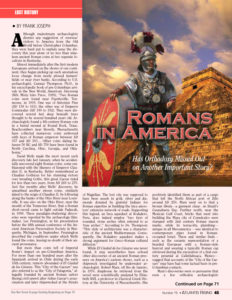
Romans in America?

by Frank Joseph