Posted on

Another Enormous Underground City Unearthed in Turkey

Archaeologists Struggle to Explain Sarayini

This image has an empty alt attribute; its file name is ai-free.png

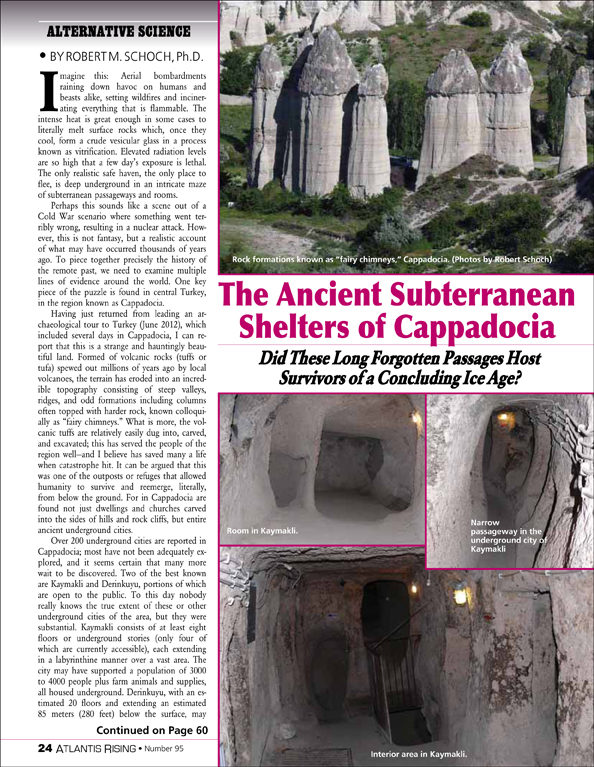
Covering at least 20,000 square meters, the newly discovered underground city of Sarayini, is one of the largest of its kind yet found in Central Anatolia. Included are large domestic areas with adjoining galleries, room-like living spaces, water wells, furnaces, workshops, chimneys, oil lamps for lighting, cellars, warehouses, ventilation, and many—as yet un-investigated—areas.

According to Konya News service, archaeologist Hasan Uguz, head of excavations of the Konya Museums Directorate, scientists have determined that “the local Christian people used the underground city in the 8th century to protect themselves from the raids that lasted for 150 years.” Yet while conventional archaeology may assign the city to the middle ages, the possibility that the structure may have been occupied during the Roman era, does little to explain just when the giant complex was actually designed and engineered. The builders were far more capable than Christian refugees of the Roman era are believed to be, and clearly had much greater resources at their disposal.
Elderly people who had lived in the area all their lives, says Uguz, played in the tunnels as children, and knew a very large underground city was nearby, but no one suspected just how enormous it was, and scientists did not believe the underground tunnels, corridors, and rooms could spread over such an extensive area. The human capacity and exact size of the complex is expected to become clear as the work progresses, but, for now, how people of Sarayini actually lived remains a mystery.
Since 2012, many astonishing subterranean sites in Turkey have drawn the attention of archaeologists from around the world. So far, over two hundred such cities have been reported, but most have not yet been adequately explored, and it seems certain that many more await discovery. Much of the recent digging has been guided by Semih Istanbulluoglu, an archaeologist from Ankara University. In December, 2015, Istanbulluoglu told Turkey’s Hurriyet Daily News, that scientists believe, pending further laboratory work, at least some of the underground cities will date back to even before the Hittites in the second millennium BC.
To this day nobody really knows the true extent of the area’s underground cities, but they are certainly substantial. Celebrated Boston University geologist Robert Schoch, in a report for Atlantis Rising Magazine, (AR #95) described two of the cities, “Kaymakli consists of at least eight floors or underground stories (only four of which are currently accessible), each extending in a labyrinthine manner over a vast area. The city may have supported a population of 3,000 to 4,000 people plus farm animals and supplies, all housed underground. Derinkuyu, with an estimated twenty floors and extending an estimated 85 meters (280 feet) below the surface may have supported anywhere from a few thousand to 10,000 people plus their livestock and goods. And the underground cities may not have been entirely isolated from one another. Kaymakli and Derinkuyu are less than a dozen kilometers (seven and a half miles) from each other and there are reports of a tunnel that may connect them.”
Cappadocia’s astonishing underground cities, Schoch believes, though, in all probability, occupied many times since, were originally built around the end of the last ice age, twelve to thirteen thousand years ago.

AR #95

“The Ancient Subterranean Shelters of Cappadocia,”

by Robert M. Schoch, Ph.D.
Posted on

HAARP is Back and Aiming at Jupiter

Gakona, Alaska’s massive ionosphere-trained antenna array has returned to the spotlight, with the biggest target yet, in its sights—the planet Jupiter, by way of Earth’s moon.

Back in the 1990s the High-frequency Active Auroral Research Program (HAARP) was launched, ostensibly as an ionospheric research program funded by the U.S. Air Force, U.S. Navy, the University of Alaska Fairbanks, and the Defense Advanced Research Projects Agency (DARPA). In Angels Don’t Play this HAARP, the best-selling book by Atlantis Rising Magazine columnist Jeane Manning and Dr. Nick Begich, argued that HAARP might actually be an attempt to weaponize weather utilizing advanced psychotronic (parapsychological) technology. Manning and Begich were not alone in their opinion.


According to Wikipedia, one Russian military journal even wrote that such ionospheric testing would “trigger a cascade of electrons that could flip Earth’s magnetic poles.”
The Alaska state legislature and the European Parliament held hearings about HAARP, the latter citing environmental concerns.


Former Governor of Minnesota, ex-professional wrestler, and documentary maker Jesse Ventura questioned whether the government was using the site to manipulate the weather or to bombard people with mind-controlling radio waves. An Air Force spokeswoman said Ventura made an official request to visit the research station but was rejected. “He and his crew showed up at HAARP anyway and were denied access,” she said.


In 10 days worth of unprecedented experiments in October, 2022, researchers attempted what they called a ‘Jupiter bounce,’or “Interplanetary Ionosonde.” According to a statement from the University of Alaska Fairbanks, the experiment was “the largest active remote sensing operation in history,” and was intended to test HAARP’s ability to bounce signals off  the ionosphere of Jupiter, and also to determine how well receivers at the University of New Mexico’s Long Wavelength Array could receive such reflected signals.
The stated purpose was to test the coordination of military and scientific facilities intended for eventual study of near-Earth asteroids, especially those that could be a hazard to Earth.


Knowing an asteroid’s composition can influence the type of defense to be used, the statement said.


The experiment consisted of transmitting a signal from HAARP to the moon and receiving the reflected signal at the California and New Mexico sites. 


The possibility of ‘psychotronics’ manipulation first made news in the 1970s, when many reports surfaced suggesting that the U.S. government had developed, and actually deployed, psychotronic weapons that made mind control of targeted individuals, and even large groups, possible. Much research, and even news reports argued for the seriousness of the topic, but the idea was relentlessly ridiculed by the mainstream media, and has since been relagated to the realm of fringe conspiracy theory—not to be taken seriously by the public. Still, there were many, including the Princeton University Anomalies Lab, the Stanford Research Institute, the Institute of Noetic Sciences, and others, who took the subject very seriously and devoted considerable research to it.


According to NASA, HAARP consists of 180 antennas designed to transmit signals into the ionosphere, which extends from 30 miles (48 kilometers) to 600 miles (965 km) above sea level and is seen as the area where Earth’s atmosphere meets space. The ionosphere plays an important role in radio transmission, as it reflects radio waves. Many satellites occupy this region of the atmosphere, which is heavily influenced by solar weather.

AR #65

Weather Goes to War

Posted on

Oldest Panorama in World

11,000-Year-Old Wall Relief Near Göbekli Tepe

An 11,000-year-old wall relief, located near Şanlıurfa’s famous Göbeklitepe in southeastern Turkey, constitutes the earliest known depiction of a narrative “scene” and reflects the complex relationship between humans, the natural world and the animal life that surrounded them during the transition to a sedentary lifestyle, new research revealed recently.

The ancient wall carving depicts five figures: Two humans, a bull and two leopards.


Eylem Özdoğan, the author of the study published in the scientific journal Antiquity, stated that there is very little information about the civilization that made this relief. (https://www.cambridge.org/core/journals/antiquity/article/sayburc-reliefs-a-narrative-scene-from-the-neolithic/3A35B54B3265C7224CB225FE70EBDD02)


“The communities living in this region share a common cultural environment. They certainly communicate with each other and share innovations, social ideology and a common culture,” Özdoğan, an archaeologist at Istanbul University, said in a statement to Gizmodo.


According to the news of Independent Turkish, radiocarbon dating studies of samples taken from the region continue, but researchers believe that these reliefs were made around 9,000 B.C.


That is due to the fact that the relief was found in the ancient city of Sayburç in Şanlıurfa. Sayburç was founded in 9,000 B.C. when hunter-gatherers switched to agriculture and settled life.


In 1949, most of the ancient city of Sayburç was open to settlement. However, excavations that began last year unearthed a Neolithic structure in the city. As the archaeological value of the city was revealed, some modern structures are planned to be demolished. So far, only half of the historic texture has been unearthed.


It is stated that the newly discovered relief is one of the oldest narrative works in archaeology. A 44,000-year-old pig painting, discovered in Indonesia in 2021, is the oldest known work of figurative art. However, there was no scene depiction in that work.


According to Özdoğan, the figures in Sayburç depict two scenes. The first tells the story of a man and a bull, and the other is of a man surrounded by two leopards. Both people are men.
It is striking that the dangerous features of the figures in the work, which covers an area of approximately 3.7 meters (12.1 feet), are also emphasized.


It is not known what exactly was once the intended meaning or message of the relief, in which the teeth of leopards and horns of bulls are highlighted.


https://www.dailysabah.com/life/history/oldest-scene-in-world-11000-year-old-wall-relief-near-gobeklitepe


https://www.cambridge.org/core/journals/antiquity/article/sayburc-reliefs-a-narrative-scene-from-the-neolithic/3A35B54B3265C7224CB225FE70EBDD02

AR #108

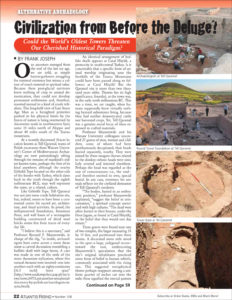
Civilization from Before the Deluge

by Frank Joseph