Posted on

Another Enormous Underground City Unearthed in Turkey

Archaeologists Struggle to Explain Sarayini

This image has an empty alt attribute; its file name is ai-free.png

Covering at least 20,000 square meters, the newly discovered underground city of Sarayini, is one of the largest of its kind yet found in Central Anatolia. Included are large domestic areas with adjoining galleries, room-like living spaces, water wells, furnaces, workshops, chimneys, oil lamps for lighting, cellars, warehouses, ventilation, and many—as yet un-investigated—areas.

According to Konya News service, archaeologist Hasan Uguz, head of excavations of the Konya Museums Directorate, scientists have determined that “the local Christian people used the underground city in the 8th century to protect themselves from the raids that lasted for 150 years.” Yet while conventional archaeology may assign the city to the middle ages, the possibility that the structure may have been occupied during the Roman era, does little to explain just when the giant complex was actually designed and engineered. The builders were far more capable than Christian refugees of the Roman era are believed to be, and clearly had much greater resources at their disposal.
Elderly people who had lived in the area all their lives, says Uguz, played in the tunnels as children, and knew a very large underground city was nearby, but no one suspected just how enormous it was, and scientists did not believe the underground tunnels, corridors, and rooms could spread over such an extensive area. The human capacity and exact size of the complex is expected to become clear as the work progresses, but, for now, how people of Sarayini actually lived remains a mystery.
Since 2012, many astonishing subterranean sites in Turkey have drawn the attention of archaeologists from around the world. So far, over two hundred such cities have been reported, but most have not yet been adequately explored, and it seems certain that many more await discovery. Much of the recent digging has been guided by Semih Istanbulluoglu, an archaeologist from Ankara University. In December, 2015, Istanbulluoglu told Turkey’s Hurriyet Daily News, that scientists believe, pending further laboratory work, at least some of the underground cities will date back to even before the Hittites in the second millennium BC.
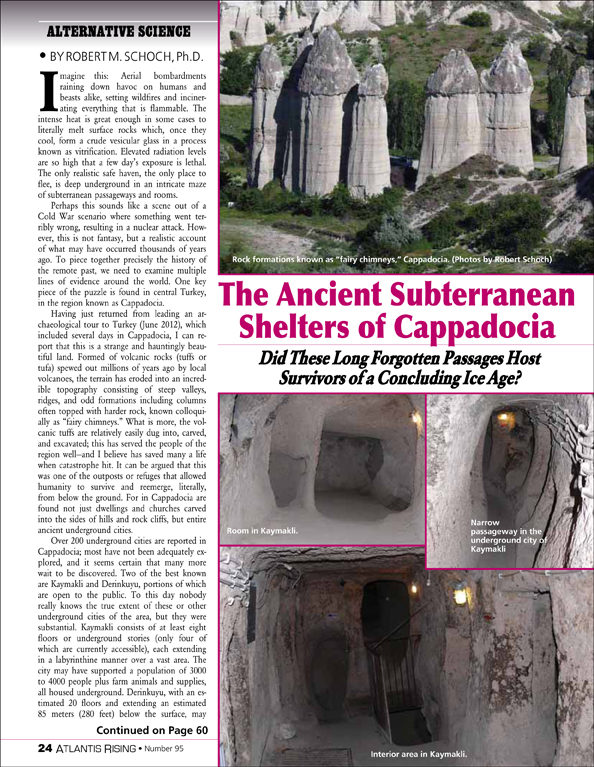
To this day nobody really knows the true extent of the area’s underground cities, but they are certainly substantial. Celebrated Boston University geologist Robert Schoch, in a report for Atlantis Rising Magazine, (AR #95) described two of the cities, “Kaymakli consists of at least eight floors or underground stories (only four of which are currently accessible), each extending in a labyrinthine manner over a vast area. The city may have supported a population of 3,000 to 4,000 people plus farm animals and supplies, all housed underground. Derinkuyu, with an estimated twenty floors and extending an estimated 85 meters (280 feet) below the surface may have supported anywhere from a few thousand to 10,000 people plus their livestock and goods. And the underground cities may not have been entirely isolated from one another. Kaymakli and Derinkuyu are less than a dozen kilometers (seven and a half miles) from each other and there are reports of a tunnel that may connect them.”
Cappadocia’s astonishing underground cities, Schoch believes, though, in all probability, occupied many times since, were originally built around the end of the last ice age, twelve to thirteen thousand years ago.

AR #95

“The Ancient Subterranean Shelters of Cappadocia,”

by Robert M. Schoch, Ph.D.
Posted on

The Advanced Astronomy of Prehistoric Cave Art

This image has an empty alt attribute; its file name is ai-free.png

A ‘Lunar calendar’ found in the caves at Lascaux, France “may predate equivalent record-keeping systems by at least 10,000 years.” Hunter-gatherers from the ice age, it seems, had a primitive writing system which has now been uncovered by Ben Bacon, an amateur archaeologist, who concluded that the 20,000-year-old markings recorded the mating cycles of local animals.

Working with academic experts Bacon has published his research in a paper for the Cambridge Archaeological Journal (https://www.sciencedirect.com/science/article/abs/pii/S0262407923000039?via%3Dihub).

Such special meaning in cave art symbols, however, has already been studied, and recently, as reported in Atlantis Rising Magazine. In 1996 at the Return to the Source conference at the University of Delaware, independent American researcher Frank Edge announced that he had identified certain celestial formations incorporated into cave drawings at Lascaux. Edge’s evidence including identification of the Pleiades and other stars in a series of black dots placed over the most prominent bull in the famed ‘Hall of the Bulls’ and was described by reporter Laura Lee in an article for Atlantis Rising in February of 1997. Then in 2000, the BBC also took notice of evidence for an ancient hidden language in the Lascaux designs, albeit without crediting the original discoverer.

Dr. David Whitehouse, BBC’s News Online science editor wrote at the time that “a prehistoric map of the night sky has been discovered on the walls of the famous painted caves at Lascaux in central France.” His story went on to describe the “map” thought to date back 16,500 years. Credited by the BBC with making the discovery, was Dr. Michael Rappenglueck, a German professor from the University of Munich, who argued that the map represented the three bright stars known as the summer triangle as well as the Pleiades. A similar pattern of stars was shown on a cave painting in Spain. The maps, said Rappenglueck show that our ancestors were more sophisticated than many believe, revealing that considerable scientific knowledge accompanied their legendary painting skill.

The significance of the art in the Lascaux caves may be greater than even the BBC suspects. More recent groundbreaking research on very ancient cave paintings in Lascaux and elsewhere, underscores the point that ancient people had a very advanced knowledge of astronomy.

A study produced in 2018 by researchers at the University of Edinburg, documents that artworks at sites across Europe, are not simply depictions of wild animals, as was previously supposed. Instead, analysis showed, the animal symbols represent star constellations in the night sky, and are used to represent dates and mark events such as comet strikes. They reveal that, perhaps as far back as 40,000 years ago, humans kept track of time using knowledge of how the position of the stars slowly changes over thousands of years. The findings suggest that long before the Greeks, ancient people understood a phenomenon known as the ‘precession of the equinoxes’. The ‘precession’ tracks in reverse order, the twelve 2150-year cycles, corresponding to the signs of the zodiac (i.e., the Age of Aquarius), also known as the “Great Year”.

The study was published in Athens Journal of History in 2018. “Early cave art shows,” said Dr Martin Sweatman, of the University of Edinburgh, and the lead author, “that people had advanced knowledge of the night sky within the last ice age. Intellectually, they were hardly any different to us today.”

AR #101

Neanderthal & Civilization

by Martin Ruggles

Posted on

Enormous Cache of Ice Age Cave Painting Unveiled in Spain

This image has an empty alt attribute; its file name is ai-free.png

Archaeologists have discovered a major Palaeolithic cave art site, arguably the most important found on the Eastern Iberian Coast in Europe.

Over a hundred ancient paintings and engravings, thought to be at least 24,000 years old, have been found in a 500 meter-long cave in ‘Cova Dones’ or ‘Cueva Dones’ – a site located in Millares near Valencia, Spain.

The cave site is well-known by locals and often visited by hikers and explorers, but the existence of Palaeolithic paintings was unnoticed until researchers from the universities of Zaragoza and Alicante (Spain), and affiliated to Archaeology at the University of Southampton (UK), made the exciting discovery in June 2021. Findings of a study into the cave art, which highlight its true significance, are now published in the journal Antiquity (https://www.cambridge.org/core/journals/antiquity/article/cova-dones-a-major-palaeolithic-cave-art-site-in-eastern-iberia/209249A848B919CE653531CB85856DEC).

The research team of Dr Ruiz-Redondo, Dr Virginia Barciela-González, Senior Lecturer of Prehistory at the University of Alicante (Spain) and Dr Ximo Martorell-Briz, research affiliate at the University of Alicante (Spain), have painstakingly documented over a hundred ‘motifs’, or designs, at Cova Dones so far.

The large number of motifs and the variety of techniques involved in their creation make the cave the most important Palaeolithic cave art site on the eastern Mediterranean coast of the Iberian Peninsula. In fact, it is probably the Palaeolithic cave with the greatest number of motifs discovered in Europe since Atxurra (Bizkaia), in 2015. The study highlights there are at least 19 confirmed animal representations, including hinds, horses, aurochs, and deer.

Unusually, the majority of the paintings have been made using clay. Although painting in clay is known in Palaeolithic Art, examples of its usage (or preservation) are scarce. In Cueva Dones, however, it is the main technique. The researchers say their investigations are at an early stage and there are still many areas to survey and panels to document – so they are likely to reveal more art in the coming years.

AR #101

Neanderthals & Civilization

by Martin Ruggles