A mysterious ancient writing system called Linear Elamite, used between about 2300 BCE and 1800 BCE in what is now southern Iran, might have finally been deciphered, although some experts are skeptical about the findings.
What’s more, it’s unclear whether all the artifacts used to decipher the writings were legally acquired. Only about 40 known examples of Linear Elamite survive today, making the script challenging to decode, but researchers say they’ve largely accomplished just that, they wrote in a paper published in July in the Journal of Assyriology and Near Eastern Archaeology (https://www.academia.edu/82452838/The_Decipherment_of_Linear_Elamite_Writing).
Key to their decipherment was the analysis of eight inscriptions on silver beakers.
Other research teams had previously decoded different Linear Elamite inscriptions, and the new study’s authors built on this previous work by comparing the writing system in the eight Linear Elamite inscriptions with cuneiform (an already-deciphered script used in what is now the Middle East) texts that date to around the same time period and likely contain the names of the same rulers and their titles and use some of the same phrases to describe the rulers. The team determined what many other additional signs meant, the team wrote. However, about 3.7 percent of the Linear Elamite signs remain undecipherable.
There are more than 300 Linear Elamite signs representing different sounds, such as a crescent-shaped sign that sounds like «pa», the team wrote in the paper.
The corresponding author for the team, François Desset, an archaeologist at the University of Tehran and the French National Center for Scientific Research (CNRS), declined to comment about the team’s work.
Experts aren’t exactly sure where the eight Linear Elamite inscriptions originated.
Seven are in the collection of a collector named Houshang Mahboubian, while the other is in the collection of Martin Schøyen, a Norwegian businessman and collector. The Schøyen collection has staff members that help oversee the collection and they regularly work with scholars.
The inscription owned by Schøyen and hundreds of other artifacts in Schøyen’s collection were impounded by the Norwegian police on 24 August 2021.
Earliest evidence for fruit tree cultivation found in Jordan valley
Researchers have uncovered the earliest evidence for fruit tree farming. Researchers analyzed remnants of charcoal from the Chalcolithic site of Tel Zaf in the Jordan Valley and determined that they came from olive trees. Since the olive did not grow naturally in the Jordan Valley, this means that the inhabitants planted the tree intentionally about 7,000 years ago. Some of the earliest stamps were also found at the site, and as a whole, the researchers say the findings indicate wealth, and early steps toward the formation of a complex multilevel society.
In a groundbreaking study, led by Dr. Dafna Langgut of the Department of Archaeology & Ancient Near Eastern Cultures, The Sonia & Marco Nadler Institute of Archaeology and the Steinhardt Museum of Natural History at Tel Aviv University, the archaeologists studied charcoal remnants found in the archaeological excavation. According to Dr. Langgut, a specialist in identification of plant remains, “trees, even when burned down to charcoal, can be identified by their anatomic structure. Wood was the ‘plastic’ of the ancient world. It was used for construction, for making tools and furniture, and as a source of energy. That’s why identifying tree remnants found at archaeological sites, such as charcoal from hearths, is a key to understanding what kinds of trees grew in the natural environment at the time, and when humans began to cultivate fruit trees.”
In her lab, Dr. Langgut identified the charcoal from Tel Zaf as belonging to olive and fig trees. “Olive trees grow in the wild in the land of Israel, but they do not grow in the Jordan Valley,” she says. “This means that someone brought them there intentionally – took the knowledge and the plant itself to a place that is outside its natural habitat. In archaeobotany, this is considered indisputable proof of domestication, which means that we have here the earliest evidence of the olive’s domestication anywhere in the world.”
“I also identified many remnants of young fig branches. The fig tree did grow naturally in the Jordan Valley, but its branches had little value as either firewood or raw materials for tools or furniture, so people had no reason to gather large quantities and bring them to the village. Apparently, these fig branches resulted from pruning, a method still used today to increase the yield of fruit trees.”
Storage capacities were up to 20 times greater than any single family’s calorie consumption, so clearly these were caches for storing great wealth. The wealth of the village was manifested in the production of elaborate pottery, painted with remarkable skill. In addition, we found articles brought from afar: pottery of the Ubaid culture from Mesopotamia, obsidian from Anatolia, a copper awl from the Caucasus, and more.
South Pole Hit Caused Big Differences Between Near and Far Side
The oldest unequivocal evidence of upright walking in the human lineage are footprints discovered at Laetoli, Tanzania, in 1978, by paleontologist Mary Leakey and her team, dated to 3.7 million years ago. Another set of mysterious footprints was partially excavated at a nearby location, known as site A, in 1976, but dismissed as possibly having been made by a bear. A recent re-excavation of the site A footprints at Laetoli and comparative analysis reveal that the footprints were made by an early human— a bipedal hominin, according to a new study reported in Nature.
“Given the increasing evidence for locomotor and species diversity in the hominin fossil record over the past 30 years, these unusual prints deserved another look,” says lead author Ellison McNutt, Guarini ’19, who started the work as a graduate student in the Ecology, Evolution, Environment, and Society program, and is now an assistant professor of instruction at the Heritage College of Osteopathic Medicine at Ohio University. At Dartmouth, she focused on the biomechanics of walking in early humans and utilized comparative anatomy, including that of bears.
McNutt was fascinated by the bipedal (upright walking) footprints at site A. Laetoli is famous for its impressive trackway of hominin footprints at sites G and S, which are generally accepted as Australopithecus afarensis—the species of the famous partial skeleton “Lucy.” But because the footprints at site A were so different, some researchers thought they were made by a young bear walking upright on its hind legs.
To determine the maker of the site A footprints, in June 2019, an international research team led by co-author Charles Musiba, an associate professor of anthropology at University of Colorado Denver and a Montgomery Fellow, went to Laetoli, where they re-excavated and fully cleaned the five consecutive footprints. They identified evidence that the fossil footprints were made by a hominin—including a large impression for the heel and the big toe. The footprints were measured, photographed, and 3D-scanned by Anjali Prabhat ’20; Catherine Miller, Guarini ’23; and Luke Fannin, Guarini ’24, who are co-authors of the paper.
The researchers compared the site A tracks to the footprints of black bears, chimpanzees, and humans. They teamed up with co-authors Ben and Phoebe Kilham, who run the Kilham Bear Center, a rescue and rehabilitation center for black bears in Lyme, N.H. They identified four semi-wild juvenile black bears at the center with feet similar in size to that of the site A footprints. Each bear was lured with maple syrup or applesauce to stand up and walk on its two hind legs across a trackway filled with mud to capture its footprints.
South Pole Hit Caused Big Differences Between Near and Far Side
The face that the Moon shows to Earth looks far different from the one it hides on its far side. The nearside is dominated by the lunar mare — the vast, dark-colored remnants of ancient lava flows. The crater-pocked far side, on the other hand, is virtually devoid of large-scale mare features. Why the two sides are so different is one of the Moon’s most enduring mysteries. Now, researchers have a new explanation for the two-faced Moon — one that relates to a giant impact billions of years ago near the Moon’s south pole. A new study published in the journal Science Advances shows that the impact that formed the Moon’s giant South Pole–Aitken (SPA) basin would have created a massive plume of heat that propagated through the lunar interior. That plume would have carried certain materials — a suite of rare-Earth and heat-producing elements — to the Moon’s nearside. That concentration of elements would have contributed to the volcanism that created the nearside volcanic plains. “We know that big impacts like the one that formed SPA would create a lot of heat,” said Matt Jones, a Ph.D. candidate at Brown University and the study’s lead author. “The question is how that heat affects the Moon’s interior dynamics. What we show is that under any plausible conditions at the time that SPA formed, it ends up concentrating these heat-producing elements on the nearside. We expect that this contributed to the mantle melting that produced the lava flows we see on the surface.” The study was a collaboration between Jones and his advisor Alexander Evans, an assistant professor at Brown, along with researchers from Purdue University, the Lunar and Planetary Science Laboratory in Arizona, Stanford University and NASA’s Jet Propulsion Laboratory. The Moon’s nearside (left) is dominated by vast volcanic deposits, while the far side (right) has far fewer). Why the two sides are so different is an enduring lunar mystery. The differences between the near and far sides of the Moon were first revealed in the 1960s by the Soviet Luna missions and the U.S. Apollo program. While the differences in volcanic deposits are plain to see, future missions would reveal differences in the geochemical composition as well. Some scientists have suspected a connection between the PKT and the nearside lava flows, but the question of why that suite of elements was concentrated on the nearside remained. For the study, the researchers conducted computer simulations of how heat generated by a giant impact would alter patterns of convection in the Moon’s interior, and how that might redistribute KREEP material in the lunar mantle. KREEP is thought to represent the last part of the mantle to solidify after the Moon’s formation. As such, it likely formed the outermost layer of mantle, just beneath the lunar crust. Models of the lunar interior suggest that it should have been more or less evenly distributed beneath the surface. But this new model shows that the uniform distribution would be disrupted by the heat plume from the SPA impact.
One of the great mysteries of late medieval history is why did the Norse, who had established successful settlements in southern Greenland in 985, abandon them in the early 15th century?
The consensus view has long been that colder temperatures, associated with the Little Ice Age, helped make the colonies unsustainable. However, new research, led by the University of Massachusetts Amherst and published recently in Science Advances, upends that old theory. It wasn’t dropping temperatures that helped drive the Norse from Greenland, but drought.
When the Norse settled in Greenland on what they called the Eastern Settlement in 985, they thrived by clearing the land of shrubs and planting grass as pasture for their livestock. The population of the Eastern Settlement peaked at around 2,000 inhabitants, but collapsed fairly quickly about 400 years later.
For decades, anthropologists, historians and scientists have thought the Eastern Settlement’s demise was due to the onset of the Little Ice Age, a period of exceptionally cold weather, particularly in the North Atlantic, that made agricultural life in Greenland untenable.
However, as Raymond Bradley, University Distinguished Professor of geosciences at UMass Amherst and one of the paper’s co-author, points out. Bradley and his colleagues traveled to a lake called Lake 578, which is adjacent to a former Norse farm and close to one of the largest groups of farms in the Eastern Settlement. There, they spent three years gathering sediment samples from the lake, which represented a continuous record for the past 2,000 years. What was discovered, said was that, while the temperature barely changed over the course of the Norse settlement of southern Greenland, it became steadily drier over time. Norse farmers had to overwinter their livestock on stored fodder, and even in a good year the animals were often so weak that they had to be carried to the fields once the snow finally melted in the spring. Under conditions like that, the consequences of drought would have been severe. An extended drought, on top of other economic and social pressures, may have tipped the balance just enough to make the Eastern Settlement unsustainable.
An enormous comet — approximately 80 miles across, more than twice the width of Rhode Island — is heading our way at 22,000 miles per hour from the edge of the solar system. Fortunately, it will never get closer than 1 billion miles from the sun, which is slightly farther from Earth than Saturn; that will be in 2031.
Comets, among the oldest objects in the solar system, are icy bodies that were unceremoniously tossed out of the solar system in a gravitational pinball game among the massive outer planets, said David Jewitt. The UCLA professor of planetary science and astronomy co-authored a new study of the comet in the Astrophysical Journal Letters. The evicted comets took up residence in the Oort cloud, a vast reservoir of far-flung comets encircling the solar system out to many billions of miles into deep space, he said.
A typical comet’s spectacular multi-million-mile-long tail, which makes it look like a skyrocket, belies the fact that the source at the heart of the fireworks is a solid nucleus of ice mixed with dust — essentially a dirty snowball. This huge one, called Comet C/2014 UN271 and discovered by astronomers Pedro Bernardinelli and Gary Bernstein, could be as large as 85 miles across.
“This comet is literally the tip of the iceberg for many thousands of comets that are too faint to see in the more distant parts of the solar system,” Jewitt said. “We’ve always suspected this comet had to be big because it is so bright at such a large distance. Now we confirm it is.”
This comet has the largest nucleus ever seen in a comet by astronomers. Jewitt and his colleagues determined the size of its nucleus using NASA’s Hubble Space Telescope. Its nucleus is about 50 times larger than those of most known comets. Its mass is estimated to be 500 trillion tons, a hundred thousand times greater than the mass of a typical comet found much closer to the sun.
“This is an amazing object, given how active it is when it’s still so far from the sun,” said lead author Man-To Hui, who earned his doctorate from UCLA in 2019 and is now with the Macau University of Science and Technology in Taipa, Macau. “We guessed the comet might be pretty big, but we needed the best data to confirm this.” So the researchers used Hubble to take five photos of the comet on Jan. 8, 2022, and incorporated radio observations of the comet into their analysis.
The comet is now less than 2 billion miles from the sun and in a few million years will loop back to its nesting ground in the Oort cloud, Jewitt said.
New Research and New Consensus Guidelines Published
Scientific advances in the 20th and 21st centuries have led to a major evolution in the understanding of death. At the same time, for decades, people who have survived an encounter with death have recalled unexplained lucid episodes involving heightened consciousness and awareness. These have been reported using the popular—yet scientifically ill-defined—term “near-death experiences.”
A multidisciplinary team of national and international leaders, led by Sam Parnia, MD, PhD, director of the Cardiopulmonary Resuscitation Research Program at NYU Langone, have published “Guidelines and standards for the study of death and recalled experiences of death,” a multidisciplinary consensus statement and proposed future directions in the Annals of the New York Academy of Sciences. This study, which examined the accumulated scientific evidence to date, represents the first-ever peer-reviewed consensus statement for the scientific study of recalled experiences surrounding death.
The researchers on the study represent many medical disciplines, including the neurosciences, critical care, psychiatry, psychology, social sciences, and humanities, and represent many of the world’s most respected academic institutions including Harvard University, Baylor University, the University of California, Riverside, the University of Virginia, Virginia Commonwealth University, the Medical College of Wisconsin, the University Hospital Southampton, and King’s College, London.
Among their conclusions are the following: • Due to advances in resuscitation and critical care medicine, many people have survived encounters with death or being near-death. These people—who are estimated to comprise hundreds of millions of people around the world based on previous population studies—have consistently described recalled experiences surrounding death, which involve a unique set of mental recollections with universal themes. • The recalled experiences surrounding death are not consistent with hallucinations, illusions, or psychedelic drug–induced experiences, according to several previously published studies. Instead, they follow a specific narrative arc involving a perception of (a) separation from the body with a heightened, vast sense of consciousness and recognition of death; (b) travel to a destination; (c) a meaningful and purposeful review of life, involving a critical analysis of all actions, intentions, and thoughts towards others; a perception of (d) being in a place that feels like “home”; and (e) a return back to life. • The experience of death culminates into previously unidentified, separate subthemes and is associated with positive long-term psychological transformation and growth. • Studies showing the emergence of gamma activity and electrical spikes—ordinarily a sign of heightened states of consciousness on electroencephalography (EEG)—in relation to death further support the claims of millions of people who have reported experiencing lucidity and heightened consciousness in relation to death. • Frightening or distressing experiences in relation to death often neither share the same themes, nor the same narrative, transcendent qualities, ineffability, and positive transformative effects. “Cardiac arrest is not a heart attack, but represents the final stage of a disease or event that causes a person to die,” lead author Dr. Parnia explains. “The advent of cardiopulmonary resuscitation showed us that death is not an absolute state, rather, it’s a process that could potentially be reversed in some people even after it has started.” “What has enabled the scientific study of death,” he continues, “is that brain cells do not become irreversibly damaged within minutes of oxygen deprivation when the heart stops. Instead, they ‘die’ over hours of time. This is allowing scientists to objectively study the physiological and mental events that occur in relation to death.” So far, the researchers say, evidence suggests that neither physiological nor cognitive processes end with death and that although systematic studies have not been able to absolutely prove the reality or meaning of patients’ experiences and claims of awareness in relation to death, it has been impossible to disclaim them either. “Few studies have explored what happens when we die in an objective and scientific way, but these findings offer intriguing insights into how consciousness exists in humans and may pave the way for further research,” Dr. Parnia adds.
Honey might be a sweet solution for developing environmentally friendly components for neuromorphic computers, systems designed to mimic the neurons and synapses found in the human brain.
Hailed by some as the future of computing, neuromorphic systems are much faster and use much less power than traditional computers. Washington State University engineers have demonstrated one way to make them more organic too. In a study published in Journal of Physics D, the researchers show that honey can be used to make a memristor, a component similar to a transistor that can not only process but also store data in memory.
“This is a very small device with a simple structure, but it has very similar functionalities to a human neuron,” said Feng Zhao, associate professor of WSU’s School of Engineering and Computer Science and corresponding author on the study.“ This means if we can integrate millions or billions of these honey memristors together, then they can be made into a neuromorphic system that functions much like a human brain.”
For the study, Zhao and first author Brandon Sueoka, a WSU graduate student in Zhao’s lab, created memristors by processing honey into a solid form and sandwiching it between two metal electrodes, making a structure similar to a human synapse. They then tested the honey memristors’ ability to mimic the work of synapses with high switching on and off speeds of 100 and 500 nanoseconds respectively. The memristors also emulated the synapse functions known as spike-timing dependent plasticity and spike-rate dependent plasticity, which are responsible for learning processes in human brains and retaining new information in neurons.
The WSU engineers created the honey memristors on a micro-scale, so they are about the size of a human hair. The research team led by Zhao plans to develop them on a nanoscale, about 1/1000 of a human hair, and bundle many millions or even billions together to make a full neuromorphic computing system.
Currently, conventional computer systems are based on what’s called the von Neumann architecture. Named after its creator, this architecture involves an input, usually from a keyboard and mouse, and an output, such as the monitor. It also has a CPU, or central processing unit, and RAM, or memory storage. Transferring data through all these mechanisms from input to processing to memory to output takes a lot of power at least compared to the human brain, Zhao said. For instance, the Fugaku supercomputer uses upwards of 28 megawatts, roughly equivalent to 28 million watts, to run while the brain uses only around 10 to 20 watts.
The human brain has more than 100 billion neurons with more than 1,000 trillion synapses, or connections, among them. Each neuron can both process and store data, which makes the brain much more efficient than a traditional computer, and developers of neuromorphic computing systems aim to mimic that structure.
Footprints found at White Sands National Park in New Mexico provide the earliest unequivocal evidence of human activity in the Americas and provide insight into life over 23,000 years ago.
The findings are described in a Science journal article co-authored by University of Arizona archaeologist Vance Holliday.
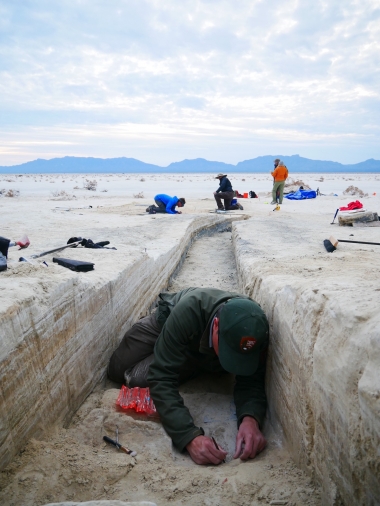
Archaeologists working at the White Sands site. Courtesy of Matthew Bennett/Bournemouth University
“For decades, archaeologists have debated when people first arrived in the Americas,” said Holliday, a professor in the UArizona School of Anthropology and Department of Geosciences. “Few archaeologists see reliable evidence for sites older than about 16,000 years. Some think the arrival was later, no more than 13,000 years ago by makers of artifacts called Clovis points. The White Sands tracks provide a much earlier date. There are multiple layers of well-dated human tracks in streambeds where water flowed into an ancient lake. This was 10,000 years before Clovis people.”
Researchers Jeff Pigati and Kathleen Springer, with the U.S. Geological Survey, used radiocarbon dating of seed layers above and below the footprints to determine their age. The dates range in age and confirm human presence over at least two millennia, with the oldest tracks dating back 23,000 years.
This corresponds to the height of the last glacial cycle, during something known as the Last Glacial Maximum, and makes them the oldest known human footprints in the Americas.
It was previously thought that humans entered America much later, after the melting of the North American ice sheets, which opened up migration routes.
“Our dates on the seeds are tightly clustered and maintain stratigraphic order above and below multiple footprint horizons – this was a remarkable outcome,” Springer said.
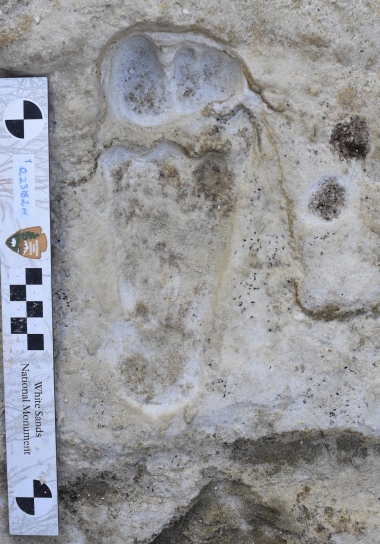
One of the oldest footprints found at the site. Courtesy of Matthew Bennett/Bournemouth University
The footprints tell an interesting tale of what life was like at this time. Judging by their size, the tracks were left mainly by teenagers and younger children, with the occasional adult.
“The footprints left at White Sands give a picture of what was taking place, teenagers interacting with younger children and adults,” said lead study author Matthew Bennett from Bournemouth University in England. “We can think of our ancestors as quite functional, hunting and surviving, but what we see here is also activity of play, and of different ages coming together. A true insight into these early people.”
Holliday and study co-author Brendan Fenerty, a UArizona doctoral student in the Department of Geosciences, documented basic geologic layering and dating in trenches on the White Sands Missile Range near the discovery site several years before the tracks were found.
“We were interested in reconstructing the evolution of the landscape in the context of environmental changes and some younger archaeological sites in the area,” Holliday said. “We had no idea what was buried nearby.”
Tracks of mammoth, giant ground sloth, dire wolves and birds are also all present at the White Sands site.
“It is an important site because all of the trackways we’ve found there show an interaction of humans in the landscape alongside extinct animals, like mammoths and giant sloths,” said study co-author Sally Reynolds of Bournemouth University. “We can see the co-existence between humans and animals on the site as a whole, and by being able to accurately date these footprints, we’re building a greater picture of the landscape.”
Tracks of mammoth, giant ground sloth, dire wolves and birds are also all present at the site. Illustration by Karen Carr
The human tracks at White Sands were first discovered by David Bustos, resources manager at the park.
“It is incredible to have the confirmation on the age of the human prints, and exciting but also sad to know that this is only a small portion of the 80,000 acres where the prints have been revealed bare and are also being rapidly lost to ongoing soil erosion,” Bustos said.
The team also pioneered non-invasive geophysical techniques to help locate the site. Tommy Urban, from Cornell University, led this part of the work.
“Detection and imaging with nondestructive technology has greatly expanded our capacity to study these remarkable footprints in their broader context,” he said.
Traditional archaeology relies on the discovery of bones and tools but can often be difficult to interpret. Human footprints provide unequivocal evidence of presence and also of behavior.
“White Sands provides the first unequivocal evidence for human presence in the Americas during the Last Glacial Maximum,” said study co-author Dan Odess of the National Park Service. “Not all archaeological sites contain such unequivocal evidence. One reason why this discovery is important is that it makes the idea that other purportedly ancient sites really are evidence for human presence that much more plausible, even if the evidence they contain is less unequivocal. This doesn’t mean all of those sites are legitimate, but it means they cannot be dismissed out of hand.”
Advanced 40,000-Year-Old Culture Discovered in China
Site in northern China reveals new, previously unidentified cultural innovations
When did populations of Homo sapiens first arrive in China and what happened when they encountered the Denisovans or Neanderthals who lived there? A new study in Nature by an international team of researchers opens a window into hunter-gatherer lifestyles 40,000 years ago. Archaeological excavations at the site of Xiamabei in the Nihewan Basin of northern China have revealed the presence of innovative behaviors and unique toolkits.
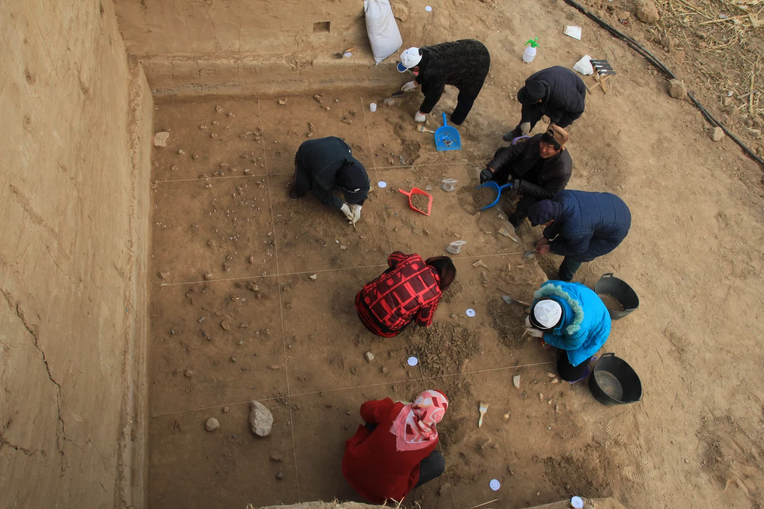
Archaeologists excavating the well-preserved surface at the Xiamabei site, northern China, showing stone tools, fossils,… [more] Fa-Gang Wang
The discovery of a new culture suggests processes of innovation and cultural diversification occurring in Eastern Asia during a period of genetic and cultural hybridization. Although previous studies have established that Homo sapiens arrived in northern Asia by about 40,000 years ago, much about the lives and cultural adaptations of these early peoples, and their possible interactions with archaic groups, remains unknown. In the search for answers, the Nihewan Basin in northern China, with a wealth of archaeological sites ranging in age from 2 million to 10,000 years ago, provides one of the best opportunities for understanding the evolution of cultural behavior in northeastern Asia.
A new article published in the journal Nature describes a unique 40,000-year-old culture at the site of Xiamabei in the Nihewan Basin. With the earliest known evidence of ochre processing in Eastern Asia and a set of distinct blade-like stone tools, Xiamabei contains cultural expressions and features that are unique or exceedingly rare in northeastern Asia. Through the collaboration of an international team of scholars, analysis of the finds offers important new insights into cultural innovation during the expansion of Homo sapiens populations.
“Xiamabei stands apart from any other known archaeological site in China, as it possesses a novel set of cultural characteristics at an early date,” says Dr. Fa-Gang Wang of the Hebei Provincial Institute of Cultural Relics and Archaeology, whose team first excavated the site.
Cultural Adaptations at Xiamabei
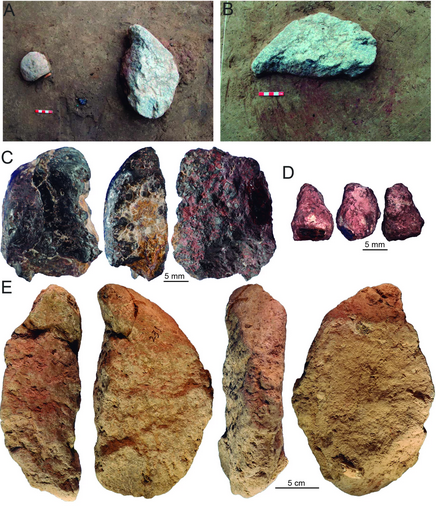
Ochre pieces and stone processing equipment laying on a red-stained pigment patch. Fa-Gang Wang, Francesco d’Errico / Wang et al., Innovative ochre processing and tool-use in China 40,000 years ago. Nature. 2022
“The ability of hominins to live in northern latitudes, with cold and highly seasonal environments, was likely facilitated by the evolution of culture in the form of economic, social and symbolic adaptations,” says Dr. Shi-Xia Yang, researcher with the Chinese Academy of Sciences and the Max Planck Institute for the Science of Human History, in Jena, Germany. “The finds at Xiamabei are helping us to understand these adaptations and their potential role in human migration.”
One of the significant cultural features found at Xiamabei is the extensive use of ochre, as shown by artefacts used to process large quantities of pigment. The artefacts include two pieces of ochre with different mineral compositions and an elongated limestone slab with smoothed areas bearing ochre stains, all on a surface of red-stained sediment. Analysis by researchers from the University of Bordeaux, led by Prof. Francesco d’Errico, indicates that different types of ochre were brought to Xiamabei and processed through pounding and abrasion to produce powders of different color and consistency, the use of which impregnated the habitation floor. Ochre production at Xiamabei represents the earliest known example of this practice in Eastern Asia.
The stone tools at Xiamabei represent a novel cultural adaptation for northern China 40,000 years ago. Because little is known about stone tool industries in Eastern Asia until microblades became the dominant technology about 29,000 years ago, the Xiamabei finds provide important insights into toolmaking industries during a key transition period. The blade-like stone tools at Xiamabei were unique for the region, with the large majority of tools being miniaturized, more than half measuring less than 20 millimeters. Seven of the stone tools showed clear evidence of hafting to a handle, and functional and residue analysis suggests tools were used for boring, hide scraping, whittling plant material and cutting soft animal matter. The site inhabitants made hafted and multipurpose tools, demonstrative of a complex technical system for transforming raw materials not seen at older or slightly younger sites.
Extraordinarily well preserved bladelet showing microscopic evidence of a bone handle, plant fibres used for binding,… [more] Andreu Oll / Wang et al., Innovative ochre processing and tool-use in China 40,000 years ago. Nature. 2022
A Complex History of Innovation
The record emerging from Eastern Asia shows that a variety of adaptations were taking place as modern humans entered the region roughly 40,000 years ago. Although no hominin remains were found at Xiamabei, the presence of modern human fossils at the contemporary site of Tianyuandong and the slightly younger sites of Salkhit and Zhoukoudian Upper Cave, suggests that the visitors to Xiamabei were Homo sapiens. A varied lithic technology and the presence of some innovations, such as hafted tools and ochre processing, but not other innovations, such as formal bone tools or ornaments, may reflect an early colonization attempt by modern humans. This colonization period may have included genetic and cultural exchanges with archaic groups, such as the Denisovans, before ultimately being replaced by later waves of Homo sapiens using microblade technologies.
Given the unique nature of Xiamabei, the authors of the new paper argue that the archaeological record does not fit with the idea of continuous cultural innovation, or of a fully formed set of adaptations which enabled early humans to expand out of Africa and around the world. Instead, the authors argue that we should expect to find a mosaic of innovation patterns, with the spread of earlier innovations, the persistence of local traditions, and the local invention of new practices all taking place in a transitional phase.
“Our findings show that current evolutionary scenarios are too simple,” says Professor Michael Petraglia of the Max Planck Institute in Jena, “and that modern humans, and our culture, emerged through repeated but differing episodes of genetic and social exchanges over large geographic areas, rather than as a single, rapid dispersal wave across Asia.”