An international team of researchers has unearthed evidence shedding new light on the ancient migration of Homo sapiens into eastern Asia around 45,000 years ago.
The findings, detailed in a study published in Nature Ecology & Evolution, uncover what is said to be a treasure trove of cultural and technological innovations in the Shiyu site in northern China, marking what is considered a significant moment in human history (https://www.nature.com/articles/s41559-023-02294-4). According to the researchers, the Shiyu site provides a glimpse into the unique convergence of cultural behaviors and technological advancements of our ancient ancestors, and challenges conventional beliefs about the dispersal of Homo sapiens populations. Key revelations from the research include: Shiyu now stands as the oldest and easternmost site of its kind, showcasing Homo sapiens’ presence in eastern Asia around 45,000 years ago as demonstrated by radiocarbon and luminescence dating led by Professor Jia-Fu Zhang of Peking University. This discovery reshapes our understanding of the timing and routes of human migration in the region. Shiyu exhibits what is described as a remarkable array of technological advancements, including stone tools crafted using Levallois and Volumetric Blade Reduction methods. Additionally, the long-distance transport of obsidian from sources hundreds of kilometers away indicates advanced resource procurement strategies. Shiyu showcases a cultural blend characterized by a mix of Upper Palaeolithic innovations such as blade reduction and symbolic tools, Middle Palaeolithic traits such as Levallois reduction, and traditional elements of Chinese core-flake industries. The discovery of unique artifacts, such as a shaped graphite disc and bone tools, illustrates, it is claimed, a rich cultural adaptation. The discovery, say the study authors, presented a different view of human migration and cultural evolution than previous studies of the Shiyu location. “The Shiyu findings challenge previous notions of early human migration and cultural development in Eastern Asia,” said study author Michael Petraglia.
Picture and Captions: https://news.griffith.edu.au/2024/01/19/shiyu-discovery-reveals-eastern-asias-early-human-migrations/
Those who forget history are condemned to repeat it, we have been told. Now, new research has identified three key drivers behind the collapse of the Qing Dynasty in China. Once an economy that was considerably wealthier in its time than modern-day China, it crumbled in 1912, and the proposed reasons behind it sound familiar.
Everything from environmental disasters to famines, uprisings, and foreign incursions have been held up as possible explanations for the collapse of such a superpower. However, Turchin and colleagues discovered that there were three key elements applying the most sociopolitical pressure.
According to a new study published in PLOS ONE, finding the key causes involved looking back at history through the lens of Structural Demographic Theory (SDT). The framework enables researchers to understand how big events like war and recession can shake up and destabilize a society. It’s useful in the modern era because it can help us better predict what events have the potential to have a catastrophic knock-on effect in the future, giving us time to try and mitigate the damage (https://journals.plos.org/plosone/article?id=10.1371/journal.pone.0289748).
The first driver behind the Qing Dynasty’s collapse was identified as a boom in the population, which increased fourfold between 1700 and 1840. This meant there was considerably less land for each person, which in economics is called “land per capita”, which we know affects rural communities the most as farming requires a lot of land if people are going to be able to support themselves.
The second driver was identified as increased competition for elite positions. It figures that if you have a boom in the number of people living in an area, the few positions of power available will find themselves inundated with potential applicants. We see it today in the job market, where hundreds of people may be applying for the same role, and the situation became particularly bleak for the Qing Dynasty by 1796. The lack of opportunities to rise into the bureaucratic ranks led to a crisis driven by a group of disgruntled elite wannabes known as aspirants.
“The big crisis was the Taiping Rebellion, probably the bloodiest civil war in human history,” Researcher Peter Turchin told IFLScience. “Tens of millions of people were killed.”
“The population of Qing Dynasty increased fourfold and there was just not enough productivity of the environment to feed them, but even more importantly, they had too many elite aspirants.”
With such catastrophic unrest comes vast expense, which leads us to the third and final key driver behind the Qing Dynasty’s collapse: the rising cost associated with the fallout. Between squashing unrest, reduced productivity, and a trade deficit brought on by depleting silver and opium, the Qing Dynasty found itself in financial chaos.
Advanced 40,000-Year-Old Culture Discovered in China
Site in northern China reveals new, previously unidentified cultural innovations
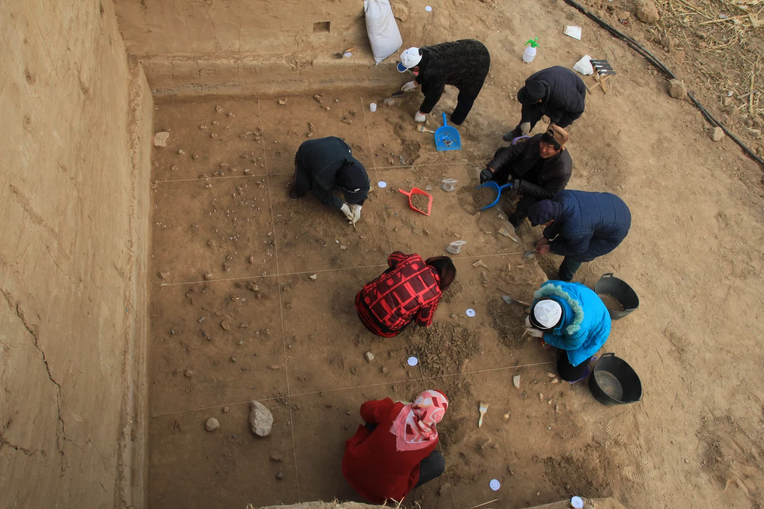
When did populations of Homo sapiens first arrive in China and what happened when they encountered the Denisovans or Neanderthals who lived there? A new study in Nature by an international team of researchers opens a window into hunter-gatherer lifestyles 40,000 years ago. Archaeological excavations at the site of Xiamabei in the Nihewan Basin of northern China have revealed the presence of innovative behaviors and unique toolkits.
Archaeologists excavating the well-preserved surface at the Xiamabei site, northern China, showing stone tools, fossils,… [more] Fa-Gang Wang
The discovery of a new culture suggests processes of innovation and cultural diversification occurring in Eastern Asia during a period of genetic and cultural hybridization. Although previous studies have established that Homo sapiens arrived in northern Asia by about 40,000 years ago, much about the lives and cultural adaptations of these early peoples, and their possible interactions with archaic groups, remains unknown. In the search for answers, the Nihewan Basin in northern China, with a wealth of archaeological sites ranging in age from 2 million to 10,000 years ago, provides one of the best opportunities for understanding the evolution of cultural behavior in northeastern Asia.
A new article published in the journal Nature describes a unique 40,000-year-old culture at the site of Xiamabei in the Nihewan Basin. With the earliest known evidence of ochre processing in Eastern Asia and a set of distinct blade-like stone tools, Xiamabei contains cultural expressions and features that are unique or exceedingly rare in northeastern Asia. Through the collaboration of an international team of scholars, analysis of the finds offers important new insights into cultural innovation during the expansion of Homo sapiens populations.
“Xiamabei stands apart from any other known archaeological site in China, as it possesses a novel set of cultural characteristics at an early date,” says Dr. Fa-Gang Wang of the Hebei Provincial Institute of Cultural Relics and Archaeology, whose team first excavated the site.
Cultural Adaptations at Xiamabei
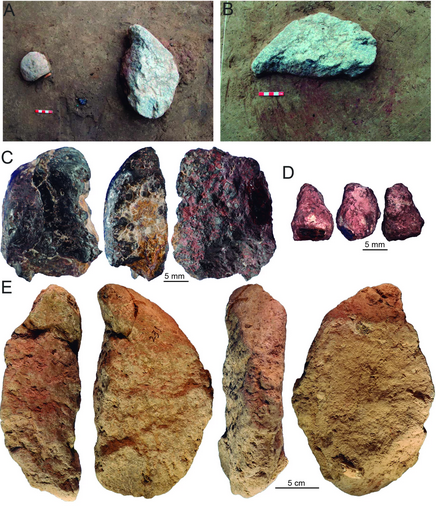
Ochre pieces and stone processing equipment laying on a red-stained pigment patch. Fa-Gang Wang, Francesco d’Errico / Wang et al., Innovative ochre processing and tool-use in China 40,000 years ago. Nature. 2022
“The ability of hominins to live in northern latitudes, with cold and highly seasonal environments, was likely facilitated by the evolution of culture in the form of economic, social and symbolic adaptations,” says Dr. Shi-Xia Yang, researcher with the Chinese Academy of Sciences and the Max Planck Institute for the Science of Human History, in Jena, Germany. “The finds at Xiamabei are helping us to understand these adaptations and their potential role in human migration.”
One of the significant cultural features found at Xiamabei is the extensive use of ochre, as shown by artefacts used to process large quantities of pigment. The artefacts include two pieces of ochre with different mineral compositions and an elongated limestone slab with smoothed areas bearing ochre stains, all on a surface of red-stained sediment. Analysis by researchers from the University of Bordeaux, led by Prof. Francesco d’Errico, indicates that different types of ochre were brought to Xiamabei and processed through pounding and abrasion to produce powders of different color and consistency, the use of which impregnated the habitation floor. Ochre production at Xiamabei represents the earliest known example of this practice in Eastern Asia.
The stone tools at Xiamabei represent a novel cultural adaptation for northern China 40,000 years ago. Because little is known about stone tool industries in Eastern Asia until microblades became the dominant technology about 29,000 years ago, the Xiamabei finds provide important insights into toolmaking industries during a key transition period. The blade-like stone tools at Xiamabei were unique for the region, with the large majority of tools being miniaturized, more than half measuring less than 20 millimeters. Seven of the stone tools showed clear evidence of hafting to a handle, and functional and residue analysis suggests tools were used for boring, hide scraping, whittling plant material and cutting soft animal matter. The site inhabitants made hafted and multipurpose tools, demonstrative of a complex technical system for transforming raw materials not seen at older or slightly younger sites.
Extraordinarily well preserved bladelet showing microscopic evidence of a bone handle, plant fibres used for binding,… [more] Andreu Oll / Wang et al., Innovative ochre processing and tool-use in China 40,000 years ago. Nature. 2022
A Complex History of Innovation
The record emerging from Eastern Asia shows that a variety of adaptations were taking place as modern humans entered the region roughly 40,000 years ago. Although no hominin remains were found at Xiamabei, the presence of modern human fossils at the contemporary site of Tianyuandong and the slightly younger sites of Salkhit and Zhoukoudian Upper Cave, suggests that the visitors to Xiamabei were Homo sapiens. A varied lithic technology and the presence of some innovations, such as hafted tools and ochre processing, but not other innovations, such as formal bone tools or ornaments, may reflect an early colonization attempt by modern humans. This colonization period may have included genetic and cultural exchanges with archaic groups, such as the Denisovans, before ultimately being replaced by later waves of Homo sapiens using microblade technologies.
Given the unique nature of Xiamabei, the authors of the new paper argue that the archaeological record does not fit with the idea of continuous cultural innovation, or of a fully formed set of adaptations which enabled early humans to expand out of Africa and around the world. Instead, the authors argue that we should expect to find a mosaic of innovation patterns, with the spread of earlier innovations, the persistence of local traditions, and the local invention of new practices all taking place in a transitional phase.
“Our findings show that current evolutionary scenarios are too simple,” says Professor Michael Petraglia of the Max Planck Institute in Jena, “and that modern humans, and our culture, emerged through repeated but differing episodes of genetic and social exchanges over large geographic areas, rather than as a single, rapid dispersal wave across Asia.”
‘Win some, lose some, and some get rained out,’ goes the old saying, and, it turns out, the same may be true of civilization. The great Liangzhu Civilization of China flourished over 5000 years ago, but then mysteriously collapsed, and, until recently, scholars could not understand why. Now new archaeological research suggests the problem was probably too much rain.
Distinguished by sophisticated architecture and brilliant hydraulic engineering demonstrating great mastery over water, inspiring dams, water reservoirs and canals in Liangzhu City on the banks of the Yangtze in Eastern China, the city earned a reputation as the “Venice of the East.” Now a new study led by geologist Christoph Spötl from the University of Innsbruck in Austria has looked at ancient mud deposits in the caves of the region and found that catastrophic flood conditions seemed to have overwhelmed the civilization. The culprit apparently was El Nino, a climate factor still operating in our own time, and blamed for numerous disasters (https://www.science.org/doi/10.1126/sciadv.abi9275).
Though some might argue that the evidence shows the continuing presence of familiar patterns, others see it a sign of ‘climate change’, and reason for alarm. Many meteorologists, indeed, link such patterns to a ‘climate crisis’ which they say exacerbates the frequency and severity of climatic extremes and variations.
In the fall of 2021, Chinese media reported unusual rains in Shanxi province with torrential downpours that lasted for days. Indeed, 59 observatories across Shanxi province all recorded historic levels of rain and that extreme weather has become the norm in northern China.
Will archaeologists of the future, wondering what happened to us, conclude that we were all wet.
Even though viruses from China are getting plenty of attention these days, most may be surprised to learn that still-living, 15,000-year-old, viruses have been discovered frozen in glacier ice from China’s Tibetan Plateau.
In 2015, ice cores gathered from the Guliya ice cap in western China, 22,000 feet above sea level, were studied by an international team of microbiologists, including scientists from Ohio State University. Not to worry though. For their study, the scientists claim to have created a “new, ultra-clean method of analyzing microbes and viruses in ice without contaminating it”. Apparently, at that altitude, no one needs to worry about bats. In all, 33 viruses were discovered, and at least 28 of those are previously unknown to science. The findings, were published in the journal Microbiome (https://microbiomejournal.biomedcentral.com/articles/10.1186/s40168-021-01106-w).
Life found in conditions which one might think would preclude it, has, in recent years, come to be labeled as ‘extremophile,’ and includes not only that found in extremely cold conditions, like on the Tibetan glacier, but in hot spots like volcanic vents deep in the ocean. The existence of such life forms has encouraged those who speculate about the possibility of life on other celestial bodies, such as the moons of Jupiter, both within, and beyond, the solar system.
The new discovery has reminded some observers of the announcement published in Nature in March 2002 of 20,000-year-old hand prints and footprints found in an area of Tibet, where at a time, it was believed, everything was covered by a giant glacier (https://www.nature.com/articles/news020325-5). A primitive stove found nearby suggested the area might have been a camp or settlement. Mainstream archaeology had previously insisted that there were no human settlements on the Tibetan plateau before 2,000 BC. The news was taken by alternative scholars, as corroboration for more traditional indigenous accounts claiming a far greater antiquity for life in Tibet…viral and otherwise.