Posted on

Earth Tilt and the Missoula Megafloods

A New Study Looks at the End of the Last Age

N

February 14, 2022

By Tim Stephens

As ice sheets began melting at the end of the last ice age, a series of cataclysmic floods called the Missoula megafloods scoured the landscape of eastern Washington, carving long, deep channels and towering cliffs through an area now known as the Channeled Scablands. They were among the largest known floods in Earth’s history, and geologists struggling to reconstruct them have now identified a crucial factor governing their flows.

In a study published February 14 in Proceedings of the National Academy of Sciences, researchers showed how the changing weight of the ice sheets would have caused the entire landscape to tilt, changing the course of the megafloods.

“People have been looking at high water marks and trying to reconstruct the size of these floods, but all of the estimates are based on looking at the present-day topography,” said lead author Tamara Pico, assistant professor of Earth and planetary sciences at UC Santa Cruz. “This paper shows that the ice age topography would have been different over broad scales due to the deformation of Earth’s crust by the weight of the ice sheets.”

During the height of the last ice age, vast ice sheets covered much of North America. They began to melt after about 20,000 years ago, and the Missoula megafloods occurred between 18,000 and 15,500 years ago. Pico’s team studied how the changing weight of the ice sheets during this period would have tilted the topography of eastern Washington, changing how much water would flow into different channels during the floods.

Glacial outburst floods

Glacial Lake Missoula formed in western Montana when a lobe of the Cordilleran ice sheet dammed the Clark Fork valley in the Idaho panhandle and melt water built up behind the dam. Eventually the water got so deep that the ice dam began to float, resulting in a glacial outburst flood. After enough water had been released, the ice dam resettled and the lake refilled. This process is thought to have been repeated dozens of times over a period of several thousand years.

Downstream from glacial Lake Missoula, the Columbia River was dammed by another ice lobe, forming glacial Lake Columbia. When Lake Missoula’s outburst floods poured into Lake Columbia, the water spilled over to the south onto the eastern Washington plateau, eroding the landscape and creating the Channeled Scablands.

During this period, the deformation of the Earth’s crust in response to the growing and shrinking of ice sheets would have changed the elevation of the topography by hundreds of meters, Pico said. Her team incorporated these changes into flood models to investigate how the tilting of the landscape would have changed the routing of the megafloods and their erosional power in different channels.

“We used flood models to predict the velocity of the water and the erosional power in each channel, and compared that to what would be needed to erode basalt, the type of rock on that landscape,” Pico said.

They focused on two major channel systems, the Cheney-Palouse and Telford-Crab Creek tracts. Their results showed that earlier floods would have eroded both tracts, but that in later floods the flow would have been concentrated in the Telford-Crab Creek system.

“As the landscape tilted, it affected both where the water overflowed out of Lake Columbia and how water flowed in the channels, but the most important effect was on the spillover into those two tracts,” Pico said. “What’s intriguing is that the topography isn’t static, so we can’t just look at the topography of today to reconstruct the past.”

The findings provide a new perspective on this fascinating landscape, she said. Steep canyons hundreds of feet deep, dry falls, and giant potholes and ripple marks are among the many remarkable features etched into the landscape by the massive floods.

“When you are there in person, it’s crazy to think about the scale of the floods needed to carve those canyons, which are now dry,” Pico said. “There are also huge dry waterfalls—it’s a very striking landscape.”

She also noted that the oral histories of Native American tribes in this region include references to massive floods. “Scientists were not the first people to look at this,” Pico said. “People may even have been there to witness these floods.”

In addition to Pico, the coauthors include Scott David at Utah State University; Isaac Larsen and Karin Lehnigk at the University of Massachusetts, Amherst; Alan Mix at Oregon State University; and Michael Lamb at the California Institute of Technology. This work was supported by the National Science Foundation.

#113

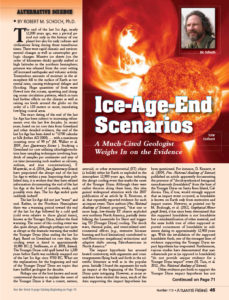
Ice-Age-End Scenarios

Dr. Robert Schoch


Posted on

The Asteroid Shoving Mission

For those who think that Atlantis was brought down by a rock from space, the prospect of history repeating itself has long been a cause for worry, if not deep dread. Ever since comet Shoemaker-Levy crashed into Jupiter in 1994 with a force, that would, if directed at Earth, have destroyed our planet, many serious people, not just Hollywood heroes, have been awakened to the threat. And given the presence of thousands of such potentially deadly bolides in our solar neighborhood, it is clear that a real threat to continued life on Earth exists. The big question is what do we do about it? And now, we are happy to report, a new effort has been launched by NASA to push back against the threat from space.

Just in case some day, a threatening asteroid were to be found heading this way, the Double Asteroid Redirection Test (DART) mission, launched in November, 2021, will deploy a technology that, it is hoped, could save the planet, by preventing a hazardous asteroid from ever making it to Earth. DART is the first demonstration of the kinetic impactor technique to change the motion of an asteroid in space—in other words, ‘shoving’ the asteroid into a non threatening trajectory by crashing into it. In September 2022, the probe is intended to crash into the minor-planet moon Dimorphos of the double asteroid Didymos.

Dimorphos is NOT a threat to Earth, but the asteroid belt is believed to be a perfect testing ground to see if intentionally crashing a spacecraft into an asteroid is an effective way to change its course, should an Earth-threatening asteroid be discovered in the future. While, according to NASA, no ‘known’ asteroid larger than 140 meters in size has a significant chance to hit Earth for the next 100 years, as of October 2021, only about 40 percent of such asteroids have been found.

Ironically, while some seek to shove asteroids around to protect Earth, others have different ideas. One scheme under consideration involves nudging a football-field-sized asteroid into orbit around earth where it would be easier to exploit. Asteroids, it is thought, could prove virtual gold mines. Certainly plenty of platinum is to be found (all platinum on earth comes from space rocks), to say nothing of water, which could be turned into hydrogen fuel and oxygen for future interplanetary missions. Many asteroids are as much a 20% water.

Posted on

Has Planet 9 Already Been Spotted?

In 2016, astronomers, Konstantin Batygin and Michael Brown published a prediction—not yet a discovery—of a possible new planet lurking at the far periphery of the solar system, in an elongated path far beyond Pluto. Ever since, the hunt has been on for the missing planet. But, could the search for planet nine have already succeeded? Has a mysterious undiscovered planet, long envisioned somewhere beyond the orbit of Neptune by astronomers and alternative researchers alike have already made an appearance to probes from Earth, but gone unnoticed? A respected British Astronomer thinks so.

So far, no one has actually seen the theoretical planet. But, then again, maybe they have. Astronomer Michael Rowan-Robinson of Imperial College London has been combing through the data from a 1983 mission, in which he participated, and he now says he has located the illusive planet, or at least the part of the sky where it could be found. The data is taken from Infrared Astronomical Satellite (IRAS) readings.

Rowan-Robinson has published the findings of his research in arXiv, an open-access archive for articles on physics, mathematics, and computer science (https://arxiv.org/abs/2111.03831).

Observations of the planet Neptune have long led astronomers to believe another planet must be out there and interfering with its orbit. Pluto was found in 1930 by looking at objects on photographic plates, but it wasn’t large enough to account for the movement of Neptune. That anomalous movement is what arouses speculation about ‘planet 9’ (‘planet 10’, if you count Pluto)–aka, ‘Planet X.’ Arguments over the possibility of another planet beyond the orbit of Neptune have raged for over a century. As early as 1906, when he established The Lowell observatory in Flagstaff, Arizona, famed astronomer Percival Lowell was looking for his own version of Planet X, which he believed was indicated by the observed perturbations in the orbit of Neptune.

Studies of the sort have come from all parts of the world. In December 2015 the Journal of Astronomy of Astrophysics, published two Swedish papers claiming a new, relatively large, body out in the neighborhood of Pluto. Astronomer Wouter Vlemmings, co-author of both studies, reported observation of an object moving against the background stars which was then dubbed Gna, after a swift Nordic deity who delivers messages for Frigg, the goddess of wisdom. In 2018, Brazilian astronomer Rodney Gomes reported that his calculations showed the presence of a planet four times the size of Earth lying beyond the orbit of Pluto. Later, Carlos and Raul de la Fuente of Spain re-examined the data and concluded that, not only, must there be a planet such as proposed by Gomes, but that there must be an even bigger planet still further out which is influencing the first one. That such objects could have remained undiscovered for so long, we were told, is quite understandable.

Late in 2021 a team of space scientists published a paper in The Annual Review of Astronomy and Astrophysics suggesting that there may be an Earth- or Mars-sized planet orbiting beyond Neptune. They further suggest that simulations of the creation of the solar system show that such a planet may have been pushed from the outer regions of the solar system by Neptune and Uranus. Over the years, there have been several reports of large objects in the Kuiper belt (ie., Pluto and Eris), but until the Batygin and Brown discovery, none have been heavy enough to contend for the title of ‘Planet X’.

Posted on

Water in the Valles Marineris

As everyone knows, SpaceX entrepreneur Elon Musk plans to make humanity a multi-planetary species. In December, his celebrated ambition to colonize Mars got a big boost.

Until now, the conventional view of most Mars researchers on the availability of water for colonists from Earth, has been focussed on the poles, where massive deposits of water ice have been located. Unfortunately, the polar regions are also the coldest and most inhospitable that visitors from Earth might face, dropping to as low as 221 degrees below zero F. By contrast, areas near the equator, which bask in relatively temperate conditions–as high as 70 degrees F on a summer day–were thought to be lacking in much water. Picking the best site for a human landing on Mars, presented mission planners with a very difficult dilemma: should they go for the best weather, or the most water?

Now, thanks to a new discovery by the European Space Agency’s (ESA) ExoMars Orbiter, we have learned that an enormous canyon near the Martian equator, the Valles Marineris, likely contains vast quantities of water ice just below the surface, similar to permafrost on Earth —in fact, according to scientists, covering an estimated forty percent of over fifteen thousand square miles. Suddenly, the prospect of actually colonizing the red planet, looks a lot more realistic.

According to ESA data from the Trace Gas Orbiter’s (TGO) Fine-Resolution Epithermal Neutron Detector (FREND) instrument, unexpectedly high levels of hydrogen were found. Combined with oxygen, hydrogen makes water, which is the essential component for life on Earth, and, perhaps, as it may yet exist on Mars. The TGO survey focussed on a large region known as Candor Chaos, in the virtual center of the Valles Marineris on the Martian equator. More than 2,500 miles long, 10 times longer and five times deeper than the Grand Canyon of Arizona, the Valles Marineris is the largest canyon in the solar system. If it were on Earth, it could reach from New York to California.

Unlike the barren deserts previously explored by robotic probes from Earth, the scenery of Candor Chaos, could present visitors not only with some spectacular scenery, but maybe, some other, previously little-considered mysteries as well. Not only is it closer than previously considered sites to the Cydonia plain, made famous for the purported ‘Face on Mars,’ the area has at least one anomalous structure that has drawn some serious attention.

In a paper published in 2017 by the Journal of Space Exploration, researchers  George J. Haas, et al, studied a large three-sided pyramidal shape photographed by ‪Mars Global Surveyor (image E06-00269) and other spacecraft, in the Western Region of Candor Chasma. According to the paper’s abstract, in the 1970s the structure caught the attention of world renowned astronomer Carl Sagan, who was so intrigued by the 3-sided pyramidal structure, that he presented the image at the Royal Institution in London during his Christmas Lecture in 1977. Sagan also featured the image in his 1980 book and television series Cosmos in which he commented; ‪“The largest Mars pyramids… are much larger than the pyramids of Sumer, Egypt and Mexico. With the ancient eroded shape, they could be small hills, sandblasted for centuries, but they need ‪to be viewed from nearby.” Perhaps now they will be (https://www.tsijournals.com/articles/threesided-pyramidal-formation-in-the-western-region-of-candor-chasma-13507.html).

Given the right circumstances, water on Mars, we now know, could hold more oxygen than previously believed, theoretically enough to support aerobic respiration. A team led by scientists at Caltech and the Jet Propulsion Laboratory (JPL), has calculated that if liquid water exists on Mars, it could—under specific conditions—contain more oxygen than previously thought possible. According to the model, the levels could even theoretically exceed the threshold needed to support simple aerobic life.

“Oxygen is a key ingredient when determining the habitability of an environment, but it is relatively scarce on Mars,” said Woody Fischer, professor of geobiology at Caltech and a co-author of a Nature Geoscience paper on the findings, which was published in October 2019.  Their paper was entitled “O2 solubility in Martian near-surface environments and implications for aerobic life.” (https://authors.library.caltech.edu/88984/)

Scientists have speculated that the flowing surface water, in an environment where the temperatures are far below freezing, indicates that there might very well be large aquifers—pools of liquid water—beneath, but close to, the surface.

Clearly, many mind-blowing discoveries lie ahead.

Posted on

Drowned Civilization in Ancient China

‘Win some, lose some, and some get rained out,’ goes the old saying, and, it turns out, the same may be true of civilization. The great Liangzhu Civilization of China flourished over 5000 years ago, but then mysteriously collapsed, and, until recently, scholars could not understand why. Now new archaeological research suggests the problem was probably too much rain.

Distinguished by sophisticated architecture and brilliant hydraulic engineering demonstrating great mastery over water, inspiring dams, water reservoirs and canals in Liangzhu City on the banks of the Yangtze in Eastern China, the city earned a reputation as the “Venice of the East.” Now a new study led by geologist Christoph Spötl from the University of Innsbruck in Austria has looked at ancient mud deposits in the caves of the region and found that catastrophic flood conditions seemed to have overwhelmed the civilization. The culprit apparently was El Nino, a climate factor still operating in our own time, and blamed for numerous disasters (https://www.science.org/doi/10.1126/sciadv.abi9275).

Though some might argue that the evidence shows the continuing presence of familiar patterns, others see it a sign of ‘climate change’, and reason for alarm. Many meteorologists, indeed, link such patterns to a ‘climate crisis’ which they say exacerbates the frequency and severity of climatic extremes and variations.

In the fall of 2021, Chinese media reported unusual rains in Shanxi province with torrential downpours that lasted for days. Indeed, 59 observatories across Shanxi province all recorded historic levels of rain and that extreme weather has become the norm in northern China.

Will archaeologists of the future, wondering what happened to us, conclude that we were all wet.