Posted on

Could a Sun ‘Umbrella,’ Fix Climate Change?

This image has an empty alt attribute; its file name is ai-free.png

Earth is rapidly warming say some scientists, and now they are developing a variety of approaches to reduce the effects of climate change. István Szapudi, an astronomer at the University of Hawaiʻi Institute for Astronomy, has proposed a novel approach—a solar shield to reduce the amount of sunlight hitting Earth, combined with a tethered, captured asteroid as a counterweight. Engineering studies using this approach they claim could start now to create a workable design that could mitigate climate change within decades.

The paper, “Solar radiation management with a tethered sun shield,” is published in Proceedings of the National Academy of Sciences https://www.pnas.org/doi/10.1073/pnas.2307434120).

One of the simplest approaches to reducing the global temperature is to shade the Earth from a fraction of the Sun’s light. This idea, called a solar shield, has been proposed before, but the large amount of weight needed to make a shield massive enough to balance gravitational forces and prevent solar radiation pressure from blowing it away makes even the lightest materials prohibitively expensive. Szapudi’s creative solution consists of two innovations: a tethered counterweight instead of just a massive shield, resulting in making the total mass more than 100 times less, and the use of a captured asteroid as the counterweight to avoid launching most of the mass from Earth.

“In Hawaiʻi, many use an umbrella to block the sunlight as they walk about during the day. I was thinking, could we do the same for Earth and thereby mitigate the impending catastrophe of climate change?” Szapudi said.

Szapudi began with the goal of reducing solar radiation by 1.7%, an estimate of the amount needed to prevent a catastrophic rise in global temperatures. He found that placing a tethered counterbalance toward the Sun could reduce the weight of the shield and counterweight to approximately 3.5 million tons, about one hundred times lighter than previous estimates for an untethered shield.

While this number is still far beyond current launch capabilities, only 1% of the weight—about 35,000 tons—would be the shield itself, and that is the only part that needs to be launched from Earth. With newer, lighter materials, the mass of the shield can be reduced even further. The remaining 99% of the total mass would be asteroids or lunar dust used as a counterweight. Such a tethered structure would be faster and cheaper to build and deploy than other shield designs.

Today’s largest rockets can only lift about 50 tons to low Earth orbit, so this approach to solar radiation management would be challenging. Szapudi’s approach brings the idea into the realm of possibility, even with today’s technology, whereas prior concepts were completely unachievable. Also, developing a light-weight but strong graphene tether connecting the shield with the counterweight is crucial.

AR #90

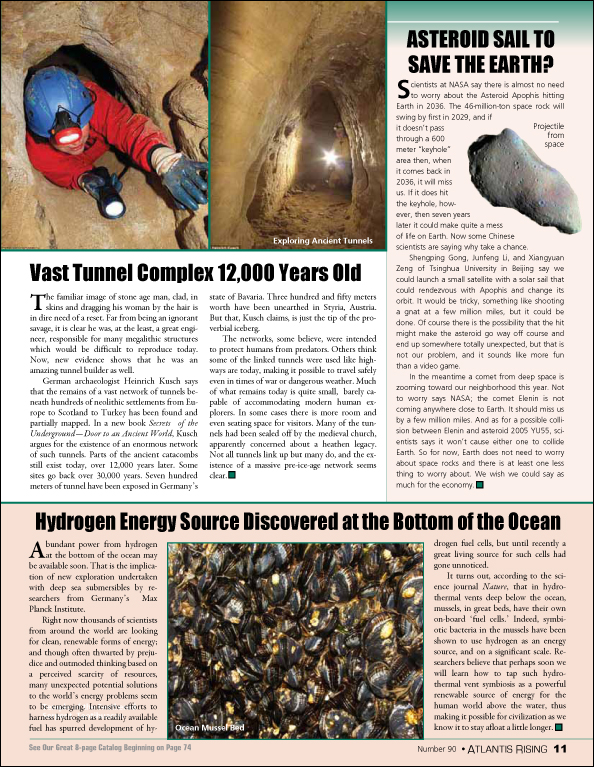
Asteroid Sail to Save the Earth?
Posted on

NASA AI Gives 30 Min. Warning

by Vanessa Thomas

This image has an empty alt attribute; its file name is ai-free.png

Like a tornado siren for life-threatening storms in America’s heartland, a new computer model that combines artificial intelligence (AI) and NASA satellite data could sound the alarm for dangerous space weather.

The model uses AI to analyze spacecraft measurements of the solar wind (an unrelenting stream of material from the Sun) and predict where an impending solar storm will strike, anywhere on Earth, with 30 minutes of advance warning. This could provide just enough time to prepare for these storms and prevent severe impacts on power grids and other critical infrastructure.

The Sun constantly sheds solar material into space – both in a steady flow known as the “solar wind,” and in shorter, more energetic bursts from solar eruptions. When this solar material strikes Earth’s magnetic environment (its “magnetosphere”), it sometimes creates so-called geomagnetic storms. The impacts of these magnetic storms can range from mild to extreme, but in a world increasingly dependent on technology, their effects are growing ever more disruptive.

For example, a destructive solar storm in 1989 caused electrical blackouts across Quebec for 12 hours, plunging millions of Canadians into the dark and closing schools and businesses. The most intense solar storm on record, the Carrington Event in 1859, sparked fires at telegraph stations and prevented messages from being sent. If the Carrington Event happened today, it would have even more severe impacts, such as widespread electrical disruptions, persistent blackouts, and interruptions to global communications. Such technological chaos could cripple economies and endanger the safety and livelihoods of people worldwide.

In addition, the risk of geomagnetic storms and devastating effects on our society is presently increasing as we approach the next “solar maximum” – a peak in the Sun’s 11-year activity cycle – which is expected to arrive sometime in 2025.

To help prepare, an international team of researchers at the Frontier Development Lab – a public-private partnership that includes NASA, the U.S. Geological Survey, and the U.S. Department of Energy – have been using artificial intelligence (AI) to look for connections between the solar wind and geomagnetic disruptions, or perturbations, that cause havoc on our technology. The researchers applied an AI method called “deep learning,” which trains computers to recognize patterns based on previous examples. They used this type of AI to identify relationships between solar wind measurements from heliophysics missions (including ACE, Wind, IMP-8, and Geotail) and geomagnetic perturbations observed at ground stations across the planet.

From this, they developed a computer model called DAGGER (formally, Deep Learning Geomagnetic Perturbation) that can quickly and accurately predict geomagnetic disturbances worldwide, 30 minutes before they occur. According to the team, the model can produce predictions in less than a second, and the predictions update every minute.

AR #92

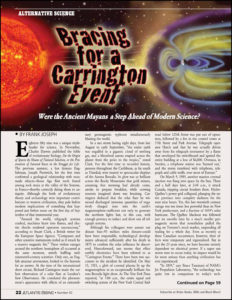
Bracing for a Carrington Event

by Frank Joseph

Posted on

Power-from-Space Technology Demonstrated

Caltech Space Solar Power Project (SSPP) is launching into orbit a prototype, dubbed the Space Solar Power Demonstrator (SSPD), which will test several key components of an ambitious plan to harvest solar power in space and beam the energy back to Earth.

Space solar power provides a way to tap into the practically unlimited supply of solar energy in outer space, where the energy is constantly available without being subjected to the cycles of day and night, seasons and cloud cover.
The launch represents a major milestone in the project and promises to make what was once science fiction a reality. When fully realized, SSPP will deploy a constellation of modular spacecraft that collect sunlight, transform it into electricity, then wirelessly transmit that electricity over long distances wherever it is needed—including to places that currently have no access to reliable power.

SSPP got its start in 2011 after philanthropist Donald Bren, chairman of Irvine Company and a lifetime member of the Caltech Board of Trustees, learned about the potential for space-based solar energy manufacturing in an article in the magazine Popular Science. Intrigued by the potential for space solar power, Bren approached Caltech’s then-president Jean-Lou Chameau to discuss the creation of a space-based solar power research project.

In 2013, Bren and his wife, Brigitte Bren, a Caltech trustee, agreed to make the donation to fund the project. The first of the donations to Caltech (which will eventually exceed $100 million in support for the project and endowed professorships) was made that year through the Donald Bren Foundation, and the research began.

https://techxplore.com/news/2023-01-caltech-space-solar-power-technology.html

AR #121

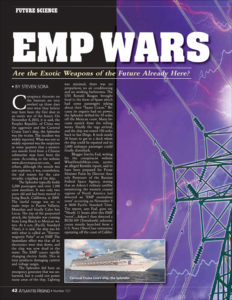
EMP Wars

by Steven Sora

Posted on

Euro Space Agency: Beam Solar Energy from Space

Engineers would have to wirelessly transmit gigawatts of energy safely and reliably from space.

By Pallab Ghosh

Space chiefs are investigating whether electricity could be beamed wirelessly from orbit into millions of homes. The eventual aim is to have giant satellites in orbit, each able to generate the same amount of electricity as a power station.

While several organizations and other space agencies have looked into the idea, the so-called Solaris initiative would be the first to lay the ground for a practical plan to develop a space-based renewable energy generation system.

The program is one of a number of proposals being considered by ministers at Esa’s triennial council, which will decide the budget for the next phase of the space agency’s plans for space exploration, environmental monitoring and communications.

Josef Aschbacher, who is Esa’s director general, told BBC News that he believed that solar power from space could be of “enormous”’ help to address future energy shortages.

Satellites with solar panels would need to be around 1.7km long – more than double the size of the world’s tallest building and an order of magnitude bigger than the current largest structure in space, which is the International Space Station, measuring 110m.

The Sun’s energy can be collected much more efficiently in space because there is neither night nor clouds. The idea has been around for more than 50 years, but it has been too difficult and too expensive to implement, until maybe now.

The game-changer has been the plummeting cost of launches, thanks to reusable rockets and other innovations developed by the private sector. But there have also been advances in robotic construction in space and the development of technology to wirelessly beam electricity from space to Earth.

Referenced story with pictures and captions:
https://www.bbc.com/news/science-environment-62982113?

AR #94

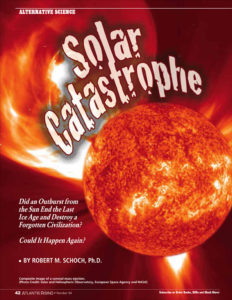
Solar Catastrophe

by Robert Schoch

Posted on

Tracking the Sun to Feed Ancient Mexicans

By Jules Bernstein

Without clocks or modern tools, ancient Mexicans watched the sun to maintain a farming calendar that precisely tracked seasons and even adjusted for leap years.Rising sun seen from the stone causeway on Mount Tlaloc in Mexico.

Before the Spanish arrival in 1519, the Basin of Mexico’s agricultural system fed a population that was extraordinarily large for the time.  Whereas Seville, the largest urban center in Spain, had a population of fewer than 50,000, the Basin, now known as Mexico City, was home to as many as 3 million people.  

To feed so many people in a region with a dry spring and summer monsoons required advanced understanding of when seasonal variations in weather would arrive. Planting too early, or too late, could have proved disastrous. The failure of any calendar to adjust for leap-year fluctuations could also have led to crop failure.

Though colonial chroniclers documented the use of a calendar, it was not previously understood how the Mexica, or Aztecs, were able to achieve such accuracy. New UC Riverside research, published in the Proceedings of the National Academy of Sciences, demonstrates how they did it. They used the mountains of the Basin as a solar observatory, keeping track of the sunrise against the peaks of the Sierra Nevada mountains. 

“We concluded they must have stood at a single spot, looking eastwards from one day to another, to tell the time of year by watching the rising sun,” said Exequiel Ezcurra, distinguished UCR professor of ecology who led the research.

To find that spot, the researchers studied Mexica manuscripts. These ancient texts referred to Mount Tlaloc, which lies east of the Basin. The research team explored the high mountains around the Basin and a temple at the mountain’s summit. Using astronomical computer models, they confirmed that a long causeway structure at the temple aligns with the rising sun on Feb. 24, the first day of the Aztec new year.

“Our hypothesis is that they used the whole Valley of Mexico. Their working instrument was the Basin itself. When the sun rose at a landmark point behind the Sierras, they knew it was time to start planting,” Ezcurra said.

The sun, as viewed from a fixed point on Earth, does not follow the same trajectory every day. In winter, it runs south of the celestial equator and rises toward the southeast. As summer approaches, because of the Earth’s tilt, sunrise moves northeast, a phenomenon called solar declination. 

This study may be the first to demonstrate how the Mexica were able to keep time using this principle, the sun, and the mountains as guiding landmarks. Though some may be familiar with the “Aztec calendar,” that is an incorrect name given to the Sun Stone, arguably the most famous work of Aztec sculpture used solely for ritual and ceremonial purposes. 

Pictures and captions:
https://news.ucr.edu/articles/2022/12/12/precise-solar-observations-fed-millions-ancient-mexico

AR #62

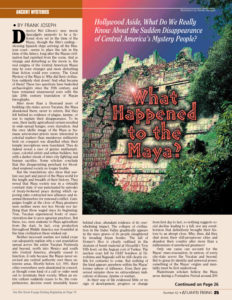
What Happened to the Mayas

by Frank Joseph

Posted on

Mysterious Sun Storm Recorded in Ice 9200 Years ago

Through analyzes of ice cores from Greenland and Antarctica, a research team led by Lund University in Sweden has found evidence of an extreme solar storm that occurred about 9,200 years ago. What puzzles the researchers is that the storm took place during one of the sun’s more quiet phases – during which it is generally believed our planet is less exposed to such events.

The sun is a prerequisite for all life on Earth. But our life-giving companion can also cause problems. When there is strong activity on the surface of the sun, more energy is released, something that can give rise to geomagnetic storms. This in turn can cause power outages and communication disturbances.

Predicting solar storms is difficult. It is currently believed that they are more likely during an active phase of the sun, or solar maximum, during the so-called sunspot cycle. However, the new study published in Nature Communications shows that this may not always be the case for very large storms.

“We have studied drill cores from Greenland and Antarctica, and discovered traces of a massive solar storm that hit Earth during one of the sun’s passive phases about 9,200 years ago”, says Raimund Muscheler, geology researcher at Lund University.

Ice cores in large pipes
Analyzing ice cores led the researchers to their surprising results (Photo: Raimund Muscheler)

The researchers scoured the drill cores for peaks of the radioactive isotopes beryllium-10 and chlorine-36. These are produced by high-energy cosmic particles that reach Earth, and can be preserved in ice and sediment.

“This is time consuming and expensive analytical work. Therefore, we were pleasantly surprised when we found such a peak, indicating a hitherto unknown giant solar storm in connection with low solar activity”, says Raimund Muscheler.

If a similar solar storm were to take place today, it could have devastating consequences. In addition to power outages and radiation damage to satellites, it could pose a danger to air traffic and astronauts as well as a collapse of various communication systems.

“These enormous storms are currently not sufficiently included in risk assessments. It is of the utmost importance to analyze what these events could mean for today’s technology and how we can protect ourselves”, concludes Raimund Muscheler.

#94 Solar Catastrophe

Robert Schoch, Ph. D.https://atlantisrising.co/product/issue-94-solar-catastrophe/