Posted on

Can A.I. Predict Events in the Lives of Real People?

By Peter Aagaard Brixen

This image has an empty alt attribute; its file name is ai-free.png

In a new scientific article, ‘Using sequences of life-events to predict human lives’, published in Nature Computational Science, researchers have analyzed health data and attachment to the labor market for 6 million Danes in a model dubbed life2vec. After the model has been trained in an initial phase, i.e., learned the patterns in the data, it has been shown to outperform other advanced neural networks and predict outcomes such as personality and time of death with high accuracy (https://www.nature.com/articles/s43588-023-00573-5).
The predictions from Life2vec are answers to general questions such as: ‘death within four years’? When the researchers analyze the model’s responses, the results are consistent with existing findings within the social sciences; for example, all things being equal, individuals in a leadership position or with a high income are more likely to survive, while being male, skilled or having a mental diagnosis is associated with a higher risk of dying. Life2vec encodes the data in a large system of vectors, a mathematical structure that organizes the different data. The model decides where to place data on the time of birth, schooling, education, salary, housing and health.
The researchers behind the article point out that ethical questions surround the life2vec model, such as protecting sensitive data, privacy, and the role of bias in data. These challenges must be understood more deeply before the model can be used, for example, to assess an individual’s risk of contracting a disease or other preventable life events.
According to the researchers, the next step would be to incorporate other types of information, such as text and images or information about our social connections. This use of data opens up a whole new interaction between social and health sciences.
A transformer model is a type of AI, deep learning data architecture used to learn about language and other tasks. The models can be trained to understand and generate language. The transformer model is designed to be faster and more efficient than previous models and is often used to train large language models on large datasets.
A neural network is a computer model inspired by the brain and nervous system of humans and animals. There are many different types of neural networks (e.g. transformer models).
Like the brain, a neural network is made up of (artificial) neurons. These neurons are connected and can send signals to each other. Each neuron receives input from other neurons and then calculates an output that is passed on to other neurons.
A neural network can learn to solve tasks by training on large amounts of data. 
Neural networks rely on training data to learn and improve their accuracy over time. But once these learning algorithms are fine-tuned for accuracy, they are powerful tools in computer science and artificial intelligence that, according to researchers, allow us to classify and group data at high speed. One of the most well-known neural networks is Google’s search algorithm.

AR #112

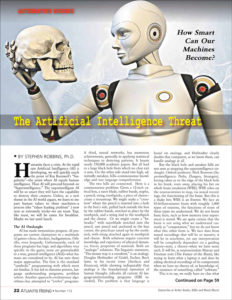
The Artificial Intelligence Threat

by Stephen Robbins, Ph.D.

Posted on

Can Machines Be Made Self-Aware?

This image has an empty alt attribute; its file name is ai-free.png

According to Australian Ph.D. candidate Michael Timothy Bennett, in an online column for The Conversation (www.theconversation.com/us) “To build a machine, one must know what its parts are and how they fit together. To understand the machine, one needs to know what each part does and how it contributes to its function. In other words, one should be able to explain the “mechanics” of how it works. “Human-like intent,” believes Bennett, “would require human-like experiences and feelings, which is a difficult thing to engineer. Furthermore, we can’t easily test for the full richness of human consciousness. Consciousness is a broad and ambiguous concept that encompasses—but should be distinguished from—the more narrow claims.”

According to a philosophical approach called mechanism, humans are arguably a type of machine—and our ability to think, speak and understand the world is the result of a mechanical process we don’t understand.
“Bombs and phones, say other critics, may be getting smarter, but we are getting dumber,” wrote anthropologist Dr. Susan Martinez in A.R. #130, “attention span alarmingly shortened from the New York minute to the Cyber Second. Constant emailing and instant-messaging, says one group of London psychiatrists, “might do more damage to you brain than smoking pot.” Meanwhile, said Martinez, “one Canadian researcher has concluded that our obsessive use of information technology is dumbing us down and encouraging superficial and uncritical thinking … [as well as] leading to compulsive behavior”. Tech addicts are fessing up: Casey F., for one, says she had to ditch her smartphone altogether: “If I have one, I will check it obsessively”. Recovering addict, Blake S. talks about how he finally broke the spell of “days attached to a smart phone from wake until sleep.” The addiction has become so prevalent (many Americans spending one quarter of their time staring at their phones) that we now have books with titles like How to Break Up With Your Phone. College kids, taking out their earbuds long enough to discuss how technology dominates their lives, swarm across campus “like giant schools of cyborg jellyfish” (Gregoire).

You know the blowback is getting serious when major Apple investors call for a probe into iPhone addiction among young users. There is a sense that much of today’s tech is less about “facilitating” the way we live than about shaping and controlling it.

Over a half century ago in his best-seller Future Shock, Alvin Toffler gave a dim prognosis for “goals set without the participation of those affected.” Instability and upheaval, he predicted, will inevitably arise from “top-down technocracy.”

AR #99

The Future of Scientific Genius

by J. Douglas Kenyon, Publisher’s Letter

Posted on

Can AI Take a Joke?

This image has an empty alt attribute; its file name is ai-free.png

Large neural networks, a form of artificial intelligence, can generate thousands of jokes along the lines of “Why did the chicken cross the road?” But do they understand why they’re funny?

Using hundreds of entries from the New Yorker magazine’s Cartoon Caption Contest as a testbed, researchers challenged AI models and humans with three tasks: matching a joke to a cartoon; identifying a winning caption; and explaining why a winning caption is funny. 

In all tasks, humans performed demonstrably better than machines, even as AI advances such as ChatGPT have closed the performance gap. So are machines beginning to “understand” humor? In short, they’re making some progress, but aren’t quite there yet.

“The way people challenge AI models for understanding is to build t0ests for them – multiple choice tests or other evaluations with an accuracy score,” said Jack Hessel, Ph.D. ’20, research scientist at the Allen Institute for AI (AI2). “And if a model eventually surpasses whatever humans get at this test, you think, ‘OK, does this mean it truly understands?’ It’s a defensible position to say that no machine can truly `understand’ because understanding is a human thing. But, whether the machine understands or not, it’s still impressive how well they do on these tasks.”
Hessel is lead author of “Do Androids Laugh at Electric Sheep? Humor ‘Understanding’ Benchmarks from The New Yorker Caption Contest,” which won a best-paper award at the 61st annual meeting of the Association for Computational Linguistics, held July 9-14 in Toronto.

Lillian Lee ’93, the Charles Roy Davis Professor in the Cornell Ann S. Bowers College of Computing and Information Science, and Yejin Choi, Ph.D. ’10, professor in the Paul G. Allen School of Computer Science and Engineering at the University of Washington, and the senior director of common-sense intelligence research at AI2, are also co-authors on the paper.

For their study, the researchers compiled 14 years’ worth of New Yorker caption contests – more than 700 in all. Each contest included: a captionless cartoon; that week’s entries; the three finalists selected by New Yorker editors; and, for some contests, crowd quality estimates for each submission.  

For each contest, the researchers tested two kinds of AI – “from pixels” (computer vision) and “from description” (analysis of human summaries of cartoons) – for the three tasks.

“There are datasets of photos from Flickr with captions like, ‘This is my dog,’” Hessel said. “The interesting thing about the New Yorker case is that the relationships between the images and the captions are indirect, playful, and reference lots of real-world entities and norms. And so the task of ‘understanding’ the relationship between these things requires a bit more sophistication.”

In the experiment, matching required AI models to select the finalist caption for the given cartoon from among “distractors” that were finalists but for other contests; quality ranking required models to differentiate a finalist caption from a nonfinalist; and explanation required models to generate free text saying how a high-quality caption relates to the cartoon.

Hessel penned the majority of human-generated explanations himself, after crowdsourcing the task proved unsatisfactory. He generated 60-word explanations for more than 650 cartoons.

“A number like 650 doesn’t seem very big in a machine-learning context, where you often have thousands or millions of data points,” Hessel said, “until you start writing them out.”

This study revealed a significant gap between AI- and human-level “understanding” of why a cartoon is funny. The best AI performance in a multiple choice test of matching cartoon to caption was only 62% accuracy, far behind humans’ 94% in the same setting. And when it came to comparing human- vs. AI-generated explanations, humans’ were preferred roughly 2-to-1.

While AI might not be able to “understand” humor yet, the authors wrote, it could be a collaborative tool humorists could use to brainstorm ideas.

Other contributors include Ana Marasovic, assistant professor at the University of Utah School of Ca.

AR #109

Self Fulfilling Skepticism

Brendan D. Murphy

Posted on

Ancient-Mysteries Magazine Bucks the Artificial-Intelligence Trend with “AI-FREE” Content

This image has an empty alt attribute; its file name is ai-free.png

Forget ChatGPT. At a time when the Internet is ablaze with the wonders of artificial intelligence, at least one content-rich on-line site is challenging conventional wisdom. In its regular blog posts, AtlantisRising.com (formerly Atlantis Rising Magazine, “magazine of record for ancient mysteries, future science, and the unexplained”) is taking the novel and counter-intuitive step of certifying that it publishes only authentic, ‘humanly-written’, content, and is labeling its stories accordingly.

Just as “healthy” food is marketed as, ‘free from artificial ingredients’, Atlantis Rising claims that, no matter how much popular AI-produced content, may resemble the real thing, it remains only a facsimile. Educated readers won’t be fooled. The reasons are complicated but, according to Doug Kenyon, AR’s long-time editor, “notwithstanding advanced machine learning, hyper language modeling, etc., the kind of personal insights that come from someone who still has skin in the game, can’t be duplicated by any mere computer or network.” What passes as the equivalent of genuine human intelligence is as unsatisfactory to the consumer as cheap white wine.

Long before Ancient Apocalypse, and other currently trending media with similar subject matter, there was Atlantis Rising Magazine, distributed for many years on newsstands internationally by Curtis circulation. The Atlantis Rising Research Group web site remains a visible brand on the internet with registered U.S. trademark and a small but loyal band of followers.

 The site’s web-site archives still contain most of the content from 135 published issues, including hundreds of original, well-researched, well-written, authoritative, and profusely illustrated articles, along with many books which the magazine has also produced. PDFs and other related products and videos can be purchased for download on line at AtlantisRising.com.

Ghosts of Atlantis, the recent 436-page book by Atlantis Rising editor J. Douglas Kenyon, is published by Inner Traditions/Simon & Schuster. 


Technologies of the Gods, one of the magazine’s original live action one-hour documentaries has drawn over a million viewings on platforms around the world. (https://www.youtube.com/watch?v=IXZr16VJg1s).

Additional documentaries include: Clash of the Geniuses and English Sacred Sites

Posted on

NASA AI Gives 30 Min. Warning

by Vanessa Thomas

This image has an empty alt attribute; its file name is ai-free.png

Like a tornado siren for life-threatening storms in America’s heartland, a new computer model that combines artificial intelligence (AI) and NASA satellite data could sound the alarm for dangerous space weather.

The model uses AI to analyze spacecraft measurements of the solar wind (an unrelenting stream of material from the Sun) and predict where an impending solar storm will strike, anywhere on Earth, with 30 minutes of advance warning. This could provide just enough time to prepare for these storms and prevent severe impacts on power grids and other critical infrastructure.

The Sun constantly sheds solar material into space – both in a steady flow known as the “solar wind,” and in shorter, more energetic bursts from solar eruptions. When this solar material strikes Earth’s magnetic environment (its “magnetosphere”), it sometimes creates so-called geomagnetic storms. The impacts of these magnetic storms can range from mild to extreme, but in a world increasingly dependent on technology, their effects are growing ever more disruptive.

For example, a destructive solar storm in 1989 caused electrical blackouts across Quebec for 12 hours, plunging millions of Canadians into the dark and closing schools and businesses. The most intense solar storm on record, the Carrington Event in 1859, sparked fires at telegraph stations and prevented messages from being sent. If the Carrington Event happened today, it would have even more severe impacts, such as widespread electrical disruptions, persistent blackouts, and interruptions to global communications. Such technological chaos could cripple economies and endanger the safety and livelihoods of people worldwide.

In addition, the risk of geomagnetic storms and devastating effects on our society is presently increasing as we approach the next “solar maximum” – a peak in the Sun’s 11-year activity cycle – which is expected to arrive sometime in 2025.

To help prepare, an international team of researchers at the Frontier Development Lab – a public-private partnership that includes NASA, the U.S. Geological Survey, and the U.S. Department of Energy – have been using artificial intelligence (AI) to look for connections between the solar wind and geomagnetic disruptions, or perturbations, that cause havoc on our technology. The researchers applied an AI method called “deep learning,” which trains computers to recognize patterns based on previous examples. They used this type of AI to identify relationships between solar wind measurements from heliophysics missions (including ACE, Wind, IMP-8, and Geotail) and geomagnetic perturbations observed at ground stations across the planet.

From this, they developed a computer model called DAGGER (formally, Deep Learning Geomagnetic Perturbation) that can quickly and accurately predict geomagnetic disturbances worldwide, 30 minutes before they occur. According to the team, the model can produce predictions in less than a second, and the predictions update every minute.

AR #92

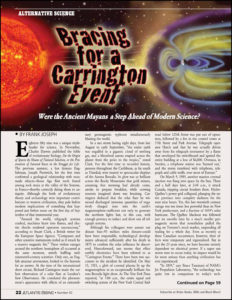
Bracing for a Carrington Event

by Frank Joseph

Posted on

Device Can Read Text from Human Minds

This image has an empty alt attribute; its file name is ai-free.png

A new artificial intelligence system called a semantic decoder can translate a person’s brain activity — while listening to a story or silently imagining telling a story — into a continuous stream of text. The system developed by researchers at The University of Texas at Austin might help people who are mentally conscious yet unable to physically speak, such as those debilitated by strokes, to communicate intelligibly again.

The study, published in the journal Nature Neuroscience, was led by Jerry Tang, a doctoral student in computer science, and Alex Huth, an assistant professor of neuroscience and computer science at UT Austin. The work relies in part on a transformer model, similar to the ones that power Open AI’s ChatGPT and Google’s Bard.

Unlike other language decoding systems in development, this system does not require subjects to have surgical implants, making the process noninvasive. Participants also do not need to use only words from a prescribed list. Brain activity is measured using an fMRI scanner after extensive training of the decoder, in which the individual listens to hours of podcasts in the scanner. Later, provided that the participant is open to having their thoughts decoded, their listening to a new story or imagining telling a story allows the machine to generate corresponding text from brain activity alone.

“For a noninvasive method, this is a real leap forward compared to what’s been done before, which is typically single words or short sentences,” Huth said. “We’re getting the model to decode continuous language for extended periods of time with complicated ideas.”

The result is not a word-for-word transcript. Instead, researchers designed it to capture the gist of what is being said or thought, albeit imperfectly. About half the time, when the decoder has been trained to monitor a participant’s brain activity, the machine produces text that closely (and sometimes precisely) matches the intended meanings of the original words.

Could this technology be used on someone without them knowing, say by an authoritarian regime interrogating political prisoners or an employer spying on employees?

No. The system has to be extensively trained on a willing subject in a facility with large, expensive equipment. “A person needs to spend up to 15 hours lying in an MRI scanner, being perfectly still, and paying good attention to stories that they’re listening to before this really works well on them,” said Huth.

Could training be skipped altogether?
No. The researchers tested the system on people whom it hadn’t been trained on and found that the results were unintelligible.

Are there ways someone can defend against having their thoughts decoded?
Yes. The researchers tested whether a person who had previously participated in training could actively resist subsequent attempts at brain decoding. Tactics like thinking of animals or quietly imagining telling their own story let participants easily and completely thwart the system from recovering the speech the person was exposed to.
What if technology and related research evolved to one day overcome these obstacles or defenses?
“I think right now, while the technology is in such an early state, it’s important to be proactive by enacting policies that protect people and their privacy,” Tang said. “Regulating what these devices can be used for is also very important.”

AR #61

Telephone Telepathy

by John Kettler

Posted on

Can Pigeons Compete with Artificial Intelligence?

Psychologists have examined the workings of the pigeon brain and claim the “brute force” of the bird’s learning shares similarities with artificial intelligence. That’s the conclusion of a new paper from University of Iowa scientists.

In their experiment, researchers gave the pigeons complex categorization tests that high-level thinking, such as using logic or reasoning, would not aid in solving. Instead, the pigeons, by virtue of exhaustive trial and error, eventually were able to memorize enough scenarios in the test to reach nearly 70% accuracy.

The researchers equate the pigeons’ repetitive, trial-and-error approach to artificial intelligence. Computers employ the same basic methodology, the researchers contend, being “taught” how to identify patterns and objects easily recognized by humans. Granted, computers, because of their enormous memory and storage power, far surpass anything pigeon brains would be able to conjure.

Still, the basic process of making associations—considered a ‘lower-level’ thinking technique—is the same between the test-taking pigeons and the latest AI advances.

We know that many birds migrate for thousands of miles, but the question of how they navigate so well and on such tight seasonal schedules has baffled science for generations. In recent years, studies, have indicated that the secret may lie in a special sensitivity to Earth’s magnetic field. It has not been entirely clear, however, just how birds are able to read that field, though it has been speculated that it may work for them something like a compass works for humans.

A recent pair of European studies argued that there is a strange protein in the birds’ eyes which makes it possible for them to actually see, at some other level of their vision, the planet’s magnetic field. Biologists at Sweden’s University of Lund, who studied zebra finches, and at Germany’s Carl von Ossietzky University in Oldenburg, who studied Robins, found that a protein called cryptochrome, linked to circadian rhythms, can facilitate something called ‘magnetoreception’.

Alternative science researchers, in one school of thought, have long believed that ‘magnetoreception’ is a faculty available to many species, including humans. Some have even theorized that so-called extra-sensory perception (ESP) is related to magnetic sensitivity. The research of renowned British biologist Rupert Sheldrake, however, suggests that, to explain ESP, something deeper may be needed. Clear evidence has been compiled by Sheldrake suggesting that many domesticated animals, including dogs and cats, know when their owners are coming home, and that many people know who is about to telephone them. These, and many similar phenomena would seem to demand a better explanation than magnetic sensitivity alone.

https://now.uiowa.edu/2023/02/ui-study-pigeons-use-same-basic-learning-process-ai

AR #99

The Future of Scientific Genius

by J. Douglas Kenyon, Publisher’s Letter

Posted on

Self-Driving Cars: What Can They Remember?

By Tom Fleischman

An autonomous vehicle is able to navigate city streets and other less-busy environments by recognizing pedestrians, other vehicles and potential obstacles through artificial intelligence. This is achieved with the help of artificial neural networks, which are trained to “see” the car’s surroundings, mimicking the human visual perception system.

But unlike humans, cars using artificial neural networks have no memory of the past and are in a constant state of seeing the world for the first time—no matter how many times they’ve driven down a particular road before. This is particularly problematic in adverse weather conditions, when the car cannot safely rely on its sensors.


Researchers at the Cornell Ann S. Bowers College of Computing and Information Science and the College of Engineering have produced three concurrent research papers with the goal of overcoming this limitation by providing the car with the ability to create “memories” of previous experiences and use them in future navigation.


“The fundamental question is, can we learn from repeated traversals?” said senior author Kilian Weinberger, professor of computer science in Cornell Bowers CIS. “For example, a car may mistake a weirdly shaped tree for a pedestrian the first time its laser scanner perceives it from a distance, but once it is close enough, the object category will become clear. So the second time you drive past the very same tree, even in fog or snow, you would hope that the car has now learned to recognize it correctly.”


“In reality, you rarely drive a route for the very first time,” said co-author Katie Luo, a doctoral student in the research group. “Either you yourself or someone else has driven it before recently, so it seems only natural to collect that experience and utilize it.”


Spearheaded by doctoral student Carlos Diaz-Ruiz, the group compiled a dataset by driving a car equipped with LiDAR (Light Detection and Ranging) sensors repeatedly along a 15-kilometer loop in and around Ithaca, 40 times over an 18-month period. The traversals capture varying environments (highway, urban, campus), weather conditions (sunny, rainy, snowy) and times of day.


This resulting dataset—which the group refers to as Ithaca365, and which is the subject of one of the other two papers—has more than 600,000 scenes.


“It deliberately exposes one of the key challenges in self-driving cars: poor weather conditions,” said Diaz-Ruiz, a co-author of the Ithaca365 paper. “If the street is covered by snow, humans can rely on memories, but without memories a neural network is heavily disadvantaged.”


The research was presented at the Proceedings of the IEEE Conference on Computer Vision and Pattern Recognition (CVPR 2022), held in New Orleans in June.

https://news.cornell.edu/stories/2022/06/technology-helps-self-driving-cars-learn-own-memories

AR #129

“Giant City Discovered in Guatemalan Jungle”


Posted on

Military Cannot Rely on A. I. for Judgment

Using artificial intelligence (AI) for warfare has been the promise of science fiction and politicians for years, but new research from the Georgia Institute of Technology argues only so much can be automated and shows the value of human judgment.

“All of the hard problems in AI really are judgment and data problems, and the interesting thing about that is when you start thinking about war, the hard problems are strategy and uncertainty, or what is well known as the fog of war,” said Jon Lindsay, an associate professor in the School of Cybersecurity & Privacy and the Sam Nunn School of International Affairs. “You need human sense-making and to make moral, ethical, and intellectual decisions in an incredibly confusing, fraught, scary situation.”

AI decision-making is based on four key components: data about a situation, interpretation of those data (or prediction), determining the best way to act in line with goals and values (or judgment), and action. Machine learning advancements have made predictions easier, which makes data and judgment even more valuable. Although AI can automate everything from commerce to transit, judgment is where humans must intervene, Lindsay and University of Toronto Professor Avi Goldfarb wrote in the paper, “Prediction and Judgment: Why Artificial Intelligence Increases the Importance of Humans in War,” published in International Security.

An example Lindsay and Goldfarb highlight is the Rio Tinto mining company, which uses self-driving trucks to transport materials, reducing costs and risks to human drivers. There are abundant, predictable, and unbiased data traffic patterns and maps that require little human intervention unless there are road closures or obstacles.
War, however, usually lacks abundant unbiased data, and judgments about objectives and values are inherently controversial, but that doesn’t mean it’s impossible. The researchers argue AI would be best employed in bureaucratically stabilized environments on a task-by-task basis.


“All the excitement and the fear are about killer robots and lethal vehicles, but the worst case for military AI in practice is going to be the classically militaristic problems where you’re really dependent on creativity and interpretation,” Lindsay said. “But what we should be looking at is personnel systems, administration, logistics, and repairs.”


AR #112

“The Artificial Intelligence Threat”
By Steven Robbins, Ph.D


Posted on

Conscious Artificial Brains: Research Ethics

One way in which scientists are studying how the human body grows and ages is by creating artificial organs in the laboratory. The most popular of these organs is currently the organoid, a miniaturized organ made from stem cells. Organoids have been used to model a variety of organs, but brain organoids are the most clouded by controversy.

Current brain organoids are different in size and maturity from normal brains. More importantly, they do not produce any behavioral output, demonstrating they are still a primitive model of a real brain. However, as research generates brain organoids of higher complexity, they will eventually have the ability to feel and think. In response to this anticipation, Associate Professor Takuya Niikawa (Kobe University) and Assistant Professor Tsutomu Sawai (Kyoto University’s Institute for the Advanced Study of Human Biology (WPI-ASHBi)), in collaboration with other philosophers in Japan and Canada, have written a paper on the ethics of research using conscious brain organoids. The paper can be read in the academic journal Neuroethics (https://link.springer.com/article/10.1007/s12152-022-09483-1).


Working regularly with both bioethicists and neuroscientists who have created brain organoids, the team has been writing extensively about the need to construct guidelines on ethical research. In the new paper, Niikawa, Sawai and their coauthors lay out an ethical framework that assumes brain organoids already have consciousness rather than waiting for the day when we can fully confirm that they do.


“We believe a precautionary principle should be taken,” Sawai said. “Neither science nor philosophy can agree on whether something has consciousness. Instead of arguing about whether brain organoids have consciousness, we decided they do as a precaution and for the consideration of moral implications.”


To justify this assumption, the paper explains what brain organoids are and examines what different theories of consciousness suggest about brain organoids, inferring that some of the popular theories of consciousness permit them to possess consciousness.


Ultimately, the framework proposed by the study recommends that research on human brain organoids follows the ethical principles similar to those for animal experiments. Therefore, recommendations include using the minimum number of organoids possible and doing the upmost to prevent pain and suffering while considering the interests of the public and patients.


“Our framework was designed to be simple and is based on valence experiences and the sophistication of those experiences,” said Niikawa.

AR #115

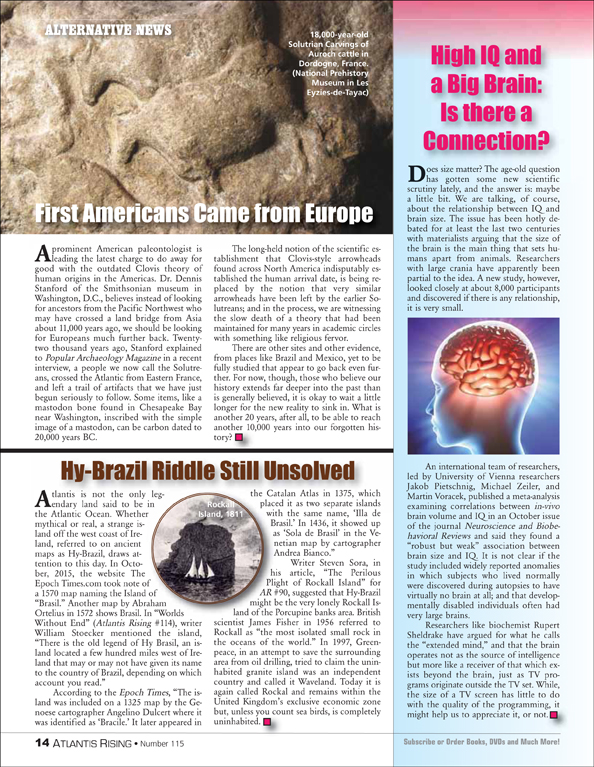
“High IQ and a Big Brain: Is there a Connection”