Posted on

Could Floating Sea Farms Feed the World and Provide Freshwater by 2050?

This image has an empty alt attribute; its file name is ai-free.png

The sun and the sea – both abundant and free – are being harnessed in a unique project to create vertical sea farms floating on the ocean that can produce fresh water for drinking and agriculture. In what is believed to be a world first, researchers have designed a self-sustaining solar-driven system that evaporates seawater and recycles it into freshwater, growing crops without any human involvement.

It could help address looming global shortages of freshwater and food in the decades ahead, with the world’s population expected to reach 10 billion by 2050.

Professor Haolan Xu and Dr Gary Owens from University of South Australia Future Industries Institute have developed the vertical floating sea farm which is made up of two chambers: an upper layer similar to a glasshouse and a lower water harvest chamber.

“The system works much like a wicking bed that household gardeners might be familiar with,” Dr Owen says.
“However, in this case, clean water is supplied by an array of solar evaporators that soak up the seawater, trap the salts in the evaporator body and, under the sun’s rays, release clean water vapour into the air which is then condensed on water belts and transferred to the upper plant growth chamber.”

In a field test, the researchers grew three common vegetable crops – broccoli, lettuce, and pak choi – on seawater surfaces without maintenance or additional clean water irrigation.

The system, which is powered only by solar light, has several advantages over other solar sea farm designs currently being trialled, according to Professor Xu.

 “Other designs have installed evaporators inside the growth chamber which takes up valuable space that could otherwise be used for plant growth. Also, these systems are prone to overheating and crop death,” Professor Xu says.
Floating farms, where traditional photovoltaic panels harvest electricity to power conventional desalination units, have also been proposed but these are energy intensive and costly to maintain.

“In our design, the vertical distribution of evaporator and growth chambers decreases the device’s overall footprint, maximising the area for food production. It is fully automated, low cost, and extremely easy to operate, using only solar energy and seawater to produce clean water and grow crops.”

Dr Owens says their design is only proof-of-concept at this stage, but the next step is to scale it up, using a small array of individual devices to increase plant production. Meeting larger food supply needs will mean increasing both the size and number of devices.

“It is not inconceivable that sometime in the future, you might see huge farm biodomes floating on the ocean, or multiple smaller devices deployed over a large sea area.”

The design experiment is published in the Chemical Engineering Journal (https://www.sciencedirect.com/science/article/pii/S1385894723041839).

It could help address looming global shortages of freshwater and food in the decades ahead, with the world’s population expected to reach 10 billion by 2050.

Professor Haolan Xu and Dr Gary Owens from University of South Australia Future Industries Institute have developed the vertical floating sea farm which is made up of two chambers: an upper layer similar to a glasshouse and a lower water harvest chamber.

“The system works much like a wicking bed that household gardeners might be familiar with,” Dr Owen says.
“However, in this case, clean water is supplied by an array of solar evaporators that soak up the seawater, trap the salts in the evaporator body and, under the sun’s rays, release clean water vapour into the air which is then condensed on water belts and transferred to the upper plant growth chamber.”

In a field test, the researchers grew three common vegetable crops – broccoli, lettuce, and pak choi – on seawater surfaces without maintenance or additional clean water irrigation.

The system, which is powered only by solar light, has several advantages over other solar sea farm designs currently being trialled, according to Professor Xu.

 “Other designs have installed evaporators inside the growth chamber which takes up valuable space that could otherwise be used for plant growth. Also, these systems are prone to overheating and crop death,” Professor Xu says.
Floating farms, where traditional photovoltaic panels harvest electricity to power conventional desalination units, have also been proposed but these are energy intensive and costly to maintain.

“In our design, the vertical distribution of evaporator and growth chambers decreases the device’s overall footprint, maximising the area for food production. It is fully automated, low cost, and extremely easy to operate, using only solar energy and seawater to produce clean water and grow crops.”

Dr Owens says their design is only proof-of-concept at this stage, but the next step is to scale it up, using a small array of individual devices to increase plant production. Meeting larger food supply needs will mean increasing both the size and number of devices.

“It is not inconceivable that sometime in the future, you might see huge farm biodomes floating on the ocean, or multiple smaller devices deployed over a large sea area.”

The design experiment is published in the Chemical Engineering Journal (https://www.sciencedirect.com/science/article/pii/S1385894723041839).

AR #123

What Does Water Remember”

by Jeane Manning

Posted on

Tracking the Sun to Feed Ancient Mexicans

By Jules Bernstein

Without clocks or modern tools, ancient Mexicans watched the sun to maintain a farming calendar that precisely tracked seasons and even adjusted for leap years.Rising sun seen from the stone causeway on Mount Tlaloc in Mexico.

Before the Spanish arrival in 1519, the Basin of Mexico’s agricultural system fed a population that was extraordinarily large for the time.  Whereas Seville, the largest urban center in Spain, had a population of fewer than 50,000, the Basin, now known as Mexico City, was home to as many as 3 million people.  

To feed so many people in a region with a dry spring and summer monsoons required advanced understanding of when seasonal variations in weather would arrive. Planting too early, or too late, could have proved disastrous. The failure of any calendar to adjust for leap-year fluctuations could also have led to crop failure.

Though colonial chroniclers documented the use of a calendar, it was not previously understood how the Mexica, or Aztecs, were able to achieve such accuracy. New UC Riverside research, published in the Proceedings of the National Academy of Sciences, demonstrates how they did it. They used the mountains of the Basin as a solar observatory, keeping track of the sunrise against the peaks of the Sierra Nevada mountains. 

“We concluded they must have stood at a single spot, looking eastwards from one day to another, to tell the time of year by watching the rising sun,” said Exequiel Ezcurra, distinguished UCR professor of ecology who led the research.

To find that spot, the researchers studied Mexica manuscripts. These ancient texts referred to Mount Tlaloc, which lies east of the Basin. The research team explored the high mountains around the Basin and a temple at the mountain’s summit. Using astronomical computer models, they confirmed that a long causeway structure at the temple aligns with the rising sun on Feb. 24, the first day of the Aztec new year.

“Our hypothesis is that they used the whole Valley of Mexico. Their working instrument was the Basin itself. When the sun rose at a landmark point behind the Sierras, they knew it was time to start planting,” Ezcurra said.

The sun, as viewed from a fixed point on Earth, does not follow the same trajectory every day. In winter, it runs south of the celestial equator and rises toward the southeast. As summer approaches, because of the Earth’s tilt, sunrise moves northeast, a phenomenon called solar declination. 

This study may be the first to demonstrate how the Mexica were able to keep time using this principle, the sun, and the mountains as guiding landmarks. Though some may be familiar with the “Aztec calendar,” that is an incorrect name given to the Sun Stone, arguably the most famous work of Aztec sculpture used solely for ritual and ceremonial purposes. 

Pictures and captions:
https://news.ucr.edu/articles/2022/12/12/precise-solar-observations-fed-millions-ancient-mexico

AR #62

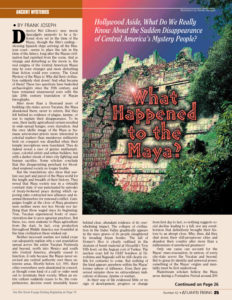
What Happened to the Mayas

by Frank Joseph

Posted on

50,000 Years Ago, Australians Ate Giant Thunderbird Eggs

Protein Evidence of Enormous Flightless Bird Found

By: Fred Lewsey

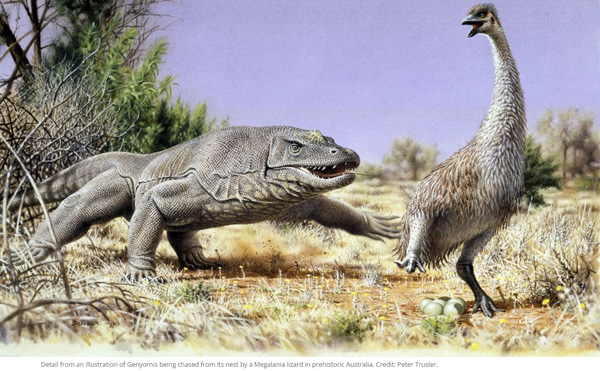
Proteins extracted from fragments of prehistoric eggshell found in the Australian sands confirm that the continent’s earliest humans consumed the eggs of a two-meter tall bird that disappeared into extinction over 47,000 years ago. 

Burn marks discovered on scraps of ancient shell several years ago suggested the first Australians cooked and ate large eggs from a long-extinct bird – leading to fierce debate over the species that laid them. 
Now, an international team led by scientists from the universities of Cambridge and Turin have placed the animal on the evolutionary tree by comparing the protein sequences from powdered egg fossils to those encoded in the genomes of living avian species.  


According to findings published in the journal Proceedings of the National Academy of Sciences, the ancient eggs came from Genyornis: a huge flightless “mihirung” – or ‘Thunder Bird’ – with tiny wings and massive legs that roamed prehistoric Australia, possibly in flocks.  


Fossil records show that Genyornis stood over two meters tall, weighed between 220-240 kilograms, and laid melon-sized eggs of around 1.5 kg. It was among the Australian “mega-fauna” to vanish a few thousand years after humans arrived, suggesting people played a role in its extinction.  


The earliest “robust” date for the arrival of humans to Australia is some 65,000 years ago. Burnt eggshells from the previously unconfirmed species all date to around 50 to 55 thousand years ago – not long before Genyornis is thought to have gone extinct – by which time humans had spread across most of the continent.  


“There is no evidence of Genyornis butchery in the archaeological record. However, eggshell fragments with unique burn patterns consistent with human activity have been found at different places across the continent,” said senior co-author Prof Gifford Miller from the University of Colorado.


“This implies that the first humans did not necessarily hunt these enormous birds, but did routinely raid nests and steal their giant eggs for food,” he said. “Over-exploitation of the eggs by humans may well have contributed to Genyornis extinction.”


While Genyornis was always a contender for the mystery egg-layer, some scientists argued that – due to shell shape and thickness – a more likely candidate was the Progura or ‘giant malleefowl’: another extinct bird, much smaller, weighing around 5-7 kg and akin to a large turkey. 


The initial ambition was to put the debate to bed by pulling ancient DNA from pieces of shell, but genetic material had not sufficiently survived the hot Australian climate.


The 50,000-year-old eggshell tested for the study came from the archaeological site of Wood Point in South Australia, but Prof Miller has previously shown that similar burnt shells can be found at hundreds of sites on the far western Ningaloo coast. 


The researchers point out that the Genyornis egg exploitation behavior of the first Australians likely mirrors that of early humans with ostrich eggs, the shells of which have been unearthed at archaeological sites across Africa dating back at least 100,000 years. 


AR #106

“Ancient Wanderers—“How Science
Has Lost Track of the Story”

by William B. Stoecker

Posted on

Could Breastfeeding Fight Cognitive Decline in Moms?

A new study led by researchers at UCLA Health has found that women over the age of 50 who had breastfed their babies performed better on cognitive tests compared to women who had never breastfed. The findings, published in Evolution, Medicine and Public Health, suggest that breastfeeding may have a positive impact on postmenopausal women’s cognitive performance and could have long-term benefits for the mother’s brain.

“While many studies have found that breastfeeding improves a child’s long-term health and well-being, our study is one of very few that has looked at the long-term health effects for women who had breastfed their babies,” said Molly Fox, PhD, lead author of the study and an Assistant Professor in the UCLA Department of Anthropology and the Department of Psychiatry and Biobehavioral Sciences. “Our findings, which show superior cognitive performance among women over 50 who had breastfed, suggest that breastfeeding may be ‘neuroprotective’ later in life.”
Cognitive health is critical for wellbeing in aging adults. Yet, when cognition becomes impaired after the age of 50, it can be a strong predictor of Alzheimer’s Disease (AD), the leading form of dementia and cause of disability among the elderly – with women comprising nearly two-thirds of Americans living with the disease.


Many studies also show that phases of a woman’s reproductive life-history, such as menstruation, pregnancy, breastfeeding and menopause can be linked to a higher or lower risk for developing various health conditions like depression or breast cancer, yet few studies have examined breastfeeding and its impact on women’s long-term cognition. Of those that have, there has been conflicting evidence as to whether breastfeeding might be linked to better cognitive performance or Alzheimer’s risk among post-menopausal women.


“What we do know is that there is a positive correlation between breastfeeding and a lower risk of other diseases such as type-2 diabetes and heart disease, and that these conditions are strongly connected to a higher risk for AD,” said Helen Lavretsky, MD, the senior author of the study and a professor in the Department of Psychiatry and Biobehavioral Sciences at the Semel Institute for Neuroscience and Human Behavior at UCLA. 


“Because breastfeeding has also been found to help regulate stress, promote infant bonding and lower the risk of post-partum depression, which suggest acute neurocognitive benefits for the mother, we suspected that it could also be associated with long-term superior cognitive performance for the mother as well,” added Dr. Fox.


To find out, the researchers analyzed data collected from women participating in two cross-sectional randomized controlled 12-week clinical trials at UCLA Health: 1) The “Brain Connectivity and Response to Tai Chi in Geriatric Depression and Cognitive Decline,” included depressed participants. 2) The “Reducing Risk for Alzheimer’s Disease in High-Risk Women through Yoga or Memory Training that included non-depressed participants with some subjective memory complaints and a risk for heart disease.


Among the two trials, 115 women chose to participate, with 64 identified as depressed and 51 non-depressed.  All participants completed a comprehensive battery of psychological tests measuring learning, delayed recall, executive functioning and processing speed. They also answered a questionnaire about their reproductive life-history that included questions about the age they began menstruating, number of complete and incomplete pregnancies, the length of time they breastfed for each child and their age of menopause.


Importantly, none of the participants had been diagnosed with dementia, or other psychiatric diagnoses such as bipolar disorder, alcohol or drug dependence, neurological disorders or had other disabilities preventing their participation or taking any psychoactive medications. There was also no significant difference in age, race, education or other cognitive measures between the depressed and non-depressed participants.


Key findings from the researchers’ analysis of the data collected from questionnaires on the women’s reproductive history revealed that about 65% of non-depressed women reported having breastfed, compared to 44% of the depressed women. All non-depressed participants reported at least one completed pregnancy compared to 57.8% of the depressed participants.


Results from the cognitive tests also revealed that those who had breastfed, regardless of whether they were depressed or not, performed better in all four of the cognitive tests measuring for learning, delayed recall, executive functioning and processing compared to women who had not breastfed.


AR #105

Morphic Fields & DNA
by William B. Stoecker