Posted on

Could a Sun ‘Umbrella,’ Fix Climate Change?

This image has an empty alt attribute; its file name is ai-free.png

Earth is rapidly warming say some scientists, and now they are developing a variety of approaches to reduce the effects of climate change. István Szapudi, an astronomer at the University of Hawaiʻi Institute for Astronomy, has proposed a novel approach—a solar shield to reduce the amount of sunlight hitting Earth, combined with a tethered, captured asteroid as a counterweight. Engineering studies using this approach they claim could start now to create a workable design that could mitigate climate change within decades.

The paper, “Solar radiation management with a tethered sun shield,” is published in Proceedings of the National Academy of Sciences https://www.pnas.org/doi/10.1073/pnas.2307434120).

One of the simplest approaches to reducing the global temperature is to shade the Earth from a fraction of the Sun’s light. This idea, called a solar shield, has been proposed before, but the large amount of weight needed to make a shield massive enough to balance gravitational forces and prevent solar radiation pressure from blowing it away makes even the lightest materials prohibitively expensive. Szapudi’s creative solution consists of two innovations: a tethered counterweight instead of just a massive shield, resulting in making the total mass more than 100 times less, and the use of a captured asteroid as the counterweight to avoid launching most of the mass from Earth.

“In Hawaiʻi, many use an umbrella to block the sunlight as they walk about during the day. I was thinking, could we do the same for Earth and thereby mitigate the impending catastrophe of climate change?” Szapudi said.

Szapudi began with the goal of reducing solar radiation by 1.7%, an estimate of the amount needed to prevent a catastrophic rise in global temperatures. He found that placing a tethered counterbalance toward the Sun could reduce the weight of the shield and counterweight to approximately 3.5 million tons, about one hundred times lighter than previous estimates for an untethered shield.

While this number is still far beyond current launch capabilities, only 1% of the weight—about 35,000 tons—would be the shield itself, and that is the only part that needs to be launched from Earth. With newer, lighter materials, the mass of the shield can be reduced even further. The remaining 99% of the total mass would be asteroids or lunar dust used as a counterweight. Such a tethered structure would be faster and cheaper to build and deploy than other shield designs.

Today’s largest rockets can only lift about 50 tons to low Earth orbit, so this approach to solar radiation management would be challenging. Szapudi’s approach brings the idea into the realm of possibility, even with today’s technology, whereas prior concepts were completely unachievable. Also, developing a light-weight but strong graphene tether connecting the shield with the counterweight is crucial.

AR #90

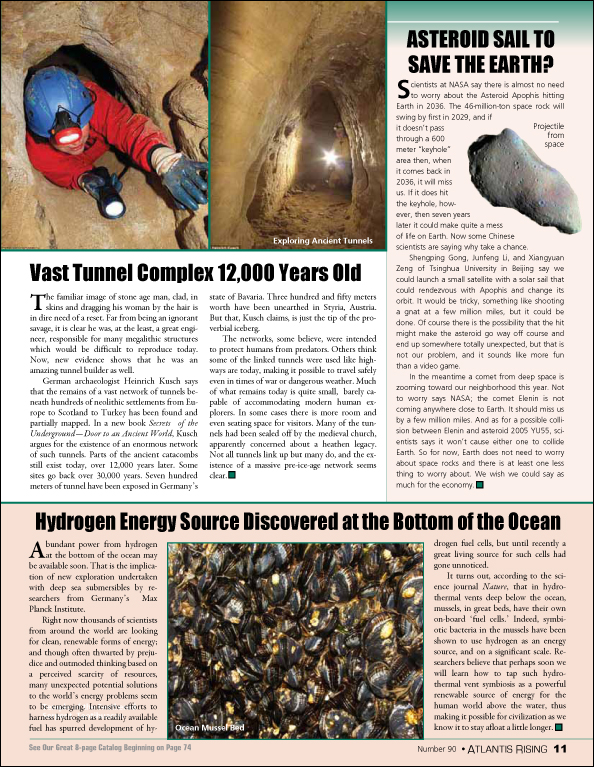
Asteroid Sail to Save the Earth?
Posted on

Harvesting Untapped Fresh Water

By Lois Yoksoulian

An almost limitless supply of fresh water exists in the form of water vapor above Earth’s oceans, yet remains untapped, researchers say. A new study from the University of Illinois Urbana-Champaign is the first to suggest an investment in new infrastructure capable of harvesting oceanic water vapor as a solution to limited supplies of fresh water in various locations around the world.

The study, led by civil and environmental engineering professor and Prairie Research Institute executive director Praveen Kumar, evaluated 14 water-stressed locations across the globe for the feasibility of a hypothetical structure capable of capturing water vapor from above the ocean and condensing it into fresh water – and do so in a manner that will remain feasible in the face of continued climate change.


Kumar, graduate student Afeefa Rahman and atmospheric sciences professor Francina Dominguez published their findings in the journal Nature Scientific Reports (https://www.nature.com/articles/s41598-022-24314-2)
“Water scarcity is a global problem and hits close to home here in the U.S. regarding the sinking water levels in the Colorado River basin, which affects the whole Western U.S.,” Kumar said. “However, in subtropical regions, like the Western U.S., nearby oceans are continuously evaporating water because there is enough solar radiation due to the very little cloud coverage throughout the year.”


Previous wastewater recycling, cloud seeding and desalination techniques have met only limited success, the researchers said. Though deployed in some areas across the globe, desalination plants face sustainability issues because of the brine and heavy metal-laden wastewater produced – so much so that California has recently rejected measures to add new desalination plants.


“Eventually, we will need to find a way to increase the supply of fresh water as conservation and recycled water from existing sources, albeit essential, will not be sufficient to meet human needs. We think our newly proposed method can do that at large scales,” Kumar said.


The researchers performed atmospheric and economic analyses of the placement of hypothetical offshore structures 210 meters in width and 100 meters in height.


Through their analyses, the researchers concluded that capturing moisture over ocean surfaces is feasible for many water-stressed regions worldwide. The estimated water yield of the proposed structures could provide fresh water for large population centers in the subtropics.


One of the more robust projections of climate change is that dry regions will get drier, and wet areas will get wetter. “The current regions experiencing water scarcity will likely be even drier in the future, exacerbating the problem,” Dominguez said. “And unfortunately, people continue moving to water-limited areas, like the Southwestern U.S.”
However, this projection of increasingly arid conditions favors the new ocean vapor-harvesting technology.


“The climate projections show that the oceanic vapor flux will only increase over time, providing even more fresh water supply,” Rahman said. “So, the idea we are proposing will be feasible under climate change. This provides a much needed and effective approach for adaptation to climate change, particularly to vulnerable populations living in arid and semi-arid regions of the world.”


The researchers said one of the more elegant features of this proposed solution is that it works like the natural water cycle.


“The difference is that we can guide where the evaporated water from the ocean goes,” Dominguez said. “When Praveen approached me with this idea, we both wondered why nobody had thought about it before because it seemed like such an obvious solution. But it hasn’t been done before, and I think it is because researchers are so focused on land-based solutions – but our study shows other options do, in fact, exist.”

https://news.illinois.edu/view/6367/833959034

AR #104

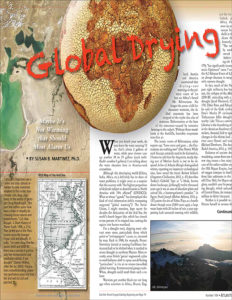
Global Drying

by Susan Martinez, Ph.D.

Posted on

Refreezing Poles Could Be Done?

By Faye Holst

The poles are warming several times faster than the global average, causing record smashing heatwaves that were reported earlier this year in both the Arctic and Antarctic. Melting ice and collapsing glaciers at high latitudes would accelerate sea level rise around the planet. Fortunately, refreezing the poles by reducing incoming sunlight would be both feasible and remarkably cheap, according to new research published in IOP Publishing’s Environmental Research Communications (https://iopscience.iop.org/article/10.1088/2515-7620/ac8cd3).

Scientists laid out a possible future program whereby high-flying jets would spray microscopic aerosol particles into the atmosphere at latitudes of 60 degrees north and south – roughly Anchorage and the southern tip of Patagonia.  If injected at a height of 43,000 feet (above airliner cruising altitudes), these aerosols would slowly drift poleward, slightly shading the surface beneath.  “There is widespread and sensible trepidation about deploying aerosols to cool the planet,” notes lead author Wake Smith, “but if the risk/benefit equation were to pay off anywhere, it would be at the poles”.


Particle injections would be performed seasonally in the long days of the local spring and early summer. The same fleet of jets could service both hemispheres, ferrying to the opposite pole with the change of seasons.
Pre-existing military air-to-air refueling tankers such as the aged KC-135 and the A330 MMRT don’t have enough payload at the required altitudes, whereas newly designed high-altitude tankers would prove much more efficient. A fleet of roughly 125 such tankers could loft a payload sufficient to cool the regions poleward of 60°N/S by 2°C per year, which would return them close to their pre-industrial average temperatures.  Costs are estimated at $11 billion annually – less than one-third the cost of cooling the entire planet by the same 2°C magnitude and a tiny fraction of the cost of reaching net zero emissions.


“Game changing though this could be in a rapidly warming world, stratospheric aerosol injections merely treat a symptom of climate change but not the underlying disease. It’s aspirin, not penicillin. It’s not a substitute for decarbonization,” says Smith.


Cooling at the poles would provide direct protection for only a small fraction of the planet, though the mid-latitudes should also experience some temperature reduction. Since less than 1% of the global human population lives in the target deployment zones, a polar deployment would entail much less direct risk to most of humanity than a global program. “Nonetheless, any intentional turning of the global thermostat would be of common interest to all of humanity and not merely the province of Arctic and Patagonian nations,” adds Smith.
In summary, the current study is just one small and preliminary step towards understanding the costs, benefits, and risks of undertaking climate intervention at high latitudes. It provides further reason to believe that such tools could prove useful both in preserving cryosphere near the poles and slowing sea level rise globally.

https://ioppublishing.org/news/refreezing-poles-feasible-and-cheap-new-study-finds/

AR Issue #59
Could Arctic Hold Secrets of Alien Life