A Neptune-sized planet denser than steel has been discovered by an international team of astronomers, who believe its composition could be the result of a giant planetary clash.
TOI-1853b’s mass is almost twice that of any other similar-sized planet known and its density is incredibly high, meaning that it is made up of a larger fraction of rock than would typically be expected at that scale.
In the study, just published in Nature, scientists led by Luca Naponiello of University of Rome Tor Vergata suggest that this is the result of planetary collisions. These huge impacts would have removed some of the lighter atmosphere and water leaving a multitude of rock behind (https://www.nature.com/articles/s41586-023-06499-2).
Senior Research Associate and co author Dr Phil Carter from the University of Bristol’s School of Physics, explained: “We have strong evidence for highly energetic collisions between planetary bodies in our solar system, such as the existence of Earth’s Moon, and good evidence from a small number of exoplanets.
“We know that there is a huge diversity of planets in exoplanetary systems; many have no analog in our solar system but often have masses and compositions between that of the rocky planets and Neptune/Uranus (the ice giants). “TOI-1853b is the size of Neptune but has a density higher than steel. Our work shows that this can happen if the planet experienced extremely energetic planet-planet collisions during its formation.
“These collisions stripped away some of the lighter atmosphere and water leaving a substantially rock-enriched, high-density planet.”
Now the team plan detailed follow-up observations of TOI-1853b to attempt to detect any residual atmosphere and examine its composition.
Associate Professor and co author Dr Zoë Leinhardt concluded: “We had not previously investigated such extreme giant impacts as they are not something we had expected. There is much work to be done to improve the material models that underlie our simulations, and to extend the range of extreme giant impacts modelled.”
The end of the last Ice Age also marked the end for more than three dozen genera of large mammals in North America, from mammoths and mastodons to bison and saber-toothed cats. Details concerning the precise timing and circumstances, however, have remained murky ever since.
A team of scientists recently focused on the famous Rancho La Brea Tar Pits in southern California in their quest to provide answers to these questions, resulting in the most exact and detailed timeline for the extinctions that happened during the latter part of the Pleistocene period in North America, along with some foreboding insight into the area’s present and future. Their work is featured on the August 18, 2023 cover of Science (https://www.science.org/doi/10.1126/science.abo3594).
Texas A&M University archaeologist Dr. Michael Waters, along with roughly a dozen fellow researchers examined the timing and cause of the extinction of a variety of large mammals, known as megafauna, that got stuck in tar at Rancho La Brea, ensuring the preservation of their bones. The team used the radiocarbon dating method to date 169 bones from seven different animals — bison, horse, camel and ground sloths as well as the carnivores that ate them, including the saber-toothed cat, dire wolf and American lion. They also compared those findings to regional pollen and charcoal records along with continent-wide data on human and large mammal populations.
Armed with their new data, the researchers subsequently used time-series modeling to produce the most detailed chronobiology to date, showing the relationships between climate and vegetation change, fire activity, human demographics and megafauna extinctions — groundbreaking results they report in the world-leading academic journal.
Waters says the team’s findings reveal that Ice Age mammal populations in southern California were steady from 15,000 to around 13,250 years ago. Afterward, there was a sharp decline in the population of the seven animals studied, and they all became extinct between 13,070 to 12,900 years ago.
In an interesting modern-day parallel, this extinction event corresponds with a change in the environment from 13,300 to 12,900 years ago marked by warming and drying that made the land more vulnerable to fires in southern California. Charcoal records show that fires increased around 13,500 years ago and peaked between 13,200 and 12,900 years ago. Studies show that humans arrived in North America’s Pacific coast 16,000 to 15,000 years ago and lived alongside the megafauna for 2,000 to 3,000 years before their extinction.
While humans hunted animals during this period, Waters says the impact of hunting on the demise of the megafauna likely was minor because of the low population of humans on the landscape. However, the fires would have been devastating, resulting in the loss of habitat causing the rapid decline and extinction of the megafauna in southern California. The study suggests these fires were ignited by humans, which had increased in number by that time. “Fire is a way that small numbers of humans can have a large impact over a broad area,” said Waters, who also cautions that climate changes observed in present-day California are similar to those of the late Pleistocene. “This study has implications for the changes we see in southern California today,” Waters added. “The temperatures are rising, and the area is drying. We also see a dramatic increase in fires. It appears that history may be repeating itself.”
While Waters acknowledges that this is the story of extinction at Rancho La Brea, he says it has the potential to offer insights into when extinctions happened across all of North America.
“Mammoths and mastodons survived in many parts of North America until around 12,700 years ago,” he added. “These animals were hunted by the Clovis people between about 13,000 and 12,700 years ago. We are now dating megafauna remains from other locations to give a broader understanding of the Rancho La Brea research in the context of North America.”
The museum at La Brea Tar Pits holds the world’s largest collection of fossils from the Ice Age and has been central to the study of animal and plant life at the end of the Pleistocene epoch for more than a century. Its naturally occurring asphalt pools entrapped and preserved the bones of thousands of individual animals representing dozens of megafaunal species during the last 60,000 years, enabling scientists to determine when different species disappeared from the ecosystem and why.
The team’s research was supported by the National Science Foundation and various Texas A&M-specific grants, such as the CSFA and the North Star Archaeological Research Fund.
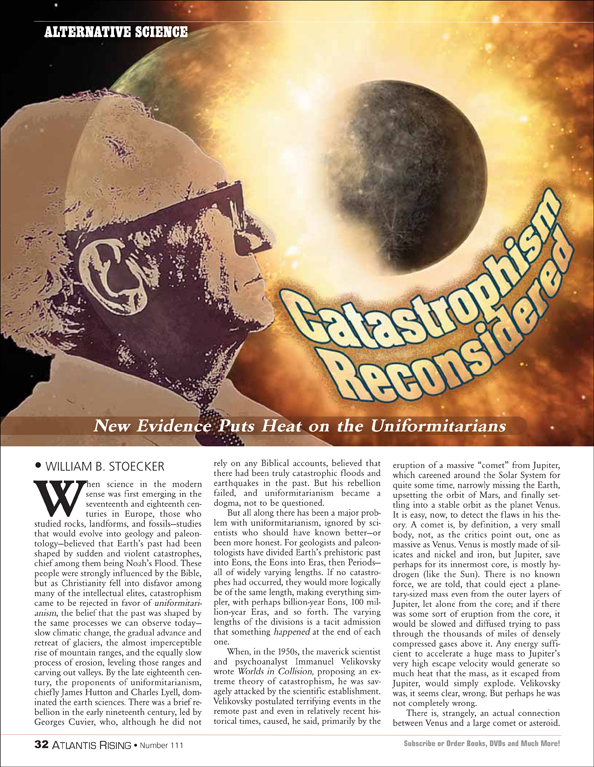
No one in the past century is more directly linked with the notion that Earth’s forgotten history has been punctuated by memory-destroying catastrophic events, than Immanuel Velikovsky.
No one in the past century is more directly linked with the notion that Earth’s forgotten history has been punctuated by memory-destroying catastrophic events, than Immanuel Velikovsky.
When the late Russian/American scientist’s Worlds in Collision was published in 1950 it caused a sensation, and brought down upon the author’s head a virtual firestorm of scorn from the custodians of the natural history establishment. Subsequent books further elaborated his ideas and inflamed the controversy. Here was a scientist of considerable authority suggesting, among other things, that Earth and Venus might once have collided, leaving a vast chaotic aftermath which could have done much to explain our peculiar history. For such arguments, Velikovsky was, ever afterward, roundly ridiculed. Surprisingly, though, many of his predictions have now been validated, and an entire school of thought, known as ‘Catastrophism,’ has arisen.
This Article is from the new edition of Watkins MIND BODY SPIRIT magazine
Among the claims for which he was ridiculed, but which have since been established as true, are: Venus is still very hot; rich in petroleum and hydrocarbon gases; and has an abnormal orbit. Other, now-verified Velikovsky claims include: Jupiter emits radio noises; Earth’s magnetosphere reaches at least to the Moon; the Sun has an electric potential of approximately 10 to the 19th power in volts; the rotation of the Earth can be affected by electromagnetic fields. Some of Velikovsky’s critics, including the late Carl Sagan, have conceded that he might have been on to something. A practicing psychoanalyst himself, Velikovsky offered unique insight into the psycho/sociological impacts of cataclysmic events. The psychological condition and case history of planet Earth is, he observed, one of ‘amnesia.’
As in the mythic tales of many traditions we, the victims of amnesia, are left with few clues to guide us through a maze of incomprehensible signs and images, while the incoherent fragments of a lost identity—the artifacts of forgotten worlds—haunt our dreams, even as the princes of the darkness, become the tyrants whom we permit to enslave us. Whether in government, orthodox religion, society, academia, or the ‘twitterverse,’ such figures find the light of recovering consciousness, a threat—best stamped out, nipped in the bud, strangled in the cradle, silenced, canceled. Should we be surprised to learn that those dark princes will fight to preserve the perks and prerogatives of their dim domain?
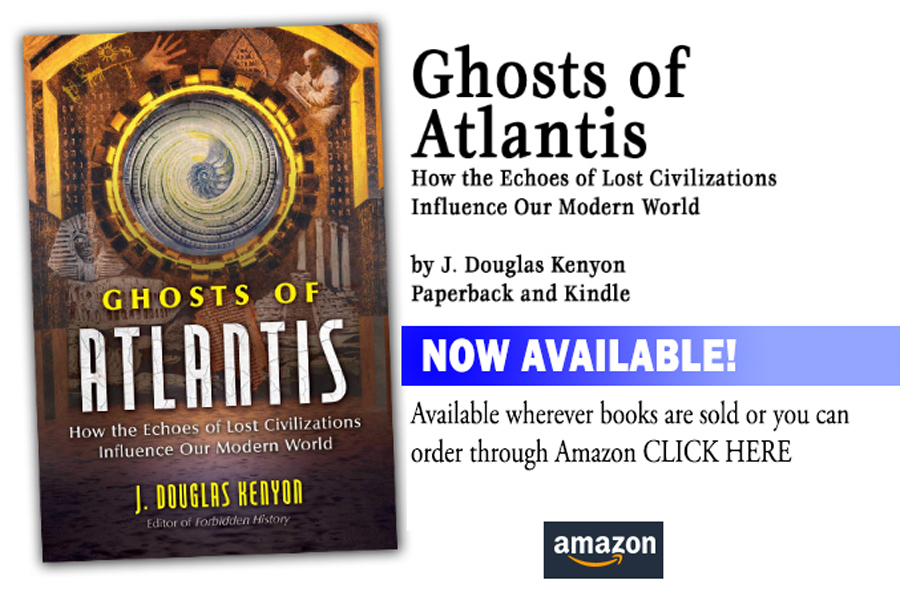
In Ghosts of Atlantis, my new book published by Inner Traditions/Bear & Co. I argue that we live within the ruins of an ancient civilization whose vast size has hitherto rendered it invisible. Remembered in myth as Atlantis, Lemuria, or other lost-world archetypes, the remains of this advanced civilization have lain buried for millennia beneath the deserts and oceans of the world, but leaving us many mysterious and bewildering clues.
Investigating the perennial myth of a forgotten fountainhead of civilization, the book offers extensive physical and spiritual evidence for a lost great culture, and the collective amnesia that wiped it from planetary memory. We explore the countless ways ancient catastrophes still haunt us. We look at the case for advanced ancient technology, study anomalous ancient maps, extraterrestrial influence, time travel, crystal science, and the true age of the Sphinx, evidence in the Bible for Atlantis and ancient Armageddon, Stone Age high-tech at Gobekli Tepe, the truth of Rapa Nui (Easter Island), the Zep Tepi monuments of Egypt, mysteries of the Gulf of Cambay, and what lies beneath the ice of Antarctica. We look at extinction events, Earth’s connection with Mars, and how our DNA reveals that humanity has had enough time to evolve civilization, and to lose it, more than once.
Exploring the advanced esoteric and spiritual knowledge of the ancients, our book also shows that the search for Atlantis and other lost worlds is, in fact, a search for the lost soul of humanity. Drawing upon Velikovsky’s notion of a species-wide amnesia brought on by the trauma of losing an entire civilization, the book reveals how the virtual ruins of a lost history are buried deep in our collective unconscious, constantly tugging at our awareness.
The popularity of the movie Titanic, not too many years ago had Hollywood scrambling to clone the formula. The secret of unlimited wealth seemed to be at stake. Most theories of the movie’s success had to do with star power, and special effects combined with a good love story, but could something else have been involved?
Call it an ‘archetype,’ if you will, but the idea of an enormous, technically advanced, and arrogant world—supposedly impervious to danger—yet suddenly destroyed by nature itself and banished to the bottom of the sea, may strike an even deeper chord than most Hollywood moguls would dare to consider.
If it is true that our civilization is, as Plato suggested, but the latest round in an eternal series of heroic ascensions followed by catastrophic falls, it makes sense that we share a deep need to better comprehend our predicament. Velikovsky offered a compelling explanation for many of the world’s pathologies. The cataclysmic destruction of a society, and its subsequent descent into barbarism, he said, would result in a loss of collective memory and, whatever new order rose from the ashes of the old, the requirements of self-preservation would tend to block the recalling of the former world.
At deeper levels, we all understand somehow, that, before the dawn of recorded history—our collective memory—we once rose to the heights, but still, we then plunged into an abyss from which we have not yet fully emerged. Like the watery ghosts of the Titanic, we long to be awakened, but we dread it too, and that’s the problem.