By J. Douglas Kenyon
No one in the past century is more directly linked with the notion that Earth’s forgotten history has been punctuated by memory-destroying catastrophic events, than Immanuel Velikovsky.
No one in the past century is more directly linked with the notion that Earth’s forgotten history has been punctuated by memory-destroying catastrophic events, than Immanuel Velikovsky.
When the late Russian/American scientist’s Worlds in Collision was published in 1950 it caused a sensation, and brought down upon the author’s head a virtual firestorm of scorn from the custodians of the natural history establishment. Subsequent books further elaborated his ideas and inflamed the controversy. Here was a scientist of considerable authority suggesting, among other things, that Earth and Venus might once have collided, leaving a vast chaotic aftermath which could have done much to explain our peculiar history. For such arguments, Velikovsky was, ever afterward, roundly ridiculed. Surprisingly, though, many of his predictions have now been validated, and an entire school of thought, known as ‘Catastrophism,’ has arisen.
Among the claims for which he was ridiculed, but which have since been established as true, are: Venus is still very hot; rich in petroleum and hydrocarbon gases; and has an abnormal orbit. Other, now-verified Velikovsky claims include: Jupiter emits radio noises; Earth’s magnetosphere reaches at least to the Moon; the Sun has an electric potential of approximately 10 to the 19th power in volts; the rotation of the Earth can be affected by electromagnetic fields. Some of Velikovsky’s critics, including the late Carl Sagan, have conceded that he might have been on to something. A practicing psychoanalyst himself, Velikovsky offered unique insight into the psycho/sociological impacts of cataclysmic events. The psychological condition and case history of planet Earth is, he observed, one of ‘amnesia.’
As in the mythic tales of many traditions we, the victims of amnesia, are left with few clues to guide us through a maze of incomprehensible signs and images, while the incoherent fragments of a lost identity—the artifacts of forgotten worlds—haunt our dreams, even as the princes of the darkness, become the tyrants whom we permit to enslave us. Whether in government, orthodox religion, society, academia, or the ‘twitterverse,’ such figures find the light of recovering consciousness, a threat—best stamped out, nipped in the bud, strangled in the cradle, silenced, canceled. Should we be surprised to learn that those dark princes will fight to preserve the perks and prerogatives of their dim domain?
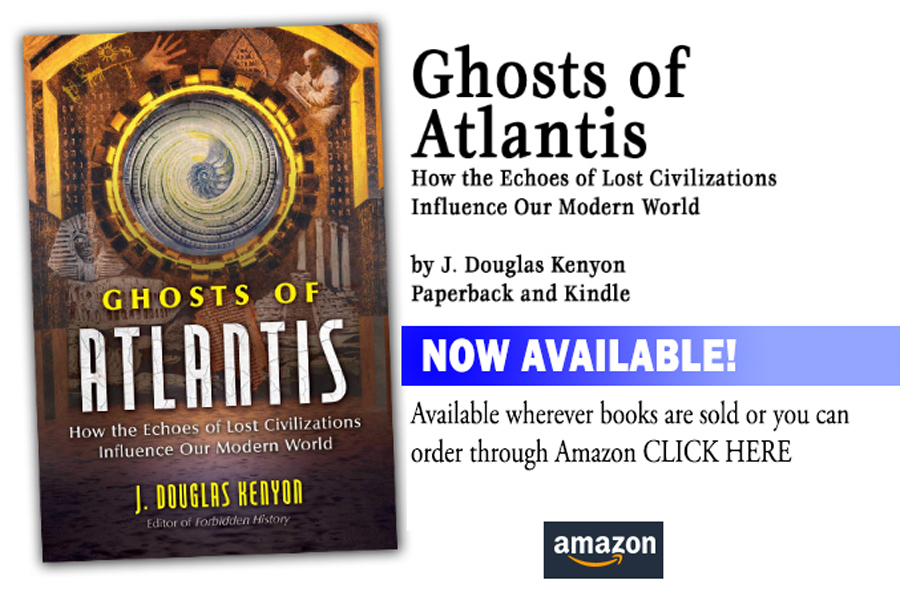
In Ghosts of Atlantis, my new book published by Inner Traditions/Bear & Co. I argue that we live within the ruins of an ancient civilization whose vast size has hitherto rendered it invisible. Remembered in myth as Atlantis, Lemuria, or other lost-world archetypes, the remains of this advanced civilization have lain buried for millennia beneath the deserts and oceans of the world, but leaving us many mysterious and bewildering clues.
Investigating the perennial myth of a forgotten fountainhead of civilization, the book offers extensive physical and spiritual evidence for a lost great culture, and the collective amnesia that wiped it from planetary memory. We explore the countless ways ancient catastrophes still haunt us. We look at the case for advanced ancient technology, study anomalous ancient maps, extraterrestrial influence, time travel, crystal science, and the true age of the Sphinx, evidence in the Bible for Atlantis and ancient Armageddon, Stone Age high-tech at Gobekli Tepe, the truth of Rapa Nui (Easter Island), the Zep Tepi monuments of Egypt, mysteries of the Gulf of Cambay, and what lies beneath the ice of Antarctica. We look at extinction events, Earth’s connection with Mars, and how our DNA reveals that humanity has had enough time to evolve civilization, and to lose it, more than once.
Exploring the advanced esoteric and spiritual knowledge of the ancients, our book also shows that the search for Atlantis and other lost worlds is, in fact, a search for the lost soul of humanity. Drawing upon Velikovsky’s notion of a species-wide amnesia brought on by the trauma of losing an entire civilization, the book reveals how the virtual ruins of a lost history are buried deep in our collective unconscious, constantly tugging at our awareness.
The popularity of the movie Titanic, not too many years ago had Hollywood scrambling to clone the formula. The secret of unlimited wealth seemed to be at stake. Most theories of the movie’s success had to do with star power, and special effects combined with a good love story, but could something else have been involved?
Call it an ‘archetype,’ if you will, but the idea of an enormous, technically advanced, and arrogant world—supposedly impervious to danger—yet suddenly destroyed by nature itself and banished to the bottom of the sea, may strike an even deeper chord than most Hollywood moguls would dare to consider.
If it is true that our civilization is, as Plato suggested, but the latest round in an eternal series of heroic ascensions followed by catastrophic falls, it makes sense that we share a deep need to better comprehend our predicament.
Velikovsky offered a compelling explanation for many of the world’s pathologies. The cataclysmic destruction of a society, and its subsequent descent into barbarism, he said, would result in a loss of collective memory and, whatever new order rose from the ashes of the old, the requirements of self-preservation would tend to block the recalling of the former world.
At deeper levels, we all understand somehow, that, before the dawn of recorded history—our collective memory—we once rose to the heights, but still, we then plunged into an abyss from which we have not yet fully emerged.
Like the watery ghosts of the Titanic, we long to be awakened, but we dread it too, and that’s the problem.