

On October 4, 2016, I boarded a British Airways flight from Los Angeles to London’s Heathrow Airport. After a few…
You must be logged in to view this content.

On October 4, 2016, I boarded a British Airways flight from Los Angeles to London’s Heathrow Airport. After a few…
You must be logged in to view this content.
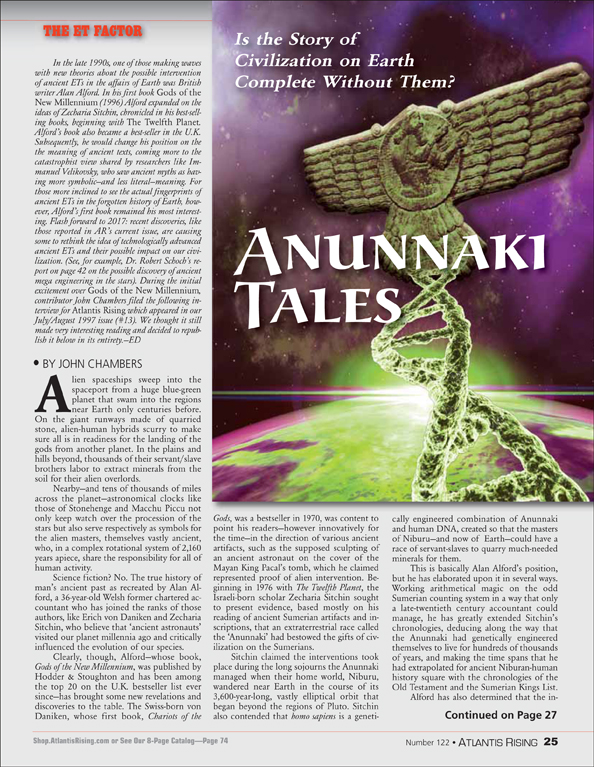
In the late 1990s, one of those making waves with new theories about the possible intervention of ancient ETs in…
You must be logged in to view this content.
Apparitions of Mary, the mother of Jesus of Nazareth, are not confined to the past and such long-time Catholic pilgrimage sites as Guadalupe in Mexico, Fatima in Portugal, and Lourdes in France. If the six “visionaries” from the village of Medjugorje in the country now known as Bosnia-Herzegovina (previously part of Yugoslavia) are to be believed, they are continuing today. In fact, they have been ongoing there since June 24, 1981, when some children witnessed the first such apparition.
According to the Medjugorje Web (medjugorje.org), “over 40 million people of all faiths, from all over the world, have visited Medjugorje and have left spiritually strengthened and renewed.” Moreover, it states, “countless unbelievers and physically or mentally afflicted have been converted and healed.”
The first such apparition, nearly 36 years ago, took place when Mirjana Dragicevic, 16, and Ivanka Ivankovic, who would turn 16 the following day, went for a walk. In her 2016 autobiography, My Heart Will Triumph, Mirjana, now 51, and with the married name of Soldo, recalls that she had just arrived from her home in Sarajevo to spend time with her uncle and aunt in Medjugorje as she had during previous summers, and the walk was to catch up on things. Ivanka lived in another village but spent the summers with her grandmother in Medjugorje. As they sat and talked in a shady spot on an unpaved road in the shadow of Podbrdo Hill, the two girls, both Catholics, saw a “beautiful woman” a hundred or more meters up the hill and agreed that it was “Our Lady.” Frightened, both ran home.
Mirjana states that she had never heard of other so-called “apparitions” of Gospa, the Croatian name for, as Catholics know her, the Blessed Virgin Mary, and because Yugoslavia was then a communist country, religious books were practically contraband.
After working the next day in the tobacco fields, Mirjana sought out Ivanka and along with Marija Pavovic, 16, Vicka Ivankovic, 16, Ivan Dragicevic, 15, and Jakov Colo, 10, they were drawn to Podbrdo Hill by three flashes of white light. Together, the six children ran up the hill towards the lady. “The first time I gazed upon the woman up close, I realized she was not of this world,” Mirjana writes. “Immediately—and involuntarily—we fell to our knees. Not sure what to say or do, we began to pray the Our Father, Hail Mary, and Glory Be. To our astonishment, the woman prayed along with us, but she remained silent during the Hail Mary.”
Mirjana further recalls that the woman before them was encompassed by a beautiful blueness, and her skin was imbued with an olive-hued radiance. Her eyes reminded her of the translucent blue of the Adriatic Sea. Most of her long black hair was covered by a white veil. A long dress with a blue-gray glow extended to her feet. There was great intensity in her gaze. “Her very presence brought with it a feeling of peace and maternal love, but I also felt fear because I did not understand what was happening.”
In a 2013 interview, Vicka remembers the initial apparition a little differently, saying that Mirjana and Ivanka, accompanied by Marija’s sister Milka, went to look for some grazing sheep and wanted her to join them. As she was on her way to meet up with them, she saw Milka running towards her, excitedly telling her that “Our Lady” was there. As Vicka ran to see what it was all about, she encountered Ivan, who was with another boy also named Ivan. They soon joined Mirjana and Ivanka and all four witnessed the woman on the hill, now called Apparition Hill. The two boys were so scared that they fled. “We were standing on the road and Our Lady was up on the hill,” Vicka relates. “We really could not see Her very clearly, not as distinctly as we can see Her now. We could see Our Lady beckoning to us to come to Her, but we did not dare. It was not only that we were scared; we just were not relaxed and open enough to go to Her. Then we turned around and left the place.”
Mirjana and Vicka both agree on a very curious point involving the second apparition. It should have taken about 12 minutes to climb the hill, then covered with thorn bushes and stones, to where the apparition was, but the six visionaries seemed to effortlessly fly up the hill until they found themselves standing in front of the woman. “It was as if I simply glided—or something carried me—to the place where the woman was standing,” Mirjana recalls, while Vicka remembers it more like flying. They dropped to their knees as the beautiful woman said in perfect Croatian, “My children, be not afraid.” Mirjana describes the voice as having a resonant, melodic tone that no human could ever duplicate.
So in shock were the six visionaries that little was said beyond the prayers at that first meeting, although Ivanka asked about her mother, who had died a month or so earlier. “She is with me,” was the reply.
While the six visionaries had already guessed the identity of Gospa, it was the next day that she said, “I am the Blessed Virgin Mary and I come here because there are a lot of faithful people here.” (This is the English translation. She likely identified herself as Gospa.) Even though the communist regime, with its atheistic ideology, had made every effort to stamp out religion, Mirjana remembers that, “the great majority of people in the parish of Medjugorje lived for God.” The government realized that it could not completely eradicate such a deep-rooted mindset and was content to treat religion as a necessary nuisance, permitting Franciscan priests to run the parish of Medjugorje.
Mary began appearing daily, often giving short messages, primarily petitions to love, pray, forgive, overcome, fast, live in peace, and expect eternal life. “Our Lady asks us to return the Word of God to our homes,” Mirjana offers in her recent book. “Do not let it sit in a dusty corner like a decoration, but put it in a place of honor where it will be seen and touched.” She quotes a typical message given to her on August 2, 2015: “With a simple heart accept His word and live it. If you live His word, you will pray. If you live His word, you will love with a merciful love; you will love each other.” (The visionaries would write down the messages as soon as the apparition disappeared, and the words may not have been exact.)
Word of the phenomenon quickly spread, and on the third day, hundreds of villagers gathered to observe, though none could see what the six children claimed to see. By the sixth day, thousands were coming every afternoon. The government made every effort to discourage gatherings and to silence the children, even having Mirjana expelled from school, resulting in her being sent to a school for delinquents in Sarajevo, but the apparitions continued and the crowds grew.
Seemingly more significant than the regular messages received over the past 35-plus years are the “10 secrets” entrusted to the visionaries individually. All 10 have been received by Mirjana, Ivanka, and Jackov, but the other three have not received the tenth. The secrets will not be revealed until Mary tells the visionaries that it is time to do so. The visionaries were told not to compare notes or discuss the secrets with each other or anyone else. Indications are that the secrets deal with future events. Mirjana and Vicka will say only that after the first two secrets come to pass, Mary will leave a permanent sign on Apparition Hill, where she first appeared, and it will be evident that human hands could not have built it. It will be permanent and indestructible.
To this day, the Catholic Church cautiously sits on the fence relative to the apparitions, neither affirming nor denying their supernatural character, but the judgment of the Church is that there is no evidence of fraud, mental illness, or the demonic. It encourages its members to participate in events, which presumes the authenticity of Medjugorje, but it forbids its clergy from officially sanctioning such events.
Seeing how the six visionaries are now revered by the many pilgrims to Medjugorje, the skeptic can easily surmise that it started as a prank or a collective hallucination by the six children and was perpetuated by the celebrity status that each quickly gained and enjoyed in spite of the harassment by government authorities and even indifference and some resistance by Church authorities. Why else would it continue for more than 35 years? Certainly, an advanced spiritual being, if such a being exists, should have been able to communicate whatever she had to say in a much shorter time frame. Considering that three of the six are still experiencing daily apparitions and the other three periodic ones, the messages should fill at least a dozen thick volumes by now.
The skeptic will also note a strong Catholic bias, with Mary asking for rote prayer for the souls in purgatory, fasting on bread and water, mentioning devils with horns and tails in a Dante-like inferno, and describing heaven as a place where one apparently does nothing but praise God. While the petitions for love and peace are paramount and have a universal appeal, transcending orthodox Christianity, the humdrum heaven and horrific hell are all too much for any rational person, skeptic or believer, to accept as truth. Such twaddle as devils with horns and tails seems to have contributed significantly to the impeachment of religion in the first place.
And yet, a number of studies by scientists—neurological and psychological, including polygraph (lie detection) tests and hypnosis—have ruled out deception by the visionaries. They have undergone electro-encephalographs, electro-oculographs, eye reflex, and auditory tests while they are in what researchers call a state of “ecstasy” communicating with the apparition. “Suddenly their gaze, already fixed on the location of the apparition, becomes more intense,” Monsignor René Laurentin and Professor Henri Joyeux report of their studies with five of the visionaries during 1984. “There are hardly any movements of the eyelids. Their faces become almost perceptibly brighter and turn toward the invisible speaker. They kneel down very naturally, all at the same time… Their lips can be seen moving, but no voices are heard, just as it was with Bernadette at Lourdes. They were not conscious of this and were surprised when we questioned them about this unusual phenomenon. They believe they are speaking normally.”
Close observation by the researchers has given no indication of play-acting or any attempt to follow a leader in the group or otherwise coordinate their movements. The visionaries seem to lose contact with the surroundings and remain insensitive to stimulation, even pinching and prodding. At the beginning of the ecstasy, eye movements cease almost simultaneously and the eyes remained immobile.
Laurentin makes special note of the humility and sincerity of the visionaries. “The visionaries, with all their strengths and admirable naiveté, do not behave as magicians or fortunetellers, or guardians of the absolute,” he offers, “but rather as beneficiaries of a unique encounter that transcends them and is responsible for the light and benefits that accrue to them and others.”
Dr. James P. Pandarakalam, a London psychiatrist, has been to Medjugorje 70 times during the past 30 years to study the visionaries and agrees with Laurentin. He says that he has confined himself to observations without equipment and of a non-quantifiable nature. “I went as an investigator and returned as a pilgrim,” he writes in a 1995 book, Medjugorje and Theistic Parapyschology, adding that he cannot explain the apparitions without the presence of Mary.
Pandarakalam, a Catholic since birth, sees the rote prayers of the rosary (repeated recitation of the “Hail Mary” prayer), as often recited by the visionaries, as an element of self-hypnosis and mindfulness—a preparation for spiritual communication with higher dimensions. Others have said that it leads to a meditative state, more “mindlessness,” which opens one up to a deeper awareness. Nor does Pandarakalam see such prayers as a need for adoration on the part of Mary. Rather, it is a more of a matter of her not being able to help unless humans ask to be helped through her intercession.
As for fasting, Pandarakalam explains that it generates hypoglycemia in the brain, causing it to become less active and for psychical powers to thus become more active. “A fasting person becomes spiritually more attuned with the higher dimensions if he also prays,” Pandarakalam says. “Prayer is seeking God, a dialogue with God, a surrender to God.”
A difficult conundrum presents itself from all of this, especially for those who believe they have achieved a reasonable degree of spiritual consciousness. If they accept that the visionaries are actually communicating with Mary, the mother of Jesus, and further accept that all the messages involving love, peace, forgiveness, and charity have value, and that the world does need to become more spiritual and less materialistic, must they also accept a return to more primitive ideas, such as devils with horns and tails in a fire and brimstone environment, and a heaven with angels doing nothing but singing praise to God for eternity? Can they be selective, choosing to believe what appeals to reason, while discounting the twaddle? Or is it possible that such twaddle is really truth?
Based on revelation coming to us through various mystics, visionaries, mediums, near-death experiencers, and others able to penetrate the veil into a greater reality since the time of Swedenborg, many “believers” have discovered a more intelligent afterlife, one in which hell is really a “fire of the mind,” like a bad dream, and a state from which there is an escape. Above that lowest level are a number of realms through which souls advance and progress toward Oneness with the Creator while retaining their individuality. Those realms, the believers come to understand, involve much more activity than strumming harps for eternity. Have such believers been misled?
As Laurentin suggests, the communication strikes the sense faculties of the visionaries, as well as the many pilgrims, according to their ad modum recipientis. In effect, this means that they comprehend it based on their limited knowledge and understanding of things. Much of it is beyond their comprehension and vocabulary, and they do their best to convert it to words and symbols familiar to them. That would account for devils with horns and tails, but one is left to wonder why an advanced spiritual being would not realize that her communication would be significantly distorted and confuse those who have discovered a more intelligent afterlife. Could it be that Mary was and is focused on reaching the masses—those who had lost simple faith, as was the case in communist countries, and needed to be brought back to at least a basic level of spiritual consciousness, one from which they might later advance? In other words, did she find it necessary to begin with Religion 101, not 301?
Could it also be that those who believe they have achieved a higher spiritual consciousness than the limited one with the primitive ideas and symbolisms of the visionaries are expected to reason and understand Mary’s tactics, at the same being reminded of the essential teachings of love, peace, forgiveness, and charity?
Perhaps it will all make more sense if and when the 10 secrets are revealed. Stay tuned…
To witness Mirjana in ecstasy during a very recent apparition, see https://www.youtube.com/watch?v=Nrfbl3AKeOo
CAPTIONS: The visionaries, as they witness an appearance in early 1980s (photo: courtesy of James P. Pandarakalam). In The Song of Bernadette (the 1943 movie), Jennifer Jones played St. Bernadette of Lourdes, to whom Mother Mary often appeared. Medjugorje visionaries in 2000 (photo: courtesy of James P. Pandarakalam).
March/April2017 – #122
The Other Side
We all know in 1492 Columbus sailed across the Atlantic and “discovered” America. Well, actually, Columbus did not believe that he had discovered anything. He believed that he had sailed to Asia. In fact he believed the natives he encountered were Indians (of the Indian subcontinent).
Five years later, it would be an agent for the Medici family, Amerigo (or Alberico) Vespucci, who would cross the Atlantic. Vespucci did understand that it was not Asia but a New World. In fact he would publish the record of his journey as the Mundus Novus. This is why the New World was supposedly named after him, or was it?
Vespucci was born in March of 1454 three years after Columbus. His family was wealthy and played patron to Michelangelo, Botticelli, and Da Vinci. His cousin Simonetta Vespucci was a beautiful woman who served as a model for Botticelli. Vespucci received his education from Georgio Antonio who tutored Rene II, the future Duke of Lorraine. Readers of Holy Blood, Holy Grail might remember that Rene II was the son of Iolande de Bar, a grandmaster of the Priory of Sion. Iolande’s husband was the lord of Sion-Vaudemont and one of the original knights in the Order of the Crescent.
In Rene’s region of Lorraine was a village called St. Die. It was a little town of woodcutters, brick makers, and flax weavers. The area surrounding St. Die had a reputation of boorish, backward peasants. Amidst the backwoods area was a printing establishment created by the Canon of St. Die who was secretary and chaplain to Rene II. In the employ of this establishment was Martin Waldseemuller, a cartographer, and Matthias Ringmann, an Alsatian professor. Their mission was to produce an edition of Ptolemy’s Geography. In 1507 Rene II received what became known as the Soderini letter. It was a description of the four voyages of Vespucci. It was almost certainly a fake, as Vespucci made only two voyages. Weaving through the crudely written “letter” is the claim that Vespucci deserves the credit, not Columbus. Why would such a text be written? Possibly because the first account of the voyages of Columbus were a best-selling profit source. And who would benefit? The printing establishment itself would benefit, but not because of any specific name. Columbus passed away a year before the book and map were printed so was never part of the issue.
It is likely that a name that sounded like ‘Amerigo’ was assumed to be the explorer’s name. There is evidence that such a name may have been already in use in the New World. Waldseemuller and his scholars were unaware and added “and since Europe and Asia received names of women, I do not see any reason not to call this latest discovery Amerige, or America, according to the sagacious man who discovered it.”
It may have come as a surprise to Vespucci, as he was not a person to steal another’s discovery. He also seemed to be concerned over the affairs of Columbus. When he was the agent for Juanoto Berardi in Seville, Columbus borrowed a half-a-million maravedis from Berardi. When Beradi died, Vespucci was in charge of liquidating the estate. Vespucci saw to it that the debt owed by Columbus to the estate disappeared.
Many other places named by Europeans often followed another rule. The names of the men making the discovery were often the surname, as in Columbia, Bolivar, and (Henry) Hudson River. If the person was royalty then the first name was used, as in Georgia, Virginia, and Prince Edward Island. To use Vespucci’s surname would have the New World being called “Wasp Land” as “vespa” is the Italian word for that stinging insect.
In any case, the booklet and map created was a success. Then other printers copied it and added names such as “New World,” “Brazil,” and “Terra Sanctae Crucis.” Waldseemuller at some point may have realized the clerics had been suckered by the Soderini letter. He printed the work again calling the new world “Terra Incognita” (Unknown Land). He also pointed out that Columbus was the discoverer.
Amaruca to America?
In the fifteen years that separated the discovery of the New World and the placing of the name ‘America’ on the map, there were numerous ocean crossings that may have brought home the name ‘America.’ Numerous Spanish voyages reached the Caribbean Islands and Central America. In Nicaragua the Spanish explorers met up with a tribe called the ‘Amerrique.’ The people told the Spanish that their land was rich in gold. A French geologist, Jules Marcou, said the Spanish brought this name home. The mountain range in Nicaragua was “land of perpetual wind” and called ‘Ameriaque’ and, actually recorded in the sailing logs of Columbus himself. Augustus Le Plongeon said the word ‘America,’ or ‘Amerrique’ actually meant, “Land of the Wind” in the Mayan language. Le Plongeon was a French-American photographer, archaeologist and author who produced several books that connected the Mayans to the Old World.
A Peruvian people were called the ‘Amaruca.’ They worshipped a god named ‘Amaru’ who was similar to the Plumed Serpent of the Maya. Discoveries continue to be made in the land of ‘Amaruca,’ which contains the remarkable Machu Picchu. The last of the Incan leaders was Tupac Amaru who was executed by the Spanish in 1572.
When the Spanish landed in Columbia they were also told they were in the land of Amaruca. It would not be incorrect to assume this was a wide-ranging area that held a group of related civilizations sharing certain characteristics.
A Celtic Source?
Frank Joseph, author of Lost Colonies of Ancient America, makes a strong argument for trans-Atlantic contact long before Columbus. The Phoenicians, he says, sailed by a star they call La Merika. They were not strangers to the Atlantic coast where the Keltic people of the peninsula known as Armorica nearly defeated Julius Caesar.
The Keltic Venitii had a fleet almost as great as Caesar’s fleet. Caesar had commented that this navy was adept at ocean sailing at which the Romans were not as experienced. Caesar’s admiral, however, was inventive enough to use long billhooks to grab the Venitii ships and enable the heavily armed Romans to board. A disastrous sea battle allowed the Romans to attack the coastal ports of the Kelts one-by-one and defeat them. How many of the Armorican ships used their ocean sailing to escape their enemy? There are many legends of a bearded white man crossing the sea and bringing knowledge of agriculture and medicine. In what became Columbia, this man had the title of “Serpent.”
Author James Bailey wrote The God-Kings and the Titans questioning whether the Akkadian word for “Western Lands,” which was ‘Amurru,’ could have been given a –ca ending just like Inca, Titicaca, and Cajamarca. If Semitic sailors from even before the Phoenicians reached the New World and were told by inhabitants of Central and South America they had arrived in Amaruca, they may have adopted the word for western lands.
An English Source?
In 1412, the Icelandic Annals reported a ship of English fishermen on Dyrholm. It was a time when, due to harsh weather and the reduced population post-plague, Norway was sending less than one ship each year. Then England started dispatching around thirty each year. The powerful Hanseatic League wanted to put a stop to it. So England ordered that no English fishermen go to Iceland.
The League was founded in the twelfth century and attempted to monopolize trade and even shipbuilding in the Baltic and North Sea. Their alliance had them joining together to take on any trespassers in a territory that ranged from Russia to London. Henry II of England, and later Henry III, had allowed their access not only to ports but also to inland trade fairs, even while the league stopped English shipping from the fishing banks of the North Atlantic.
The entrepreneurs of Bristol took a different approach to sailing for the lucrative cod as far away as the Grand Banks. They claimed they were exploring in the Atlantic and specifically searching for an island known as ‘Hy-Brasil’ or “Brazil.” Oddly enough, this island appeared on maps as old as 1325. The island was part of a legend. In legend it was perceived as an island due west of Ireland that could only be found every seven years.
On July 15, 1480, a ship (of eighty tons) owned by John Jay and John Lloyd sailed from Bristol in search of Brasil. They were described as the most expert seamen in all England. They hit bad weather and returned without finding it.
The next year, two ships owned in part by Thomas Croft set out to find Brasil. Croft had been denied a license for trade. His ship was carrying 40 bushels of salt. While he would claim he was on a voyage of exploration, it would be unusual to carry such a great amount of salt if one was not planning to return with fish, particularly cod fish. So Croft and others may have been fishing on their own or simply buying cod from the Basques or others. There are few records of such ventures and Croft acted like the Basques, keeping his discovery a secret. He was, however, found out and prosecuted. His claim was that he got the cod from an area in the Atlantic. It was a good story and a friendly jury acquitted him.
In 1956, a letter from one John Day to Christopher Columbus turned up in the archives of Simancas. It describes the voyages of John Cabot but also mentions the Isle of Brasil discovered by men from Bristol, possibly before 1480.
John Cabot came to Bristol in 1495 and would sail to America two years later. He was an adventurer and, no doubt, privy to the secrets of the sailing clans in Bristol. He was also aware that the Sheriff of Bristol was also the tax collector. Sheriff Richard Amerike was like royalty in Bristol who would deal with both merchants and pirates. He was given credit for funding Cabot’s voyage and even for owning Cabot’s ship, The Matthew. Author Rodney Broome gives him credit for not only naming the New World for Cabot’s patron but also claiming a relationship between the Amerike coat of arms and the American flag.
The Vikings
Five hundred years before Columbus and Cabot sailed the Atlantic, Vikings from Scandinavia ruled in Ireland, Scotland, the Orkney Islands, Iceland, and Greenland. Most historians took their own sagas as fiction until a whole Viking village turned up in Canada’s Newfoundland. Today, Parks Canada rebuilt the village that was discovered at L’Anse aux Meadows. While just how far their explorations took them is in debate, there is no debate that they crossed the Atlantic. They sailed in open boats, often with animals, so it is likely they hopped from one island to another, with no segment longer than three days.
From Scotland, the first step might have been the Faroes. From there, they would sail on to Iceland and then Greenland. Finally the farthest landfall was America. The Old Norse word for “farthest outland” was, in fact, Ommerike. In 1477, Columbus sailed to Ireland where two brown bodies turned up on a beach. Then he sailed to Iceland, which was settled by Norse farmers and traders.
It is then possible that Columbus is responsible. He had heard of the Norse sailing to Ommerike. He had correspondence referring to Cabot’s voyage. He mentions the word Ameriaque in his own log. Columbus also had knowledge few were privy to. He had married the daughter of a Knight of Christ. This was the reconstituted Knights Templar Order. Bartolomeo Perestrello sailed for Prince Henry the Navigator, and his job was to explore the Atlantic Ocean. He discovered Madeira and made his home there. After his death, his wife gave Columbus all the maps and charts compiled by the Knights of Christ’s explorers. It is possible the term ‘Amaruca’ had been recorded long before Columbus sailed.
Lost History
March/April2017 – #122
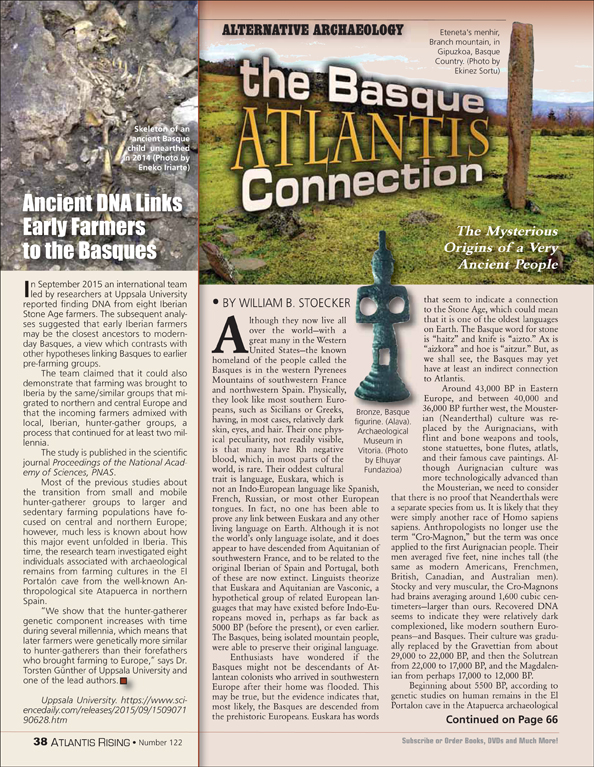
Although they now live all over the world—with a great many in the Western United States—the known homeland of the…
You must be logged in to view this content.
The emergence of Energy Psychology (EP), including methods such as EFT (Emotional Freedom Techniques), TFT (Thought Field Therapy), PSYCH-K, and Matrix Reimprinting (to name a few) means that, for millions of people suffering from phobias, self-limiting beliefs, and even major emotional and/or physical traumas, expensive and often ineffective traditional therapies can be eschewed in favor of more affordable (or free)—and very often spectacularly successful—“new” methods that can achieve better results in a fraction of the time.
Energy psychology describes a collection of novel psychological interventions that “balance, restore, and enhance human functioning by stimulating the human subtle energy system,” which includes the acupuncture meridian system, chakras, and nadis. “These techniques… have been observed to catalyze rapid, dramatic, and lasting changes in feelings, beliefs, mental states, and behaviors,” as well as physiology and biochemistry. Thus, EP techniques involve “stimulating energy, whether by tapping, touching, or intention” (J. Freedom, “Energy Psychology: The Future of Therapy?”, Noetic Now, August 2011, http://noetic.org/noetic/issue-thirteen-august/energy-psychology/). EP therefore traces its roots not just to Chinese medicine and qi gong but also to the work of modern pioneers, such as chiropractor and founder of applied kinesiology George Goodheart, Australian psychiatrist John Diamond, and Thought Field Therapy founder Roger Callahan.
In short, EP modalities use both psychological interventions and energetic interventions together (EFT is a Form of Energy Psychology, http://www.setfree.co.nz/about-eft/eft-is-a-form-of-energy-psychology/). The result is something far greater than the sum of the parts: EP techniques, claim adherents, offer a uniquely powerful way to address and heal the subconscious mind from which around 95% of our thoughts and behavior originate. Cognitive neuroscientists estimate that our conscious minds contribute roughly 5% of our cognitive activity, meaning that the vast majority of our actions, emotions, decisions, and behaviors result from the unobserved workings of the subconscious (B. Lipton & S. Bhaerman, Spontaneous Evolution, Hay House, 2011, 33). Consider the sobering fact that during the first six years of life, most of our beliefs about ourselves and the world are formed and adopted into our subconscious quite passively, according to what we experience and observe—all before we have developed critical thinking faculties that would allow us to reject self-defeating notions before we adopt them as beliefs that then shape our thoughts and actions, and the kind of lives we lead (Spontaneous Evolution).
EFT and TFT
For psychological issues rooted deeply in intense emotion (more so than at the mental level), EFT, TFT, and Matrix Reimprinting (which developed from EFT), the evidence suggests may be more effective more of the time than virtually any other therapies. Scientific research combined with voluminous anecdotal reporting suggests monumental potential for future applications of EFT and TFT.
Developed in the 1990s by Gary Craig, EFT arose from TFT (Thought Field Therapy), which was developed by Dr. Roger Callahan and articulated and popularized by him through the 1970s and 1980s. What Callahan did was make the serendipitous discovery that tapping on a sequence of acupoints (acupuncture points) on a female client with an extreme phobia of water, produced profound relief and resolution—far beyond what an educated Western medical professional could ever have hoped for, based on their knowledge at that time (and for those stuck in the mainstream allopathic mindset, this largely still holds true).
Callahan’s client could not even look at water without acquiring a splitting headache, and because the approach of systematic desensitization was making such little in-road into the problem, Callahan changed tack and tried tapping on acupoints instead (a method from applied kinesiology). After only one minute of this, the woman knew immediately—without Callahan even needing to test her—that her fear was gone. (The Future of Therapy?)
From this initial epiphany, Callahan went on to develop an elaborate and complicated system of specialized algorithms—each custom designed to treat a particular problem; and to this day he insists that the body’s energy fields respond differently to different tapping sequences (which is probably true), and thus, for maximum results, each malady requires its own condition-specific tapping algorithm. Callahan has a list of professional advocates with impressive credentials who rave about the wonders they have seen TFT work. (See the Frequently Asked Questions about Thought Field Therapy (TFT) at: www.RogerCallahan.com/faq.php.)
The story gets more interesting, however, when Gary Craig enters the picture. Craig was one of Callahan’s students many years ago, at a time when Callahan was charging individuals a whopping $100,000 each to learn TFT. Craig—having paid the money and learned under Callahan—simply asked himself whether such amazing results could be obtained through simpler, easier-to-apply, and essentially random tapping sequences (rather than specialized algorithms). So Craig tested his hypothesis out, and the results he got were impressive. No matter the order in which Craig stimulated the acupoints on his subjects, significant therapeutic benefits were obtained. Craig decided that the world needed this information, and he began giving his knowledge and methods away to the public for free (This is the essence of the story as relayed by Australian EFT Master Peter Graham to a group of us in 2011.) Thus, EFT was born into the world—condition-specific tapping algorithms and hefty tuition fees be damned!
EFT’s bread and butter involves repeatedly tapping a selection of acupoints while tuning in to the feelings (and even the colors and textures) sensed in the body that are stemming from a particular memory, unpleasant current emotion, or old trauma. The idea is to decrease the intensity of the sensation down as close to zero (on a scale of zero to ten) as possible, zero being complete resolution (no emotional charge) and ten being maximum intensity. (This “subjective units of disturbance/distress” [SUDs] self-reporting scale was developed by psychologist Joseph Wolpe in 1958.) In short, energy psychology techniques such as EFT and TFT systematize the use of acupoints into a structured stress and trauma reduction routine—and unlike pharmaceuticals, they actually heal.
In 2003 a scientific study by the Australian psychologist Dr. Steven Wells, et al., detailed phenomenal success in using EFT to treat clinically diagnosed phobias of small animals such as snakes, spiders, bats, and mice. The pre-EFT intensity of the phobias were measured by taking into account several factors: increases in pulse rate while contemplating the feared object; the number of steps they could walk towards the feared creature; written stress questionnaires. Subjects were then briefed for half an hour on the treatment method, including receiving a brief EFT session. The subjects then had their phobias tested again. On every measure, fear had dropped dramatically, and some subjects could even walk right up to the animals that had normally triggered phobic reactions.
One woman with a previously crippling fear of cockroaches followed her 30-minute EFT session by immediately walking into the nearby room harboring a cockroach in a jar, picking it up and examining it closely. She found that her newfound confidence and self-esteem permeated all areas of her life. Six months later, a follow-up study showed that subjects still had much reduced phobic reactions to the objects of their fear. This study was later replicated by Harvey Baker’s research team of New York’s Queen’s College (D. Church, The Genie in Your Genes, Energy Psychology Press, 2009, 223–5).
Numerous studies in energy psychology have repeatedly shown its potency, evincing the ability not just to reduce or eliminate phobic responses but pain and anxiety, too.
Another study involved taking brain scans of subjects with generalized anxiety disorder. Anxiety and depression, for instance, have specific electronic signatures. EEG readings of participants’ brains taken through twelve energy psychology sessions show enhanced wave-frequency ratios and less dysfunction, especially in the frontal lobes—which are involved in higher mental functions, including humor appreciation, personality, self-awareness, and emotions in general (P. Shammi and D. Stuss, “Humour Appreciation: a role of the right frontal lobe”, http://brain.oxfordjournals.org/content/122/4/657.full, 1998). Subjects’ brains which were treated simply with antidepressants showed no such improvements; and the group treated with the more widely known cognitive behaviour therapy (CBT) required more sessions to achieve similar results to the EFT group, and the effects were not as durable, as revealed by a one-year follow-up (The Genie in Your Genes).
In further support of these findings, in February 2013, Dr Dawson Church, et al. reported the results of a study of 59 U.S. veterans with clinically diagnosed (severe) posttraumatic stress disorder (PTSD). These were published in the respected Journal of Nervous and Mental Disease. In this randomized controlled study (the “gold standard” of scientific research), 30 veterans in the EFT group received six separate one-hour-long EFT sessions (concurrent with standard care), while the control group (n = 29) received no EFT treatment. Measures of the breadth and severity of psychological distress for veterans in the EFT group plum- meted. After six sessions, fully 90% from the EFT group no longer qualified as having PTSD. In contrast, a month after the initial tests, only 4% of the control group no longer registered as having PTSD. After the wait period, the control group then also received EFT. Again the results were stunning, with huge drops in clinical symptoms.
For the 49 subjects (of the original overall sample of 59 participating veterans) who actually did receive EFT treatment in the end, fully 80% of them remained free of manifest PTSD symptoms (they were “subclinical”) six months later. Church reported: “This is the best result for PTSD ever obtained in a clinical trial for any therapy” (Church, et al., “Psychological Trauma Symptom Improvement in Veterans Using Emotional Freedom Techniques: A Randomized Controlled Trial”, Journal of Nervous & Mental Disease: February 2013, Volume 201, Issue 2, p. 153–160). To put this in perspective, many traditional therapists wrongly believe that PTSD is incurable.
In fact, EFT’s more complicated “big brother”—TFT—has achieved results at least as remarkable. A volunteer team of EP practitioners who traveled to Kosovo to treat survivors of the Serbian massacre using TFT was able to report that remaining survivors experienced complete recovery from “the post-traumatic emotional effects of 247 of the 249 memories of torture, rape, and witnessing the massacre of loved ones” that were treated. Kosovo’s surgeon general wrote in glowing terms of the achievements of the international EP team, lauding their efforts. Additionally, in formal follow-ups at an average of five months later, all those treated remained free of relapse (The Genie in Your Genes, 312–313).
Treatments by international teams working with post-disaster victims in Kosovo, Rwanda, the Congo, and South Africa tallied the treatment outcomes of 337 individuals. Treatment focused on reducing severe emotional reactions evoked by specific traumatic memories [such as those in the above Kosovo study]. Following the energy psychology interventions, 334 of the 337 individuals were able to bring to mind their most traumatic memories from the disaster and report no physiological/affective arousal. Twenty-two traumatized Hurricane Katrina caregivers… reported a reduction [on the SUDs scale] from a mean of 8.14 to 0.76 on 51 [emotional] problem areas [after one 15-minute EP session]…(EFT Is a Form of Energy Psychology, http://www.setfree.co.nz/about-eft/eft-is-a-form-of-energy-psychology/)
Along with drastic improvements in emotional maladies, it is true that many physical symptoms also spontaneously improve or vanish through the use of EP. Darkfield analysis by one doctor of a patient’s live red blood cells showed significantly decreased clumping of red blood cells immediately following the use of EFT, as compared with the obvious clumping seen beforehand. In the accompanying images, red blood cell clumping is problematic because it means less surface area for oxygen from the lungs to bond to the cell surface for transport around the body. Hence, more spacing between red cells is ideal for maximizing oxygen uptake. The bottom image was taken a mere 12 minutes after the initial image. Only 12 minutes and two rounds of EFT with the conscious intent of producing an even cell distribution were required to produce this effect. In contrast, if red cell clumping can be reversed at all using mainstream, allopathic methods, it normally takes months (The Genie in Your Genes, 312–313). On top of that, the conventional medical mindset denies that intention can produce such striking effects on typically unconscious physiological processes, thus further disempowering millions of people around the world.
The list of physical complaints and symptoms that have reportedly been remedied or reduced with EFT is virtually endless: PMS, lupus, failing eyesight, headaches, allergies, carpal tunnel syndrome, cancer, MS—you name it (www.emofree.com). At the 13th International Energy Psychology Conference held in Reston, Viriginia in 2011, it was reported that then-current research was additionally demonstrating the effectiveness of EP on “test anxiety, food cravings and weight loss maintenance, public speaking anxiety, optimal test performance, and psychosomatic conditions such as psoriasis, tinnitus, and fibromyalgia.”
The day when EFT gains widespread mainstream appeal and acceptance is edging ever closer. In November 2012, the American Psychological Association (APA) accepted and published a summation of validated studies by ACEP showing the effectiveness of EFT—a reversal of the position held by the APA for the previous 13 years, in which it refused to acknowledge EFT’s effectiveness (P. Graham, Tap 4 Peace Newsletter, February 2013). Matrix Reimprinting (MR) is an outgrowth of EFT and was developed by EFT Master Karl Dawson. It, too, is producing some extraordinary healing results in diverse areas. The basic premise of MR is that we all exist in a unified field (the “Matrix”) and that when our psyche is traumatized, part of it dissociates/splits off and lingers in the Matrix, essentially remaining as a version of oneself that is frozen in time, never growing older. This entity is an “ECHO” (Energy Consciousness Hologram). (Shamanism agrees that this splitting/dissociative process occurs under trauma and seeks to resolve the problem through “soul retrieval.” Spirit Release Therapy, on the other hand, uses hypnosis to locate dissociated parts of the psyche and reintegrate them.)
In an editorial in Energy Psychology Journal, Church further elaborates on the potential socioeconomic benefits of a wider employment of EP practices, stating that a projection of results from multiple studies into depression, anxiety, pain, and PTSD, “suggests that [America] would save at least $65 billion annually by adopting EP interventions in primary care.”
EP practices have a habit of working where nothing else will—and that is, in fact, the unofficial motto for EFT. Profit-driven pharmaceutical companies—whose business models are geared towards perpetual disease management—stand to lose a lot of business in the long run as we embrace EP, and the benefit to society from healing millions of the “walking wounded” around the world will be incalculable. Health care costs will dive, and billions of dollars will be saved and redirected elsewhere; and that’s just the beginning. The incidence of otherwise inevitable diseases that could be nipped in the bud well in advance of the advent of physical symptoms using EP is huge. Disease-induced suffering can be slashed, and the collective quality of life quotient increased significantly.
Copyright 2012 and 2017, Brendan D. Murphy, co-founder of Global Freedom Movement. Murphy is a leading Australian researcher, thinker, and public speaker, as well as advocate and facilitator of accelerated, conscious evolution through DNA activation. He is author of The Grand Illusion: A Synthesis of Science and Spirituality, Vol. 1, available at www.BrendanMurphy.com.
Alternative Science
March/April2017 – #122
“The stars we are given. The constellations we make. The stars exist in the cosmos, but constellations are the imaginary lines we draw between them, the reading we give the sky, the stories we tell. —Rebecca Solnit
Lascaux Cave, Grotte de Lascaux, is in the Vezere River valley in the Dordogne region of southwestern France. The cave is situated in an area rich in earlier prehistoric sites—caves, rock shelters, and settlements. The discovery of the cave paintings at Lascaux was first made public in 1880 and led to bitter controversy between experts, which continued into the early twentieth century. Many “experts” did not believe that prehistoric humans had the intellectual capacity to produce any kind of artistic expression, let alone the magnificent art on the cave walls. Acknowledgment of the authenticity of the paintings finally came in 1902 and changed forever the perception of prehistoric humans. The Lascaux paintings are dated to 17,000 years ago and have been called “the Sistine Chapel of Paleolithic Art.”
There are more than 350 cave-art sites in France and Spain alone that were occupied at various times over the 25,000 years preceding the end of the last ice age, about 12,000 years ago. Lascaux in France and Altamira in Spain are the most famous. Until recently, the earliest European Paleolithic cave art dates from around 32,000 years ago, at Chauvet in France. However, new research published in June 2012, in Science, reveals that hand stencils and disks, made by blowing paint onto the wall in El Castillo cave in Northern Spain, have been dated to at least 40,800 years, making them the oldest-known cave art in Europe. A large, club-shaped symbol in the famous polychrome chamber at Altamira was found to be at least 35,600 years old, indicating that painting started there 10,000 years earlier than previously thought, and that the cave was revisited and painted a number of times over a period spanning more than 20,000 years.
Four young boys exploring Lascaux Hill found the Lascaux Caves in 1940. The cave walls are decorated with more than 1,500 stunning images, spanning a distance of 850 feet (250 meters). Lascaux has long been closed to the public in order to protect the priceless prehistoric artwork, but December of 2016 marked the unveiling of a $94 million full-scale replica. Called Lascaux 4, the project has completely reconstructed one of the most significant archaeological discoveries of the twentieth century. Simon Coencas, now 89, is the last surviving member of the original explorers. He was a special guest at the unveiling of the new replica.
Lascaux has three long and narrow subterranean galleries in the form of a letter ‘K,’ including what have become known as the Axial Gallery, the Hall of the Bulls, the Chamber of Felines, the Nave, the Apse, and the Shaft. Numerous monochrome and polychrome paintings and engravings cover most parts of the cave. Images include horses, aurochs (ancestors of modern cattle), bison, oxen, stags, ibex, felines, woolly rhinoceros, birds, bears, an anthropoid, and a chimera. There are some possible abstract representations of plants, symbols, geometric figures, series and sets of dots. Carbon-14 dates from charcoal used sparingly for painting, pollen analysis, and stylistic evaluations suggest that the majority of the rock pictures are associated with what is called the Lower Magdalenian culture from 17,000–15,000 BP. Magdalenians are considered Cro-Magnon and were known as reindeer hunters.
Some researchers have suggested that the Lascaux paintings are sympathetic magic, relating only to the hunt. Copying the animals onto the cave walls created a place to prepare, understand, and follow the animals during their seasonal migration. However, the idea that paintings at Lascaux represent stars or constellations is not new. In the 1990s Frank Edge, who taught mathematics and cosmology at Mitchell Community College in North Carolina, saw the Hall of the Bulls as a map of the summer sky. He explored his ideas in a research paper titled Aurochs in the Sky. The key to his vision was the seven dots painted above the shoulder of one of the bulls (circled in red above). Edge saw this as the Pleiades star cluster above Taurus, the Bull. The Pleiades, because of their position on the ecliptic, have drawn the attention of many cultures. The auroch is the ancestor of modern cattle, suggesting that this animal was an earlier depiction of what is now the constellation Taurus, the Bull. If true, this places the origin and identity of Taurus at least 10,000 years earlier than is currently believed.
French researcher Dr. Chantal Jegues-Wolkiewiez has been working on this for a decade. She affirms that there was a long tradition of sky watching among the Cro-Magnon people of Europe during the period from 30,000–10,000 BCE. Dr. Jegues-Wolkiewiez visited 130 caves in France over a seven-year period to identify solar alignments. She found orientations to sunset during solstices in 122 of the sites. She believes the famous paintings in the caves at Lascaux record the constellations of a prehistoric zodiac, which includes major stars as wells as solstice points. She examined alignments using modern astronomy software. Models were made of the western map of each constellation and then the orientation of the paintings was measured according to an astronomical compass. She was able to determine that summer solstice sunsets penetrated the caves and illuminated certain paintings. Her work is based on identification of dots and tracings superimposed on the paintings of bulls, horses, and aurochs on the cave walls. These appear to correspond to the constellation of Taurus, the asterism of the Pleiades, and the stars Aldebaran and Antares.
Dr. Michael Rappenglueck, from the University of Munich, has arrived at similar conclusions. He believes the paintings of Lascaux represent not only constellations but also the cosmology of Paleolithic shamans. He suggests that an enigmatic painting of a male figure, a bull, and a bird on a pole represent the stars Vega, Deneb, and Altair, all of which supports the earlier work of Frank Edge. These bright stars form what is now called the Summer Triangle. Rappenglueck says these three stars would have been prominent in early spring skies 17,000 years ago.
Rappenglueck also identified what might be the earliest known depiction of Orion that was carved into the tusk of a mammoth and has been dated to 32,000 years ago. He also identified what could be the oldest lunar calendar on the walls of Lascaux, showing symbolic paintings dating back 15,000 years. The German researcher says groups of dots and squares painted among representations of bulls, antelopes, and horses depict the 29-day cycle of the Moon.
A number of Lascaux pictures have possible astronomical significance. These include the ‘e’ and ‘fronting ibex’ in the Axial Gallery and the ‘crossed bison’ in the Chamber of Felines; the stag-and-horse motif and related dots in the Axial Gallery and the five ‘swimming stags’ in the Nave; the aurochs in the Hall of the Bulls with its clusters of dots; and two pictograph panels in the Shaft. The majority of the animals depicted at Lascaux show seasonal characteristics that could have functioned as calendars. For example, deer are represented in their rutting season at the start of autumn, horses at the time of mating and foaling in late winter/early spring, and ibexes at the time when they congregated during late summer/early autumn in same-sex herds. Paintings of animals accurately represent their seasonal coat colors, and indications of particular seasons are sometimes enhanced by drawings of stylized plants. The ‘Chinese horse’ in the Axial Gallery is shown in its summer fur, pregnant, and surrounded by stylized branches, illustrating the time of foaling around summer solstice.
Some abstract designs associated with seasonal animals may be like almanacs. It’s been argued that a set of 13 dots and another of 26 that appear beneath a roaring stag and a pregnant horse (representing autumn and spring, respectively) in the Axial Gallery represent the 13- and 26-week intervals from summer solstice to autumn equinox and then to the spring equinox—each spot counting seven days. Two pictograph panels in the Shaft have been interpreted as the sky panorama that would have been seen by the Magdalenian people from the top of Lascaux Hill around midnight at the time of summer solstice circa 14,500 BCE.
Herodotus, a Greek historian from the fifth century BCE, claimed he received his material from Egyptian priests who, in turn, claimed that their Egyptian history was at least 14,000 years old. Charles Berlitz, in his book, Atlantis, quoted Diodorus Siculus, writing in the first century CE, who said, “The Egyptians were strangers who, in remote times, settled on the banks of the Nile, bringing with them the civilization from their mother country, the art of writing and a polished language. They had come from the direction of the setting Sun and were the most ancient of men.” Authors Graham Hancock, Dr. Carmen Boulter, and others believe that what we call “Atlantis” was not merely an island nation in the Atlantic Ocean but was instead a number of sophisticated cultures around the globe that were destroyed by a series of ancient cataclysms.
According to the famous psychic Edgar Cayce, Atlantis was destroyed by volcanic and earthquake-like explosions on three distinct and widely separated occasions. Cayce said in trance sessions that each of these destructions lasted over a period of months, or years, not just in a single day and night. The first of these disasters appear to have taken place about 50,700 BCE and the second about 28,000 BCE. The third and last destruction occurred around 10,000 BCE, which is the most familiar timeframe in Atlantis lore. If there were multiple destructions over a 40,000-year time span, it makes sense that colonists and survivors would go to great lengths to preserve and protect knowledge that was critical to their survival, as they may have done at Lascaux and elsewhere.
The site of Gobekli Tepe in Turkey, which upended the conventional view of “hunter gatherers,” has been dated at about 11,700 years ago. This date corresponds with eerie precision to the end of what is called the Younger Dryas (named for an alpine tundra wildflower that is an “indicator genus”), a geological period from circa 12,900–11,700 BCE. The Younger Dryas saw a sharp decline in temperature over most of the northern hemisphere at the end of the Pleistocene epoch, which is often colloquially referred to as the Ice Age. This geological epoch lasted from about 2,588,000 to 11,700 years ago, spanning the world’s most recent period of repeated glaciations. The end of the Pleistocene also corresponds with the end of the so-called Paleolithic Age. The change was relatively sudden, taking place in decades, and resulted in the extinction of most of the large mammoths and the rapid demise of the North American Clovis culture. The Younger Dryas ice age lasted for about 1,200 years before the climate warmed again.
Could at least parts of the zodiac, which we think originated in Babylon, be instead a legacy of Atlantis? It is possible to imagine, based on growing evidence of the antiquity and sophistication of Cro-Magnon and Neanderthal cultures, that the spread of civilization may have come over thousands of years from Atlantis and may have affected ancient cultures in Europe and Asia as far back as 40,000 years ago?
It seems natural that before artificial light, the night sky was a canvas upon which the shining dots of light were connected into star pictures, and tales were told to mark the passage of the seasons. What ancient stories might have been shared, by fires and inside caves, to bring meaning to a universe that must have seemed remote, unpredictable, and sometimes dangerous? A change in the sky could portend disaster. It is both humbling and inspiring to imagine that some of the paintings on cave walls such as those at Lascaux, like the Bull of Heaven, have survived as art and symbolism for many thousands of years. We have much in common with our ancient forebears. We still gaze at the stars and study the constellations, reflecting on their mythic stories and decoding their symbolic meaning.
Visit: www.JulieLoar.com
Classic Astrology
March/April2017 – #122
Over a thousand years ago, while European civilization stagnated during the Dark Ages, did a race of advanced extraterrestrials in a distant part of our galaxy build a huge energy-capturing mega structure around their sun? This may be the story behind an anomalous star known to astronomers as KIC 8462852 (KIC = Kepler Input Catalog of the Kepler space observatory). Informally dubbed “Tabby’s Star,” “Boyajian’s Star” (Tabetha S. Boyajian spearheaded initial analyses of the star), and “WTF Star” (after the title of the paper authored by Boyajian, et al., 2015 [revised 2016], “Planet Hunters X. KIC 8462852 – Where’s the Flux?”, arXiv), this mysterious object continues to elude a satisfactory and wholly convincing “natural” explanation.
Launched in March 2009, the Kepler space observatory was designed to survey the Milky Way searching for exoplanets (planets orbiting around stars other than our Sun). Despite some setbacks, Kepler has been extraordinarily successful in its mission; thousands of exoplanets have been discovered. Extrapolating from the data thus far, possibly our Milky Way Galaxy contains tens of billions of Earth-size planets orbiting stars within habitable zones.
The primary method of detecting such exoplanets is by the periodic dimming of a star as an orbiting exoplanet crosses in front, blocking light. Kepler can continuously monitor approximately 150,000 stars. This brings us to the strangeness of KIC 8462852.
KIC 8462852 has dimmed and then brightened again on numerous occasions, but not in the systematic way that a star typically dims due to an orbiting planet or planets. The dimming, the dips in brightness detected coming from KIC 8462852, occur in a manner that appears random. For instance, after hundreds of days of relative stability, the star dimmed by 15% over several days. Then, after having come back to approximately its original brightness, about 725 or so days later, the star suddenly dimmed by 22% over just a few days, subsequently returning to its previous brightness. Three weeks later, it dimmed by 3% or so. After returning to its previous brightness, not quite a month later it dimmed by 8% for a few days, only to return to its previous brightness once again. To put these levels of dimming into perspective, if our Sun were being observed by an observatory on a distant planet, as Jupiter crossed, the dimming effect would only amount to about 1%.
“Citizen scientists” participating in the “Planet Hunters” project discovered KIC 8462852 collectively. These volunteers sifted through data from Kepler looking for patterns potentially indicative of planets orbiting stars, as well as other interesting or unusual phenomena. Tabetha Boyajian, then a postdoc researcher at Yale University (currently on the faculty of Louisiana State University) was overseeing the Planet Hunters when various participants noticed the strangeness of KIC 8462852. Boyajian became the lead author (along with 48 co-authors) on the initial paper that brought KIC 8462852 to the attention of the general astronomical community and to the world at large.
Other than its odd behavior, KIC 8462852 is not a remarkable star; in fact, it is a rather ordinary F-type main sequence star (our Sun is a G-type main sequence star; stars are classified based on factors such as surface temperature—F-type stars are slightly hotter than G-type stars). Located in the region of the constellation Cygnus at a distance of around 1200 to 1500 light-years from us (estimates vary), KIC 8462852 has an apparent magnitude of about 11 or 12 (far too dim to be seen with the naked eye), an estimated radius of 1.6 times that of our Sun and a mass of about 1.4 times that of our Sun.
Once brought to the awareness of the scientific community, other astronomers began studying KIC 8462852 from different perspectives. Although KIC 8462852 cannot be seen with the naked eye, it has been viewed through telescopes, and photographed, since the late nineteenth century. Analyzing old records and photographic plates, Bradley Schaefer (Louisiana State University) determined that it had dimmed by about 20% in overall brightness during the century from 1890 to 1989. But could this incredibly strange dimming be nothing more than an artifact of the diverse instrumentation used to photograph the star? Despite Schaefer’s careful work, there were doubts. However, using Kepler space observatory data collected from 2009 to 2013, Benjamin Montet (California Institute of Technology and the Harvard-Smithsonian Center for Astrophysics) and Joshua Simon (Observatories of the Carnegie Institution of Washington) found that KIC 8462852 had dimmed by about 3% overall during this period, with 2% to 2.5% of the dimming occurring during an approximately 200-day stretch. This bolsters Schaefer’s conclusion that the star dimmed by about 20% overall in a century.
There seems to be no doubt that there is indeed something very mysterious about KIC 8462852. What could explain these strange observations? A number of hypotheses have been put forward (see: J. T. Wright and S. Sigurdsson, 2016, “Families of Plausible Solutions to the Puzzle of Boyajian’s Star,” arXiv), but none of them are completely convincing or satisfying—at least not to everyone!
One possibility suggested to explain the strangeness of KIC 8462852 is that there are dust clouds or dense regions in the interstellar medium, which occasionally block and obscure KIC 8462852 from our sight. However, other stars in the vicinity of KIC 8462852 (as seen along our line of sight from Earth) do not show the same strange behavior. Is a hypothetical dust cloud so small that its effects only extend to KIC 8462852? This seems highly unlikely.
Another possibility is that some sort of large disk-shaped “dark object” (one that blocks and/or absorbs light) with ring structures around it is associated with KIC 8462852, and as they orbit around one another the light we see from KIC 8462852 dims intermittently. Such an object might be a black hole encircled by rings of dark matter; perhaps KIC 8462852 is part of a binary system consisting of a typical star and a black hole. However, if a star and a dark object formed a binary system, one would expect regular patterns in the behaviors observed, not dissimilar to the regularities of planets orbiting a star. Arguing against this hypothesis is both the apparent lack of periodicity in the dimming dips and also the pattern of overall dimming (extending over a century) of KIC 8462852.
Might the strange behavior of KIC 8462852 be due to anomalous internal stellar dynamics? Perhaps it is an unstable star that is going through some sort of weird disequilibrium and decay. If so, this would be very unusual indeed since other than the strange dimming events and decay in brightness overall, KIC 8462852 appears to be a typical F-type star. Or possibly the odd behavior is due to some sort of merger between the star and another object, such as another star or a black hole. But such an event would generally be expected to result in episodes of brightening, not dimming, unless one argues that the dips in brightness reflect the star’s inherent brightness; that is, the star is undergoing sustained periods of brightness, and the “dimming” is just a return to its “background brightness.” But, such an explanation appears to be very contrived and does not easily explain the sudden dips in brightness actually observed.
Or could KIC 8462852 be a star in its infancy that is still coalescing and stabilizing, and its odd dips in brightness are due to its youth? This idea has been proposed, but the actual data (supporting that it is a typical F-type star in “middle age” and lacks material coalescing around it, as expected of a young star) and the area where it is located (far from any “stellar nursery”) argue against this hypothesis. It is also unclear how youthfulness on the part of KIC 8462852 would specifically explain the strange dimming phenomena.
Could some sort of massive collision between planets or planet-like objects, or an exploding planet, have created a debris field that is circling the star, perhaps irregularly, creating the dips in brightness? If such a scenario were true, the fragments, dust, and debris resulting from the collision or explosion should be relatively hot and give off excess energy in the infrared range detectable by space-based telescopes run by NASA. Despite searches, no such excessive infrared emissions have been found associated with KIC 8462852, effectively ruling out the collision and exploding planet hypotheses—unless perhaps the collision or explosion happened a very long time ago, such that the debris is now cold. This leads us to another hypothesis.
In some circles the favored explanation for the strange behavior of KIC 8462852 is that proposed by Boyajian and co-authors in their original paper: that comets or planetesimal fragments either surround the star or are passing by the star. Unlike a massive collision or explosion, comets or planetesimal fragments would be relatively cold and thus not give off excess infrared emissions. However, there are other significant problems with the comet/planetesimal swarm hypothesis. It is difficult to fathom how a comet swarm (or similar cold debris) could be large enough to obscure the star by up to 22%, but for only short periods. The real downfall of the comet theory may be this: how can a comet swarm explain the long-term (recorded in a century worth of data) dimming trend of KIC 8462852? According to most researchers, it cannot; the comet swarm theory is effectively ruled out. So where does this leave us? Perhaps with the most interesting suggestion of all.
The hypothesis that brought KIC 8462852 to the attention of the public is that perhaps the strange behavior could be the result of alien technology. Might KIC 8462852 be evidence of an advanced extraterrestrial civilization? Possibly it is an example of so-called “star lifting,” the massive extraction of matter and/or energy from a star by technologically sophisticated beings. In his 1937 novel, Star Maker, British author and philosopher Olaf Stapledon introduced the concept that an advanced alien civilization, in its quest to utilize ever more energy, could enclose or encapsulate a star with a huge material structure (shell or sphere) in order to capture and utilize energy emitted by the star. Stapledon’s idea was fictional, but in 1960 the English-American physicist and mathematician Freeman Dyson proposed the idea in the prestigious journal Science (3 June 1960). Thus, this concept is now often referred to as a Dyson sphere or some variation on the theme, such as a Dyson ring for a series of objects orbiting along the same path around a star or a Dyson swarm for a large number of independent constructions (perhaps energy collectors and artificial habitats) forming a dense collection around a star. In a follow-up to his initial article, Dyson clarified his thinking: “The form of ‘biosphere’ that I envisaged consists of a loose collection or swarm of objects traveling on independent orbits around the star” (Science, 22 July 1960).
One argument against a Dyson sphere, swarm, or similar structure surrounding KIC 8462852 is that, under certain scenarios, it would be expected to absorb and then reradiate energy and give off a detectable signature that is anomalous relative to known natural phenomena. In his original 1960 paper, Dyson suggested that this should most likely result in an increase in infrared radiation (essentially excessive “waste heat”). As already pointed out, there is no evidence of excessive infrared energy coming from KIC 8462852. However, the basic assumption may be incorrect in this case. The analyses have generally assumed that the aliens would be human-like in terms of their fundamental technologies and use human-like techniques to build their Dyson structures with materials similar to those we might use (metals, ceramics, and so forth) that would be predicted to give off anomalous infrared emissions. However, alien technologies might be of such an advanced nature or efficiency that excessive waste heat is not given off; possibly excess heat would be collected and utilized.
Depending on the nature of the Dyson swarm around a star, it could theoretically give exactly the pattern of dips in brightness observed with KIC 8462852. The problem relative to testing the alien megastructure idea is that we have virtually no way of falsifying such a hypothesis since a theoretical model of an alien megastructure can be created which will fit any number of parameters and datasets. One concept I find particularly interesting, however, is that the long-term dimming of KIC 8462852 may be due to the progressive construction of a Dyson swarm around the star that has obscured ever more light overall from our view. Did our instruments just happen to image this star during the building phase of a Dyson sphere? (Of course, given that KIC 8462852 is over 1000 light-years away, the Dyson swarm may be long complete.)
Another form of star lifting is the actual mining of a star for metals or other elements. As suggested by Eduard Heindl (Furtwangen University in Germany), perhaps aliens are superheating a portion of the star to create a jet that literally lifts material off the star and places it in orbit around the star where it can cool down, with the result that from our perspective, the star will appear to dim periodically and also perhaps over the long term. Or perhaps, as Clément Vidal (Free University of Brussels) has hypothesized, there are stellivore (feeding on stars) civilizations that utilize a small black hole or some other means to extract energy from a star (C. Vidal, 2016, Acta Astronautica, vol. 128). Could this be the explanation for the unusual behavior of KIC 8462852?
Overall, I agree with astronomer Jason T. Wright and his co-authors (Pennsylvania State University) who have written, “We have in KIC 8462[852] a system with all of the hallmarks of a Dyson swarm… Given this object’s qualitative uniqueness, given that even contrived natural explanations appear inadequate, and given predictions that Kepler would be able to detect large alien megastructures via anomalies like these, we feel [it] is the most promising stellar SETI [Search for Extraterrestrial Intelligence] target discovered to date.” (Wright et al. 2015, “The G Search for Extraterrestrial Civilizations with Large Energy Supplies. IV. “The Signatures and Information Content of Transiting Megastructures,” arXiv, p. 9. Material in brackets inserted by R. Schoch.)
Taking up this call, various astronomers have searched for radio signals suggestive of alien technology associated with KIC 8462852. Thus far, they have come up short; however, the truth is that we do not really know what to look for. Alien technology may be unexpectedly different; there is no guarantee aliens would use communications and engineering technologies similar to ours. Given the data from KIC 8462852, I believe we have strong indications that we may have located an advanced alien civilization. I doubt that they are aware of us; 1200 to 1500 years ago (the time it takes for electromagnetic radiation to travel from our solar system to KIC 8462852) we were in the depths of the European Dark Ages. A thousand years from now, will we be building a Dyson swarm around the Sun?
Robert M. Schoch, Honorary Professor at the Nikola Vaptsarov Naval Academy and a full-time faculty member at Boston University, earned his Ph.D. in geology and geophysics at Yale University. Best known for re-dating the Great Sphinx, he is the author of books both technical and popular, including Forgotten Civilization: The Role of Solar Outbursts in Our Past and Future. Website: RobertSchoch.com
Astronomy
March/April2017 – #122
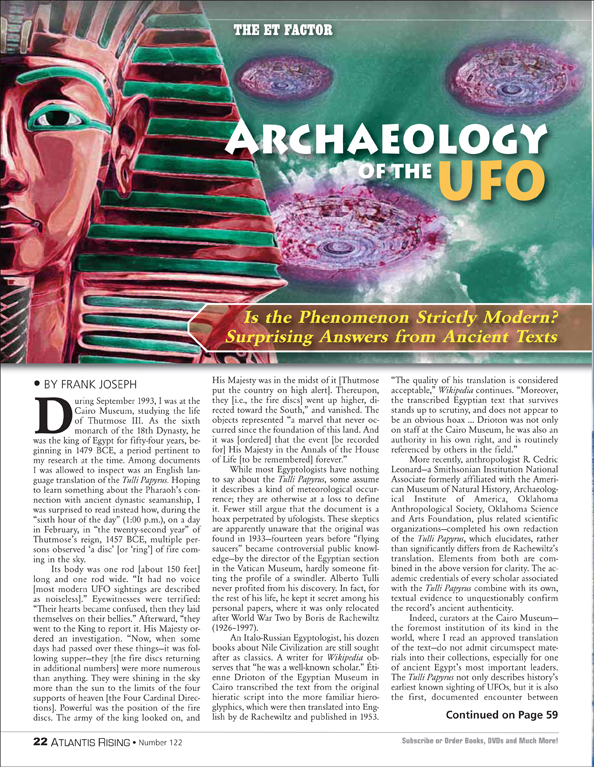
During September 1993, I was at the Cairo Museum, studying the life of Thutmose III. As the sixth monarch of…
You must be logged in to view this content.

It is a certainty of this world that we know how airplanes fly. Simple: It is the curvature of the…
You must be logged in to view this content.


