Posted on

Comeback for Cold Fusion


Major Funding Provided by a US Government Agency

By Rahul Rao, Popular Science
https://www.popsci.com/science/cold-fusion-low-energy-nuclear-reaction/

This image has an empty alt attribute; its file name is ai-free.png

Earlier this year, ARPA-E, a US government agency dedicated to funding advanced energy research, announced a handful of grants for a field it calls “low-energy nuclear reactions,” or LENR. Most scientists likely didn’t take notice of the news. But, for a small group of them, the announcement marked vindication for their specialty: cold fusion.

Cold fusion, better known by its practitioners as LENR, is the science—or, perhaps, the art—of making atomic nuclei merge and, ideally, harnessing the resultant energy. All of this happens without the incredible temperatures, on the scale of millions of degrees, that you need for “traditional” fusion. In a dream world, successful cold fusion could provide us with a boundless supply of clean, easily attainable energy.

Tantalizing as it sounds, for the past 30 years, cold fusion has largely been a forgotten specter of one of science’s most notorious controversies, when a pair of chemists in 1989 claimed to achieve the feat—which no one else could replicate. There is still no generally accepted theory that supports cold fusion; many still doubt that it’s possible at all. But those physicists and engineers who work on LENR believe the new grants are a sign that their field is being taken seriously after decades in the wilderness.

“It got a bad start and a bad reputation,” believes David Nagel, an engineer at George Washington University, “and then, over the intervening years, the evidence has piled up.”

Igniting fusion involves pressing the hearts of atoms together, creating larger nuclei and a fountain of energy. This isn’t easy. The protons inside a nucleus give it a positive charge, and like-charged nuclei electrically repel each other. Physicists must force the atoms to crash together anyway. 

Normally, breaking this limit needs an immense amount of energy, which is why stars, where fusion happens naturally, and Earthbound experiments reach extreme heat. But what if there were another, lower-temperature way?

Scientists had been theorizing such methods since the early 20th century, and they’d found a few tedious, extremely inefficient ways. But in the 1980s, two chemists thought they’d made one method work to great success. 

The duo, Martin Fleischmann and Stanley Pons, had placed the precious metal palladium in a bath of heavy water: a form of H2O whose hydrogen atoms have an extra neutron, a form known as deuterium, commonly used in nuclear science. When Fleischmann and Pons switched on an electrical current through their apparatus and left it running, they began to see abrupt heat spikes, or so they claimed, and particles like neutrons.

Those heat spikes and particles, according to them, could not be explained by any chemical process. What could explain them were the heavy water’s deuterium nuclei fusing, just as they would in a star.
If Fleischmann and Pons were right, fusion could be achievable at room temperature in a relatively basic chemistry lab. If you think that sounds too good to be true, you’re far from alone. When the pair announced their results in 1989, what followed was one of the most spectacular firestorms in the history of modern science. Scientist after scientist tried to recreate their experiment, and no one could reliably replicate their results.

Pons and Fleischmann are remembered as fraudsters. It likely didn’t help that they were chemists trying to make a mark on a field dominated by physicists. Whatever they had seen, “cold fusion” found itself at respectable science’s margins. 

Still, in the shadows, LENR experiments continued. (Some researchers tried variations on Fleischmann and Pons’ themes. Others, especially in Japan, sought LENR as a means of cleaning up nuclear waste by transforming radioactive isotopes into less dangerous ones.) A few experiments showed oddities such as excess heat or alpha particles—anomalies that might best be explained if atomic nuclei were reacting behind the scenes.

“The LENR field has somehow, miraculously, due to the convictions of all these people involved, has stayed alive and has been chugging along for 30 years,” says Jonah Messinger, an analyst at the Breakthrough Institute think tank and a graduate student at MIT.

Fleischmann and Pons’ fatal flaw—that their results could not be replicated—continues to cast a pall over the field. Even some later experiments that seemed to show success could not be replicated. But this does not deter LENR’s current proponents. “Science has a reproducibility problem all the time,” says Florian Metzler, a nuclear scientist at MIT.

In the absence of a large official push, the private sector had provided much of LENR’s backing. In the late 2010s, for instance, Google poured several million dollars into cold fusion research to limited success. But government funding agencies are now starting to pay attention. The ARPA-E program joins European Union projects, HERMES and CleanHME, which both kicked off in 2020. (Messinger and Metzler are members of an MIT team that will receive ARPA-E grant funds.)

By the standards of other energy research funding, none of the grants are particularly eye-watering. The European Union programs and ARPA-E total up to around $10 million each: a pittance compared to the more than $1 billion the US government plans to spend in 2023 on mainstream fusion.
But that money will be used in important ways, its proponents say. The field has two pressing priorities. One is to attract attention with a high-quality research paper that clearly demonstrates an anomaly, ideally published in a reputable journal like Nature or Science. “Then, I think, there will be a big influx of resources and people,” says Metzler.

A second, longer-term goal is to explain how cold fusion might work. The laws of physics, as scientists understand them today, do not have a consensus answer for why cold fusion could happen at all.
Metzler doesn’t see that open question as a problem. “Sometimes people have made these arguments: ‘Oh, cold fusion contradicts established physics,’ or something like that,” he says. But he believes there are many unanswered questions in nuclear physics, especially with larger atoms. “We have an enormous amount of ignorance when it comes to nuclear systems,” he says.

Yet answers would have major benefits, other experts argue. “As long as it’s not understood, a lot of people in the scientific community are put off,” says Nagel. “They’re not willing to pay any attention to it.”

It is, of course, entirely possible that cold fusion is an illusion. If that’s the case, then ARPA-E’s grants may give researchers more proof that nothing is there. But it’s also possible that something is at work behind the scenes.

And, LENR proponents say, the Fleischmann and Pons saga is now fading as younger researchers enter the field with no memory of 1989. Perhaps that will finally be what lets LENR emerge from the pair’s shadow.“If there is a nuclear anomaly that occurs,” says Messinger, “my hope is that the wider physics community is ready to listen.”

AR #80

Big Science on Trial

by Martin Ruggles
Posted on

Fusion Energy Breakthrough

The U.S. Department of Energy (DOE) and DOE’s National Nuclear Security Administration (NNSA) today announced the achievement of fusion ignition at Lawrence Livermore National Laboratory (LLNL) — a major scientific breakthrough decades in the making that will pave the way for advancements in national defense and the future of clean power. On Dec. 5, a team at LLNL’s National Ignition Facility (NIF) conducted the first controlled fusion experiment in history to reach this milestone, also known as scientific energy breakeven, meaning it produced more energy from fusion than the laser energy used to drive it. This first-of-its-kind feat will provide unprecedented capability to support NNSA’s Stockpile Stewardship Program and will provide invaluable insights into the prospects of clean fusion energy, which would be a game-changer for efforts to achieve President Biden’s goal of a net-zero carbon economy.

“This is a landmark achievement for the researchers and staff at the National Ignition Facility who have dedicated their careers to seeing fusion ignition become a reality, and this milestone will undoubtedly spark even more discovery,” said U.S. Secretary of Energy Jennifer M. Granholm. “The Biden-Harris Administration is committed to supporting our world-class scientists — like the team at NIF — whose work will help us solve humanity’s most complex and pressing problems, like providing clean power to combat climate change and maintaining a nuclear deterrent without nuclear testing.”

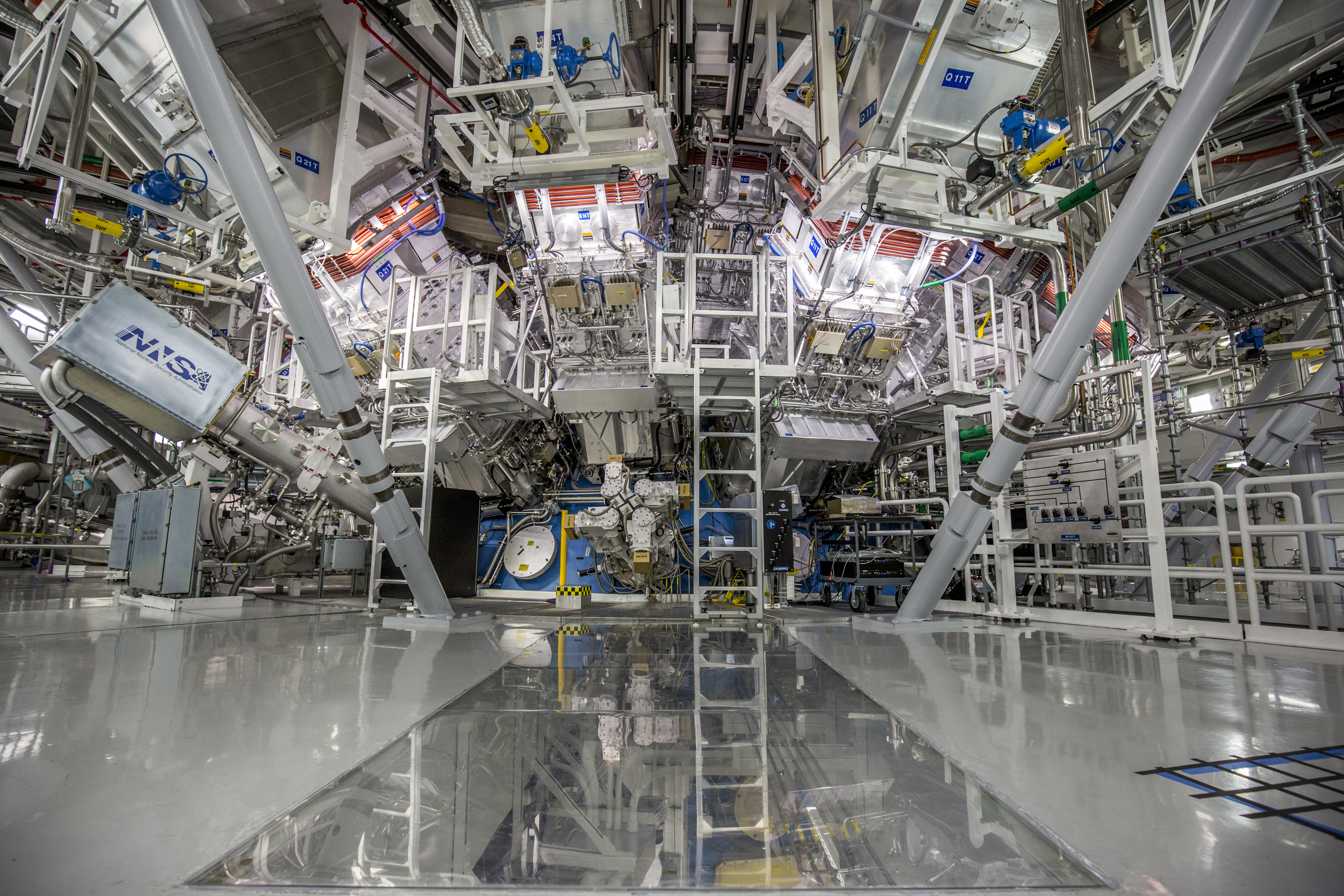
target chamber 121322
The target chamber of LLNL’s National Ignition Facility, where 192 laser beams delivered more than 2 million joules of ultraviolet energy to a tiny fuel pellet to create fusion ignition on Dec. 5, 2022.

“We have had a theoretical understanding of fusion for over a century, but the journey from knowing to doing can be long and arduous. Today’s milestone shows what we can do with perseverance,” said Dr. Arati Prabhakar, the President’s chief adviser for Science and Technology and director of the White House Office of Science and Technology Policy.

“Monday, December 5, 2022, was a historic day in science thanks to the incredible people at Livermore Lab and the National Ignition Facility. In making this breakthrough, they have opened a new chapter in NNSA’s Stockpile Stewardship Program,” NNSA Administrator Jill Hruby said. “I would like to thank the members of Congress who have supported the National Ignition Facility because their belief in the promise of visionary science has been critical for our mission. Our team from around the DOE national laboratories and our international partners have shown us the power of collaboration.”

“The pursuit of fusion ignition in the laboratory is one of the most significant scientific challenges ever tackled by humanity, and achieving it is a triumph of science, engineering, and most of all, people,” LLNL Director Dr. Kim Budil said. “Crossing this threshold is the vision that has driven 60 years of dedicated pursuit — a continual process of learning, building, expanding knowledge and capability, and then finding ways to overcome the new challenges that emerged. These are the problems that the U.S. national laboratories were created to solve.”

“This astonishing scientific advance puts us on the precipice of a future no longer reliant on fossil fuels but instead powered by new clean fusion energy,” U.S. Senate Majority Leader Charles Schumer (NY) said. “I commend Lawrence Livermore National Labs and its partners in our nation’s Inertial Confinement Fusion (ICF) program, including the University of Rochester’s Lab for Laser Energetics in New York, for achieving this breakthrough. Making this future clean energy world a reality will require our physicists, innovative workers and brightest minds at our DOE-funded institutions, including the Rochester Laser Lab, to double down on their cutting-edge work. That’s why I’m also proud to announce today that I’ve helped to secure the highest-ever authorization of over $624 million this year in the National Defense Authorization Act for the ICF program to build on this amazing breakthrough.”

“After more than a decade of scientific and technical innovation, I congratulate the team at Lawrence Livermore National Laboratory and the National Ignition Facility for their historic accomplishment,” said U.S. Senator Dianne Feinstein (CA). “This is an exciting step in fusion and everyone at Lawrence Livermore and NIF should be proud of this milestone achievement.”

“This is an historic, innovative achievement that builds on the contributions of generations of Livermore scientists. Today, our nation stands on their collective shoulders. We still have a long way to go, but this is a critical step and I commend the U.S. Department of Energy and all who contributed toward this promising breakthrough, which could help fuel a brighter clean energy future for the United States and humanity,” said U.S. Senator Jack Reed (RI), the chairman of the Senate Armed Services Committee.

“This monumental scientific breakthrough is a milestone for the future of clean energy,” said U.S. Senator Alex Padilla (CA). “While there is more work ahead to harness the potential of fusion energy, I am proud that California scientists continue to lead the way in developing clean energy technologies. I congratulate the scientists at Lawrence Livermore National Laboratory for their dedication to a clean energy future, and I am committed to ensuring they have all of the tools and funding they need to continue this important work.”

“This is a very big deal. We can celebrate another performance record by the National Ignition Facility. This latest achievement is particularly remarkable because NIF used a less spherically symmetrical target than in the August 2021 experiment,” said U.S. Representative Zoe Lofgren (CA-19). “This significant advancement showcases the future possibilities for the commercialization of fusion energy. Congress and the Administration need to fully fund and properly implement the fusion research provisions in the recent CHIPS and Science Act and likely more. During World War II, we crafted the Manhattan Project for a timely result. The challenges facing the world today are even greater than at that time. We must double down and accelerate the research to explore new pathways for the clean, limitless energy that fusion promises.”

hohlraum 121322
The hohlraum that houses the type of cryogenic target used to achieve ignition on Dec. 5, 2022, at LLNL’s National Ignition Facility.

“I am thrilled that NIF — the United States’ most cutting-edge nuclear research facility — has achieved fusion ignition, potentially providing for a new clean and sustainable energy source in the future. This breakthrough will ensure the safety and reliability of our nuclear stockpile, open new frontiers in science, and enable progress toward new ways to power our homes and offices in future decades,” said U.S. Representative Eric Swalwell (CA-15). “I commend the scientists and researchers for their hard work and dedication that led to this monumental scientific achievement, and I will continue to push for robust funding for NIF to support advancements in fusion research.”

LLNL’s experiment surpassed the fusion threshold by delivering 2.05 megajoules (MJ) of energy to the target, resulting in 3.15 MJ of fusion energy output, demonstrating for the first time a most fundamental science basis for inertial fusion energy (IFE). Many advanced science and technology developments are still needed to achieve simple, affordable IFE to power homes and businesses, and DOE is currently restarting a broad-based, coordinated IFE program in the United States. Combined with private-sector investment, there is a lot of momentum to drive rapid progress toward fusion commercialization.

Fusion is the process by which two light nuclei combine to form a single heavier nucleus, releasing a large amount of energy. In the 1960s, a group of pioneering scientists at LLNL hypothesized that lasers could be used to induce fusion in a laboratory setting. Led by physicist John Nuckolls, who later served as LLNL director from 1988 to 1994, this revolutionary idea became inertial confinement fusion, kicking off more than 60 years of research and development in lasers, optics, diagnostics, target fabrication, computer modeling and simulation and experimental design.

To pursue this concept, LLNL built a series of increasingly powerful laser systems, leading to the creation of NIF, the world’s largest and most energetic laser system. NIF — located at LLNL in Livermore, California — is the size of a sports stadium and uses powerful laser beams to create temperatures and pressures like those in the cores of stars and giant planets, and inside exploding nuclear weapons.

X-rays 121322
To create fusion ignition, the National Ignition Facility’s laser energy is converted into X-rays inside the hohlraum, which then compress a fuel capsule until it implodes, creating a high temperature, high pressure plasma.

Achieving ignition was made possible by dedication from LLNL employees as well as countless collaborators at DOE’s Los Alamos National Laboratory, Sandia National Laboratories and Nevada National Security Site; General Atomics; academic institutions, including the University of Rochester’s Laboratory for Laser Energetics, the Massachusetts Institute of Technology, the University of California, Berkeley, and Princeton University; international partners, including the United Kingdom’s Atomic Weapons Establishment and the French Alternative Energies and Atomic Energy Commission; and stakeholders at DOE and NNSA and in Congress.

AR #64

Power from the Nightside

by Susan Martinez

Posted on

Harnessing Entanglement

For the first time, scientists have entangled atoms for use as networked quantum sensors, specifically, atomic clocks and accelerometers.

The research team’s experimental setup yielded ultraprecise measurements of time and acceleration. Compared to a similar setup that does not draw on quantum entanglement, their time measurements were 3.5 times more precise, and acceleration measurements exhibited 1.2 times greater precision.

The result, published in Nature, is partially supported by Q-NEXT, a U.S. Department of Energy (DOE) National Quantum Information Science Research Center led by DOE’s Argonne National Laboratory. The research was conducted by scientists currently working at Stanford University, Cornell University and DOE’s Brookhaven National Laboratory.

“The impact of using entanglement in this configuration was that it produced better sensor network performance than would have been available if quantum entanglement were not used as a resource,” said Mark Kasevich, lead author of the paper, a member of Q-NEXT, the William R. Kenan, Jr. professor in the Stanford School of Humanities and Sciences and professor of physics and of applied physics. “For atomic clocks and accelerometers, ours is a pioneering demonstration.”

Greater sensitivity in atomic clocks and accelerometers would lead to more precise timekeeping and navigation systems, such as those used in global positioning systems, in defense and in broadcast communications. Ultraprecise clocks are also used in finance and trading.

“GPS tells me where I am to about a meter right now,” Kasevich said. “But what if I wanted to know where I was to within 10 centimeters? That’s what the impact of better clocks would be.”

One can mark the passage of time by counting the number of pulses in an electromagnetic wave, just as you would count the ticks of a clock. If you know that a particular wave pulses 6 billion times per second, you know that, once you count 6 billion crests of the wave, one second has passed. So knowing the exact frequency of a microwave gives one a precise way to track time.

https://www.anl.gov/article/the-entanglement-advantage

AR #80

Entangled Minds

by Patrick Marsolek

Posted on

Solar Energy Harvesting Discovery

By Laurie Fickman

The great inventor Thomas Edison once said, “So long as the sun shines, man will be able to develop power in abundance.” 

His wasn’t the first great mind to marvel at the notion of harnessing the power of the sun; for centuries inventors have been pondering and perfecting the way to harvest solar energy.  


They’ve done an amazing job with photovoltaic cells which convert sunlight directly into energy. And still, with all the research, history and science behind it, there are limits to how much solar power can be harvested and used – as its generation is restricted only to the daytime.  


A University of Houston professor is continuing the historic quest, reporting on a new type of solar energy harvesting system that breaks the efficiency record of all existing technologies. And no less important, it clears the way to use solar power 24/7. 


“With our architecture, the solar energy harvesting efficiency can be improved to the thermodynamic limit,” reports Bo Zhao, Kalsi Assistant Professor of mechanical engineering and his doctoral student Sina Jafari Ghalekohneh in the journal Physical Review Applied. The thermodynamic limit is the absolute maximum theoretically possible conversion efficiency of sunlight into electricity. 


Finding more efficient ways to harness solar energy is critical to transitioning to a carbon-free electric grid. According to a recent study by the U.S. Department of Energy Solar Energy Technologies Office and the National Renewable Energy Laboratory, solar could account for as much as 40% of the nation’s electricity supply by 2035 and 45% by 2050, pending aggressive cost reductions, supportive policies and large-scale electrification.  
How Does it Work? 


Traditional solar thermophotovoltaics (STPV) rely on an intermediate layer to tailor sunlight for better efficiency. The front side of the intermediate layer (the side facing the sun) is designed to absorb all photons coming from the sun. In this way, solar energy is converted to thermal energy of the intermediate layer and elevates the temperature of the intermediate layer.  


But the thermodynamic efficiency limit of STPVs, which has long been understood to be the blackbody limit (85.4%), is still far lower than the Landsberg limit (93.3%), the ultimate efficiency limit for solar energy harvesting.  


“In this work, we show that the efficiency deficit is caused by the inevitable back emission of the intermediate layer towards the sun resulting from the reciprocity of the system. We propose nonreciprocal STPV systems that utilize an intermediate layer with nonreciprocal radiative properties,” said Zhao. “Such a nonreciprocal intermediate layer can substantially suppress its back emission to the sun and funnel more photon flux towards the cell.

https://uh.edu/news-events/stories/october-2022/10032022-bo-zhao-solar-harvesting-24-7.php

AR Issue #64

Power from the Night Side

by Susan Martinez, Ph.D.

Posted on

Could Energy Be Beneath Our Feet?

Deep Holes on Earth Set to Tap Ancient Geothermal Sources

There’s an abandoned coal power plant in upstate New York that most people regard as a useless relic. But MIT’s Paul Woskov sees things differently.

There’s an abandoned coal power plant in upstate New York that most people regard as a useless relic. But MIT’s Paul Woskov sees things differently.


Woskov, a research engineer in MIT’s Plasma Science and Fusion Center, notes the plant’s power turbine is still intact and the transmission lines still run to the grid. Using an approach he’s been working on for the last 14 years, he’s hoping it will be back online, completely carbon-free, within the decade.


In fact, Quaise Energy, the company commercializing Woskov’s work, believes if it can retrofit one power plant, the same process will work on virtually every coal and gas power plant in the world.


Quaise is hoping to accomplish those lofty goals by tapping into the energy source below our feet. The company plans to vaporize enough rock to create the world’s deepest holes and harvest geothermal energy at a scale that could satisfy human energy consumption for millions of years. They haven’t yet solved all the related engineering challenges, but Quaise’s founders have set an ambitious timeline to begin harvesting energy from a pilot well by 2026.
The plan would be easier to dismiss as unrealistic if it were based on a new and unproven technology. But Quaise’s drilling systems center around a microwave-emitting device called a gyrotron that has been used in research and manufacturing for decades.


“This will happen quickly once we solve the immediate engineering problems of transmitting a clean beam and having it operate at a high energy density without breakdown,” explains Woskov, who is not formally affiliated with Quaise but serves as an advisor. “It’ll go fast because the underlying technology, gyrotrons, are commercially available. You could place an order with a company and have a system delivered right now — granted, these beam sources have never been used 24/7, but they are engineered to be operational for long time periods. In five or six years, I think we’ll have a plant running if we solve these engineering problems. I’m very optimistic.”


Woskov and many other researchers have been using gyrotrons to heat material in nuclear fusion experiments for decades. It wasn’t until 2008, however, after the MIT Energy Initiative (MITEI) published a request for proposals on new geothermal drilling technologies, that Woskov thought of using gyrotrons for a new application.
“[Gyrotrons] haven’t been well-publicized in the general science community, but those of us in fusion research understood they were very powerful beam sources — like lasers, but in a different frequency range,” Woskov says. “I thought, why not direct these high-power beams, instead of into fusion plasma, down into rock and vaporize the hole?”


As power from other renewable energy sources has exploded in recent decades, geothermal energy has plateaued, mainly because geothermal plants only exist in places where natural conditions allow for energy extraction at relatively shallow depths of up to 400 feet beneath the Earth’s surface. At a certain point, conventional drilling becomes impractical because deeper crust is both hotter and harder, which wears down mechanical drill bits.
Woskov’s idea to use gyrotron beams to vaporize rock sent him on a research journey that has never really stopped. With some funding from MITEI, he began running tests, quickly filling his office with small rock formations he’d blasted with millimeter waves from a small gyrotron in MIT’s Plasma Science and Fusion Center.

Graphics and captions
https://news.mit.edu/2022/quaise-energy-geothermal-0628

AR #79

No Fossils Needed to Make Oil, Study Says

Alternative News


Posted on

Bacteria Make Rocket Fuel

Converting petroleum into fuels involves crude chemistry first invented by humans in the 1800s. Meanwhile, bacteria have been producing carbon-based energy molecules for billions of years. Which do you think is better at the job?

Well aware of the advantages biology has to offer, a group of biofuel experts led by Lawrence Berkeley National Laboratory (Berkeley Lab) took inspiration from an extraordinary antifungal molecule made by Streptomyces bacteria to develop a totally new type of fuel that has projected energy density greater than the most advanced heavy-duty fuels used today, including the rocket fuels used by NASA.


“This biosynthetic pathway provides a clean route to highly energy-dense fuels that, prior to this work, could only be produced from petroleum using a highly toxic synthesis process,” said project leader Jay Keasling, a synthetic biology pioneer and CEO of the Department of Energy’s Joint BioEnergy Institute (JBEI). “As these fuels would be produced from bacteria fed with plant matter—which is made from carbon dioxide pulled from the atmosphere—burning them in engines will significantly reduce the amount of added greenhouse gas relative to any fuel generated from petroleum.”


The incredible energy potential of these fuel candidate molecules, called POP-FAMEs (for polycylcopropanated fatty acid methyl esters), comes from the fundamental chemistry of their structures. Polycylcopropanated molecules contain multiple triangle-shaped three-carbon rings that force each carbon-carbon bond into a sharp 60-degree angle. The potential energy in this strained bond translates into more energy for combustion than can be achieved with the larger ring structures or carbon-carbon chains typically found in fuels. In addition, these structures enable fuel molecules to pack tightly together in a small volume, increasing the mass – and therefore the total energy – of fuel that fits in any given tank.


“With petrochemical fuels, you get kind of a soup of different molecules and you don’t have a lot of fine control over those chemical structures. But that’s what we used for a long time and we designed all of our engines to run on petroleum derivatives,” said Eric Sundstrom, an author on the paper describing POP fuel candidates published in the journal Joule, and a research scientist at Berkeley Lab’s Advanced Biofuels and Bioproducts Process Development Unit (ABPDU).


Eventually, the scientists hope to engineer the process into a workhorse bacteria strain that could produce large quantities of POP molecules from plant waste food sources (like inedible agricultural residue and brush cleared for wildfire prevention), potentially making the ultimate carbon-neutral fuel.


This work was supported by the U.S. Department of Energy Office of Science and Office of Energy Efficiency and Renewable Energy. JBEI is an Office of Science Bioenergy Research Center.
 

https://newscenter.lbl.gov/2022/06/30/bacteria-for-blastoff/

AR #130

Impossible Material and the Graphene Age

by Jeane Manning


Posted on

Solar Power Breakthrough: CO2 Converted to Fuel

Swedish Researchers Score Win Over Greenhouse Gases

A research team led by Lund University in Sweden has shown how solar power can convert carbon dioxide into fuel, by using advanced materials and ultra-fast laser spectroscopy. The breakthrough could be an important piece of the puzzle in reducing the levels of greenhouse gases in the atmosphere in the future. The study is published in Nature Communications.

The sunlight that hits Earth during one hour corresponds roughly to humanity’s total energy consumption for an entire year. Our global carbon dioxide emissions are also increasing. Using the sun’s energy to capture greenhouse gases and converting it into fuel or another useful chemical, is a research focus for many today. However, there is still no satisfactory solution, but an international research team has now revealed a possible way forward.

“The study uses a combination of materials that absorb sunlight and use its energy to convert carbon dioxide. With the help of ultra-fast laser spectroscopy, we have mapped exactly what happens in that process”, says Tönu Pullerits, chemistry researcher at Lund University.

The researchers have studied a porous organic material called COF – covalent organic framework. The material is known for absorbing sunlight very efficiently. By adding a so-called catalytic complex to COF, they succeeded, without any additional energy, in converting carbon dioxide to carbon monoxide.

“The conversion to carbon monoxide requires two electrons. When we discovered that photons with blue light create long-lived electrons with high energy levels, we could simply charge COF with electrons and complete a reaction”, says Kaibo Zheng, chemistry researcher at Lund University.

How can these results be useful? Tönu Pullerits and Kaibo Zheng hope that in the future the discovery can be used to develop larger units that can be used on a global level to, with the help of the sun, absorb carbon dioxide from the atmosphere and convert it into fuel or chemicals. That could be one of many solutions to overcome the climate crisis we are facing.

“We have completed two initial steps with two electrons. Before we can start thinking about a carbon dioxide converter, many more steps need to be taken, and probably even our first two must be refined. But we have identified a very promising direction to take”, concludes Tönu Pullerits.

#67

Aerospace Insider Embraces New Energy Science

Jeane Manning