Posted on

Ancient Plans for Mysterious Desert Mega Structures

This image has an empty alt attribute; its file name is ai-free.png

Although human constructions have modified natural spaces for millennia, few plans or maps predate the period of the literate civilizations of Mesopotamia and Ancient Egypt. Researchers have now been able to identify engravings in Jordan and Saudi Arabia as the oldest known true-to-scale construction plans in human history. The 8,000 to 9,000-year-old engravings depict so-called desert dragons—kilometer long prehistoric megastructures used to trap animals.

Researchers from the French research organization “Centre national de la recherche scientifique” (CNRS), together with Prof. Dr. Frank Preusser from the University of Freiburg, have now been able to identify engravings in Jordan and Saudi Arabia as the oldest known true-to-scale construction plans in human history. “Conclusions can be drawn from the findings about the people of the time. The ability to transfer a large space to a small, two-dimensional plan represents a milestone in intelligent behavior,” explains Preusser. The results, which were published in mid-May in the scientific journal PLOS ONE, should help to understand how desert dragons were conceived and built.

Both finds are representations of nearby desert dragons engraved with stone tools. First sighted from aircrafts in the 1920s, desert dragons, up to five kilometers long, consist of stone walls that converge in a complex bounded by pits. As archaeologists have been able to determine in recent years, they were used for large-scale trapping of wild animals. In Jordan, there are eight desert dragons in the area of Jibal al-Khasabiyeh. There, the researchers found a depiction engraved in stone that measures 80 by 32 cm, its age is about 9,000 years. At Jebel az-Zilliyat in Saudi Arabia, two visible pairs of dragons are found three and a half kilometres apart. Here, too, a scaled engraving dating back about 8,000 years was discovered with a total length of 382 cm and a width of 235 cm.

Plans of large structures have so far only been attested by rough representations, in stark contrast to the precision of the engravings of al-Khashabiyeh and az-Zilliyat. The question of their exact use and how they were implemented, especially due to the difficulty of grasping the entire complex from the ground, remains for the time being the secret of the people by whom they were created.

AR #109

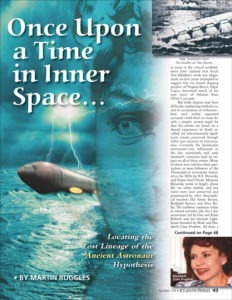
Once Upon a Time in Inner Space

by Martin Ruggles
Posted on

Third of Milky Way Planets May Be Able to Host Life

This image has an empty alt attribute; its file name is ai-free.png

In a new analysis based on the latest telescope data, astronomers have discovered that a third of the planets around the most common stars in the galaxy could be in a goldilocks orbit close enough, and gentle enough, to hold onto liquid water—and possibly harbor life.

The remaining two-thirds of the planets around these ubiquitous small stars are likely roasted by gravitational tides, sterilizing them.

University of Florida astronomy professor Sarah Ballard and doctoral student Sheila Sagear published their findings the week of May 29 in the Proceedings of the National Academy of Sciences. Ballard and Sagear have long studied exoplanets, those worlds that orbit stars other than the sun (https://www.pnas.org/doi/10.1073/pnas.2217398120https://www.pnas.org/doi/10.1073/pnas.2217398120).

“I think this result is really important for the next decade of exoplanet research, because eyes are shifting toward this population of stars,” Sagear said. “These stars are excellent targets to look for small planets in an orbit where it’s conceivable that water might be liquid and therefore the planet might be habitable.”

Our familiar, warm, yellow sun is a relative rarity in the Milky Way. By far the most common stars are considerably smaller and cooler, sporting just half the mass of our sun at most. Billions of planets orbit these common dwarf stars in our galaxy.

Scientists think that liquid water is required for life to evolve on other planets, like it did on Earth. Because these dwarf stars are cooler, any planets would have to huddle very close to their star to draw enough warmth to host liquid water. However, these close orbits leave the planets susceptible to extreme tidal forces caused by the star’s gravitational effect on the planets.

Sagear and Ballard measured the eccentricity – how oval the orbit is –  of a sample of more than 150 planets around these dwarf stars, which are about the size of Jupiter. If a planet orbits close enough to its star, at about the distance that Mercury orbits the sun, an eccentric orbit can subject it to a process known as tidal heating. As the planet is stretched and deformed by changing gravitational forces on its irregular orbit, friction heats it up. At the extreme end, this could bake the planet, removing all chance for liquid water.

“It’s only for these small stars that the zone of habitability is close enough for these tidal forces to be relevant,” Ballard said.

Data came from NASA’s Kepler telescope, which captures information about exoplanets as they move in front of their host stars. To measure the planets’ orbits, Ballard and Sagear focused especially on how long the planets took to move across the face of the stars. Their study also relied on new data from the Gaia telescope, which measured the distance to billions of stars in the galaxy.

“The distance is really the key piece of information we were missing before that allows us to do this analysis now,” Sagear said.

AR #109

Once Upon a Time in Inner Space

by Martin Ruggles