The promise of superconductivity for electrical power transmission and transportation has long been held back by high costs. Now researchers from the University of Houston and Germany have demonstrated a way to cut the cost and upend both the transit and energy transport sectors by using superconductors to move people, cargo and energy along existing highway infrastructure.
The combined system would not only lower the cost of operating each system but would also provide a way to store and transport liquified hydrogen, an important future source of clean energy. The liquified hydrogen would be used to cool the superconductor guideway as it is stored and transported, reducing the need for a separate specialized pipeline system capable of cooling the fuel to 20 degrees Kelvin, or minus 424 Fahrenheit.
The concept, described in a paper published in April in the journal APL Energy, suggests a future in which air travel and traditional freight transport could become obsolete, replaced by a “super system” allowing personal and commercial vehicles to travel at speeds up to 400 miles an hour – maybe even twice that fast.
“I call it a world-changing technology,” said Zhifeng Ren, director of the Texas Center for Superconductivity at UH, who came up with the concept and is a corresponding author on the paper. “Superconductivity has had such promise to transmit electric power without power loss, to power magnetically levitating, super-fast trains and for energy storage. But it has not been economically viable, which is why it hasn’t happened at large scale yet.”
The modern era of superconductivity research began in 1987, when a team led by UH physicist Paul Chu discovered a compound which acted as a superconductor at a temperature above the boiling point of liquid nitrogen. Since then, demonstration projects have proven that superconductors can be used to power magnetically levitated trains and to transmit electrical power without energy loss, reducing waste. Magnetically levitating trains traditionally operate on a magnetized rail, with superconductors embedded in the train undercarriage. This concept flips that, embedding superconductors into the existing highway infrastructure and adding magnets to the undercarriages of vehicles, which avoids having to cool the superconductors on each vehicle. Instead, the liquified hydrogen would cool the superconductors as it moves across the system, with liquified nitrogen and a vacuum layer used to thermally insulate the liquified hydrogen.
The surface of the moon contains a new source of water embedded in millions of microscopic glass beads. Someday all that water, scientists say, might help astronauts produce drinking water, breathable air and even rocket fuel. The new findings come from a Chinese rover that spent two weeks on the moon in 2020.
Evidence of lunar water had only recently emerged from data collected by NASA’s Stratospheric Observatory for Infrared Astronomy (SOFIA). A large telescope on a modified Boeing 747SP jet was able to study the moon from above 99 percent of Earth’s atmospheric water vapor, permitting precise infrared observations without needing any space-based facilities. Another NASA paper published in the same issue of Nature Astronomy has studied permanently shadowed areas—known as cold traps—on the moon in which extremely low temperatures could freeze and preserve water essentially indefinitely, allowing it, over geologic time, to accumulate significant deposits. (https://www.nature.com/articles/s41550-020-01222-x)
Volatile elements and compounds, such as water, say researchers, are crucial to geological processes and will be vital for future in-situ resource utilization on the Moon. Thus, say scientists, it is important to understand the abundance of these elements, their location (i.e., locked in minerals or at depth as ice), and evolution through time on the Moon. Spacecraft missions such as the Lunar Reconnaissance Orbiter have demonstrated that the lunar surface harbors water in at least some form. However, the origin of this water and its distribution across the lunar surface remains largely unknown. Compounding this is the fact that volatile elements likely migrate around the surface of the Moon and can be lost to space. An as-yet-undiscovered reservoir in the near-surface is required to replenish surface water and maintain the lunar water cycle.
In the recent Chinese discovery, Huicun He and colleagues from the Chinese Academy of Sciences analyzed 117 glass beads from a lunar soil sample collected by the Chang’e 5 robotic arm and returned to Earth on December 16, 2020. These beads showed water-poor cores but had elevated water abundances in their rims. This trend correlated with changing hydrogen isotope composition (the ratio of hydrogen to deuterium) from core to rim. This can be explained by the inward diffusion of water derived from the solar wind (primarily composed of pure hydrogen). The researchers also noted that one bead showed water loss at the outermost rim and suggested that this records water loss during daily surface temperature fluctuations.
Modeling-based estimates indicate that the amount of water that these glass beads could contribute to the lunar regolith is as much as 2.7 × 10¹⁴ kg. The researchers conclude, lunar glass beads might therefore provide the needed reservoir to maintain the lunar water cycle and act as a buffer for the global and daily variations of water abundance on the lunar surface.
The 2019 Notre Dame fire in Paris presented archaeologists with a unique opportunity to peer into the cathedral’s history.
Parts of the landmark that were concealed for centuries are now being picked apart and put back together, providing a window into the architectural innovations that once made this 32-meter-high (105 feet) building the tallest cathedral in its age, thanks to the iron that runs through the majestic structure’s veins.
Archaeologists have uncovered thousands of metal staples in various parts of the cathedral, some dating back to the early 1160s.
The findings suggest the extensive use of iron in masonry is not as modern as experts once assumed. Medieval builders working on Notre Dame were employing the architectural technique long before restoration works started in the 19th century.
“Notre Dame is now unquestionably the first known Gothic cathedral where iron was massively used to bind stones as a proper construction material,” archaeologists working in Paris conclude.
The team estimates that the iron fixtures found at Notre Dame were designed up to two decades before France’s Soisson cathedral was built and four decades before the Bourges cathedral came to be. Until now, both these gothic buildings were considered the first examples of systemic iron masonry.
The Gothic cathedral architecture originated in France in the early twelfth century during the heyday of the Knights Templar. The Templars officially called the ‘Poor Fellow-Soldiers of Christ and of the Temple of Solomon’ formed a knight’s order of priests who ostensibly protected the pilgrimage routes to Jerusalem.
Founded in 1118 by Hugo van Payens the order originally included nine brave knight-priests. The group eventually became one of the richest and most powerful in history. With the vast wealth, collected from financing the crusades, the templars were able to build Europe’s gothic cathedrals. With twin towers facing west, the cathedrals resemble the Temple of Solomon with its two pillars Jachin and Boaz standing in front. This explains why in many cases a statue of Solomon is placed at the West portal of the French cathedrals between the twin towers.
Much has been written about the mysteries of the French Gothic cathedrals and the sacred geometry employed in their architecture. One famous book, Le Mystère des Cathédrales was written in 1929 by Fulcanelli (1839 – 1953), the mysterious French alchemist. According to Fulcanelli a cathedral is an alchemical book written in stone.
About 1,300 years ago a scribe in Palestine took a book of the Gospels inscribed with a Syriac text and erased it. Parchment was scarce in the desert in the Middle Ages, so manuscripts were often erased and reused, creating what are called palimpsests, on which the original text can still be made out. One of the earliest translations of the gospels ever was found by Grigory Kessel, a medievalist from the Austrian Academy of Sciences.
“The tradition of Syriac Christianity knows several translations of the Old and New Testaments,” says medievalist Grigory Kessel. “Until recently, only two manuscripts were known to contain the Old Syriac translation of the Gospels.” While one of these is now kept in the British Library in London, another was discovered as a palimpsest in St. Catherine’s Monastery at Mount Sinai. The fragments from the third manuscript were recently identified in the course of the “Sinai Palimpsests Project.”
The small manuscript fragment, which can now be considered as the fourth textual witness, was identified by Kessel using ultraviolet photography as the third layer of text, i.e., double palimpsest, in the Vatican Library manuscript. The fragment is so far the only known remnant of the fourth manuscript that attests to the Old Syriac version – and offers a unique gateway to the very early phase in the history of the textual transmission of the Gospels. For example, while the original Greek of Matthew chapter 12, verse 1 says: “At that time Jesus went through the grainfields on the Sabbath; and his disciples became hungry and began to pick the heads of grain and eat,” the Syriac translation says: “[…] began to pick the heads of grain, rub them in their hands, and eat them.”
On October 9, 2022, an intense pulse of gamma-ray radiation swept through our solar system, overwhelming gamma-ray detectors on numerous orbiting satellites, and sending astronomers on a chase to study the event using the most powerful telescopes in the world.
The new source, dubbed GRB 221009A for its discovery date, turned out to be the brightest gamma-ray burst (GRB) ever recorded.
In a new study that appeared in March, in The Astrophysical Journal Letters, has shed new light on the decades-long quest to understand the origin of these extreme cosmic explosions.
The gamma-ray emission from GRB 221009A lasted over 300 seconds. Astronomers think that such “long-duration” GRBs are the birth cry of a black hole, formed as the core of a massive and rapidly spinning star collapses under its own weight. The newborn black hole launches powerful jets of plasma at near the speed of light, which pierce through the collapsing star and shine in gamma-rays.
With GRB 221009A being the brightest burst ever recorded, a real mystery lay in what would come after the initial burst of gamma-rays. “As the jets slam into gas surrounding the dying star, they produce a bright ‘afterglow’ of light across the entire spectrum,” says Tanmoy Laskar, assistant professor of physics and astronomy at the University of Utah, and lead author of the study. “The afterglow fades quite rapidly, which means we have to be quick and nimble in capturing the light before it disappears, taking its secrets with it.”
As part of a campaign to use the world’s best radio and millimeter telescopes to study the afterglow of GRB 221009A, astronomers Edo Berger and Yvette Cendes of the Center for Astrophysics (CfA) rapidly gathered data with the SMA. After analyzing and combining the data from the SMA and other telescopes all over the world, the astronomers were flummoxed: the millimeter and radio wave measurements were much brighter than expected based on the visible and X-ray light.
“This is one of the most detailed datasets we have ever collected, and it is clear that the millimeter and radio data just don’t behave as expected,” says CfA research associate Yvette Cendes. “A few GRBs in the past have shown a brief excess of millimeter and radio emission that is thought to be the signature of a shockwave in the jet itself, but in GRB 221009A the excess emission behaves quite differently than in these past cases.” She adds, “It is likely that we have discovered a completely new mechanism to produce excess millimeter and radio waves.”
In 2005 an explosion 50,000 light years away, on the other side of the galaxy, was characterized at the time as the largest of it kind ever seen on Earth. If it had been just 10 light years away it could have caused mass extinctions and severely damaged our atmosphere. As it was, the blast was more than 100 times more powerful than any previous explosion ever recorded. The exploding neutron star is called a magnestar for its intense magnetic fields. No bigger than a large Earth city, the explosion was said to produce more energy in a tenth of a second than our own sun turns out in 100,000 years.
A giant insect plucked from the façade of an Arkansas Walmart has set historic records. The Polystoechotes punctata or giant lacewing is the first of its kind recorded in eastern North America in over 50 years — and the first record of the species ever in the state.
The giant lacewing was formerly widespread across North America, but was mysteriously extirpated from eastern North America by the 1950s. This discovery suggests there may be relic populations of this large, Jurassic-Era insect yet to be discovered, explained Michael Skvarla, director of Penn State’s Insect Identification Lab. Skvarla found the specimen in 2012, but misidentified it and only discovered its true identity after teaching an online course based on his personal insect collection in 2020. He recently co-authored a paper about the discovery in the Proceedings of the Entomological Society of Washington.
“I remember it vividly, because I was walking into Walmart to get milk and I saw this huge insect on the side of the building,” said Skvarla, who was a doctoral student at the University of Arkansas at the time. “I thought it looked interesting, so I put it in my hand and did the rest of my shopping with it between my fingers. I got home, mounted it, and promptly forgot about it for almost a decade.”
It wasn’t until the COVID-19 pandemic that the giant lacewing would find its time to shine. In the fall of 2020, with the world in lockdown, Skvarla was teaching Entomology 432: Insect Biodiversity and Evolution at Penn State. He taught the lab course via Zoom, with students following along remotely on loaner microscopes, and used his own personal insect collection as specimen samples.
As he went to demonstrate the features of a specimen he had previously labeled an “antlion,” Skvarla noticed that the characteristics didn’t quite match those of the dragonfly-like predatory insect. Instead, he thought it looked more like a lacewing. A giant lacewing has a wingspan of roughly 50 millimeters, which is quite large for an insect, a clear indicator that the specimen was not an antlion, as Skvarla had mistakenly labeled it. The students got to work comparing features — and a discovery was made, live on Zoom.
“We were watching what Dr. Skvarla saw under his microscope and he’s talking about the features and then just kinda stops,” said Codey Mathis, a doctoral candidate in entomology at Penn State. “We all realized together that the insect was not what it was labeled and was in fact a super-rare giant lacewing. I still remember the feeling. It was so gratifying to know that the excitement doesn’t dim, the wonder isn’t lost. Here we were making a true discovery in the middle of an online lab course.”
For additional confirmation, Skvarla and his colleagues performed molecular DNA analyses on the specimen. Since confirming its true identity, Skvarla has deposited the insect safely in the collections of the Frost Entomological Museum at Penn State, where scientists and students will have access to it for further research.
Huge Quantities of Water Ice May Be Present Near Equator Now
In 2011, scientists recorded a previously unknown feeding strategy in whales around the world. Now, researchers in Australia think they may have found evidence of this behaviour being described in ancient accounts of sea creatures, recorded more than 2,000 years ago.
They believe that misunderstandings of these descriptions contributed to myths about medieval sea monsters.
Whales are known to lunge at their prey when feeding, but recently, whales have been spotted at the surface of the water with their jaws open at right angles, waiting for shoals of fish to swim into their mouths. A clip of this strategy was captured in 2021 and went viral on Instagram.
This strategy seems to work for the whales because the fish think they have found a place to shelter from predators, not realizing they are swimming into danger.
It’s not known why this strategy has only recently been identified, but scientists speculate that it’s a result of changing environmental conditions – or that whales are being more closely monitored than ever before by drones and other modern technologies.
Ortelius’s 1658 map of Iceland showing various mythological sea creatures. Below, a detail of a sea creature labelled H, ‘the greatest of whales’ which could not chase fish but caught them through cunning. Dr John McCarthy, a maritime archaeologist Australia’s Flinders University, first noticed intriguing parallels between marine biology and historical literature while reading about Norse sea monsters.
“It struck me that the Norse description of the hafgufa was very similar to the behaviour shown in videos of trap feeding whales, but I thought it was just an interesting coincidence at first. Once I started looking into it in detail and discussing it with colleagues who specialize in medieval literature, we realized that the oldest versions of these myths do not describe sea monsters at all, but are explicit in describing a type of whale, says Dr McCarthy.
“That’s when we started to get really interested. The more we investigated it, the more interesting the connections became and the marine biologists we spoke to found the idea fascinating. Old Norse manuscripts describing the creature date from the 13th century and name the creature as a ‘hafgufa’.
This creature remained part of Icelandic myths until the 18th century, often included in accounts alongside the more infamous kraken and mermaids.
However, it appears the Norse manuscripts may have drawn on medieval bestiaries, a popular type of text in the medieval period. Bestiaries describe large numbers of real and fantastical animals and often include a description of a creature very similar to the hafgufa, usually named as the ‘aspidochelone’.
Both the hafgufa and aspidochelone are sometimes said to emit a special perfume or scent that helps to draw the fish towards their stationary mouths. Although some whales produce ambergris, which is an ingredient of perfume, this is not true of such rorquals as the humpback.
Research co-author Dr Erin Sebo, an Associate Professor in Medieval Literature and Language at Flinders University, says this may be another example of accurate knowledge about the natural environment preserved in forms that pre-date modern science.
“It’s exciting because the question of how long whales have used this technique is key to understanding a range of behavioural and even evolutionary questions. Marine biologists had assumed there was no way of recovering this data but, using medieval manuscripts, we’ve been able to answer some of their questions.”
Huge Quantities of Water Ice May Be Present Near Equator Now
If there is still water ice preserved at shallow depths at a low latitude on Mars, there would be implications for science and human exploration.
In a groundbreaking announcement at the 54th Lunar and Planetary Science Conference held in The Woodlands, Texas, in March, scientists revealed the discovery of a relict glacier near Mars’ equator. Located in Eastern Noctis Labyrinthus at coordinates 7° 33′ S, 93° 14′ W, this finding is significant as it implies the presence of surface water ice on Mars in recent times, even near the equator. This discovery raises the possibility that ice may still exist at shallow depths in the area, which could have significant implications for future human exploration. (https://www.calameo.com/read/004812363b9a6e9a9fb12).
The surface feature identified as a “relict glacier” is one of many light-toned deposits (LTDs) found in the region. Typically, LTDs consist mainly of light-colored sulfate salts, but this deposit also shows many of the features of a glacier, including crevasse fields and moraine bands. The glacier is estimated to be 6 kilometers long and up to 4 kilometers wide, with a surface elevation ranging from +1.3 to +1.7 kilometers. This discovery suggests that Mars’ recent history may have been more watery than previously thought, which could have implications for understanding the planet’s habitability.
“What we’ve found is not ice, but a salt deposit with the detailed morphologic features of a glacier. What we think happened here is that salt formed on top of a glacier while preserving the shape of the ice below, down to details like crevasse fields and moraine bands,” said Dr. Pascal Lee, a planetary scientist with the SETI Institute and the Mars Institute, and the lead author of the study.
The presence of volcanic materials blanketing the region hints of how the sulfate salts might have formed and preserved a glacier’s imprint underneath. When freshly erupted pyroclastic materials (mixtures of volcanic ash, pumice, and hot lava blocks) come in contact with water ice, sulfate salts like the ones commonly making up Mars’ light-toned deposits may form and build up into a hardened, crusty salt layer.
“This region of Mars has a history of volcanic activity. And where some of the volcanic materials came in contact with glacier ice, chemical reactions would have taken place at the boundary between the two to form a hardened layer of sulfate salts,” explains Sourabh Shubham, a graduate student at the University of Maryland’s Department of Geology, and a co-author of the study. “This is the most likely explanation for the hydrated and hydroxylated sulfates we observe in this light-toned deposit.”
Over time, with erosion removing the blanketing volcanic materials, a crusty layer of sulfates mirroring the glacier ice underneath became exposed, which would explain how a salt deposit is now visible, presenting features unique to glaciers such as crevasses and moraine bands.
“Glaciers often present distinctive types of features, including marginal, splaying, and tic-tac-toe crevasse fields, and also thrust moraine bands and foliation. We are seeing analogous features in this light-toned deposit, in form, location, and scale. It’s very intriguing,” said John Schutt, a geologist at the Mars Institute, experienced icefield guide in the Arctic and Antarctica, and a co-author of this study.
The glacier’s fine-scale features, its associated sulfate salts deposit, and the overlying volcanic materials are all very sparsely cratered by impacts and must be geologically young, likely Amazonian in age, the latest geologic period which includes modern Mars. “We’ve known about glacial activity on Mars at many locations, including near the equator in the more distant past. And we’ve known about recent glacial activity on Mars, but so far, only at higher latitudes. A relatively young relict glacier in this location tells us that Mars experienced surface ice in recent times, even near the equator, which is new,” said Lee.
It remains to be seen whether water ice might still be preserved underneath the light-toned deposit or if it has disappeared entirely. “Water ice is, at present, not stable at the very surface of Mars near the equator at these elevations. So, it’s not surprising that we’re not detecting any water ice at the surface. It is possible that all the glacier’s water ice has sublimated away by now. But there’s also a chance that some of it might still be protected at shallow depth under the sulfate salts.”
The study draws an analogy with the ancient ice islands on salt lakebeds, or salars, of the Altiplano in South America. There, old glacier ice has remained protected from melting, evaporation, and sublimation underneath blankets of bright salts. Lee and his co-authors hypothesize a similar situation to explain how sulfate salts on Mars might be able to offer protection to otherwise sublimation-vulnerable ice at low latitudes on the planet.
If there is still water ice preserved at shallow depths at a low latitude on Mars, there would be implications for science and human exploration. “The desire to land humans at a location where they might be able to extract water ice from the ground has been pushing mission planners to consider higher latitude sites. But the latter environments are typically colder and more challenging for humans and robots. If there were equatorial locations where ice might be found at shallow depth, then we’d have the best of both environments: warmer conditions for human exploration and still access to ice,” said Lee.
But Lee cautions that more work still needs to be done: “We now have to determine if, and how much, water ice might actually be present in this relict glacier, and whether other light-toned deposits might also have, or have had, ice-rich substrates.”
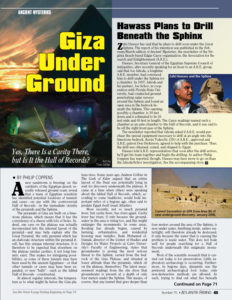
A hidden corridor, 30 feet long, has been discovered close to the main entrance of the 4,500-year-old Great Pyramid of Giza, and this could lead to further findings, say officials of the Egyptian Antiquities Authority.
The discovery within the Pyramid, the last of the Seven Wonders of the Ancient World still standing, was made under the Scan Pyramids project that, since 2015, has been using non-invasive technology including infrared thermography, 3D simulations and cosmic-ray imaging to peer inside the structure. An article published in the journal, Nature, in February said the discovery could contribute to knowledge about the construction of the Pyramid and the purpose of a gabled limestone structure that sits in front of the corridor. (https://www.nature.com/articles/s41467-023-36351-0)
According to orthodox Egyptology, the Great Pyramid was constructed as a monumental tomb around 2560 BC, during the reign of the Pharaoh Khufu, or Cheops. Built to a height of 146 meters (479 feet), it now stands at 139 meters and was the tallest structure made by humans, until the Eiffel Tower in Paris in 1889.
The unfinished corridor, it is asserted, was likely created to redistribute the Pyramid’s weight around either the main entrance, now used by tourists, about 20 feet away, or around another as yet undiscovered chamber or space, said Mostafa Waziri, head of Egypt’s Supreme Council of Antiquities. “We’re going to continue our scanning so we will see what we can do … to figure out what we can find out beneath it, or just by the end of this corridor,” he told reporters, after a press conference in front of the Pyramid.
Five rooms atop the king’s burial chamber in another part of the Pyramid are also thought to have been built to redistribute the weight of the massive structure. It was possible the Pharaoh had more than one burial chamber, Waziri added.
Scientists detected the corridor through cosmic-ray muon radiography, before retrieving images of it by feeding a 6mm-thick endoscope from Japan through a tiny joint in the pyramid’s stones.
In 2017, Scan Pyramids researchers announced the discovery of a void, at least 30 meters long, inside the Great Pyramid, the first major inner structure found since the 19th century.
According to William Brown, an American Civil Engineer who worked extensively with a Polish Research Team, at least 7 such ‘anomaly’ tomb-like features had been found within the limits of Giza plateau before the Scan Pyramid project, but had not been reported.
“We feel we were double-crossed and lied to,” said Dennis Parada, co-owner of Finders Keepers reports FoxNews. The FBI had searched a remote area in Dents Run in 2018 for a cache of gold worth hundreds of millions of dollars, but the agency said it did not find anything. The area is allegedly where an 1863 shipment of Union gold disappeared on its way to the U.S. Mint in Philadelphia. Parada sued the Justice Department last year to force the FBI to release records on the search of the excavation site, and a judge ruled in favor of the agency.
After reviewing the newly released documents, Parada said the FBI is distorting key evidence and improperly withholding records in an apparent effort to conceal the recovery of the historic gold cache. A federal judge overseeing the case will decide if the FBI must release its operational plan for the gold dig and other records it wants to keep secret. The judge could also order the FBI to keep looking for additional materials to turn over to the treasure hunter.
Notorious outlaw Jesse James started his career during the Civil War. He followed in the path of his older brother Frank who was part of a guerrilla operation known as Quantrill’s Raiders—out to win the Civil War their own way. Even after General Lee had surrendered, these guerrillas continued their operations. Cole Younger led a group of Quantrill’s men to rob the Clay County Savings Association in Liberty, Missouri that netted an immense sum, for the times, $70,000 dollars. Even most modern bank robberies net less. The James-Younger Gang was not doing this for its own gain, or to hand out money to poor Missouri farmers. Their goal was nothing short of becoming the force that would help the South to rise again. They belonged to a greater organization known as the Knights of the Golden Circle, almost exclusively made up of sympathetic Freemasons, many of whom were Rosicrucians and often funded by wealthy English merchants. It was possibly the most powerful subversive organization in the United States.
A document called the Holt Report declared that Lincoln’s Secretary of War Edwin Stanton claimed there could be several hundred thousand members, and that their plan was to fund a war for Southern Independence after the civil war. Stanton did nothing about them, however, and may have been a traitor himself. The James gang took the proceeds of their twenty to twenty five successful robberies and hid them in secret stashes from Arkansas to Arizona. Most remain hidden to this day, guarded by secret symbols and protected by guardian families determined to see that they are not pilfered.