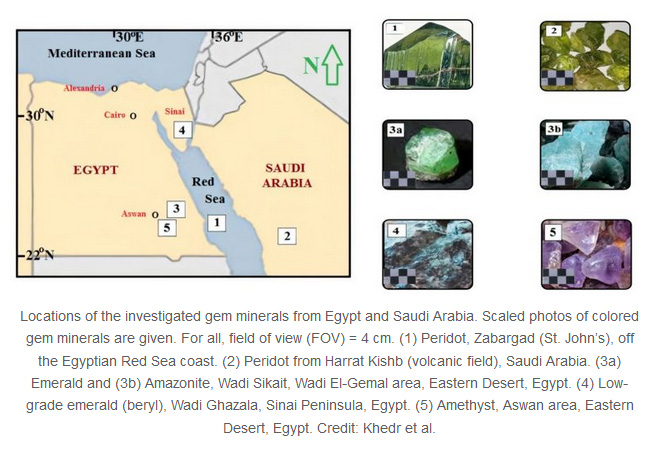
Since ancient times, gemstones have been mined and traded across the globe, sometimes traveling continents from their origin. Gems are geologically defined as minerals celebrated for beauty, strength, and rarity. Their unique elemental composition and atomic orientation act as a fingerprint, enabling researchers to uncover the stones’ past, and with it, historical trade routes.
In new research published in AIP Advances, researcher explain how they employed three modern spectroscopic techniques to rapidly analyze gems found in the Arabian-Nubian Shield and compare them with similar gems from around the world (https://pubs.aip.org/aip/adv/article/13/8/085023/2907404/Thermodynamics-of-mechanopeptide-sidechains?searchresult=1). Using laser-induced breakdown spectroscopy (LIBS), Fourier transform infrared (FTIR) spectroscopy, and Raman spectroscopy, the authors identified elements that influence gems’ color, differentiated stones found within and outside the region, and distinguished natural from synthetic.
The Arabian-Nubian Shield is an exposure of mineral deposits that sandwiches the Red Sea in current-day Egypt and Saudi Arabia. The deposits date back to the Earth’s earliest geological age, and the precious metals and gemstones have been harvested for thousands of years.
“We showed the main spectroscopic characteristics of gemstones from these Middle East localities to distinguish them from their counterparts in other world localities,” said author Adel Surour. “This includes a variety of silicate gems such as emerald from the ancient Cleopatra’s mines in Egypt, in addition to amethyst, peridot, and amazonite from other historical sites, which mostly date to the Roman times.”
The various spectroscopic techniques they employed revealed different information about the stones. LIBS quickly characterizes chemical composition, while FTIR determines functional groups connected to the structure and indicates the presence of water and other hydrocarbons. Even for chemically identical materials, Raman spectroscopy shows the unique crystalline structure of the gems’ atoms.
The authors identified that iron content correlates to amethysts’ signature purple hue, and other elements such as copper, chromium, and vanadium are also responsible for colorization. A signature water peak exposes lab-grown synthetic gems, which are useful for scientific purposes and identical to natural gems but are less expensive. Crystalline structure differentiated amazonite beads from Mexico, Jordan, and Egypt.
“Gemstones such as emerald and peridot have been mined since antiquity,” Surour said. “Sometimes, some gemstones were brought by sailors and traders to their homelands. For example, royal crowns in Europe are decorated with peculiar gemstones that originate from either Africa or Asia. We need to have precise methods to distinguish the source of a gemstone and trace ancient trade routes in order to have correct information about the original place from which it was mined.”
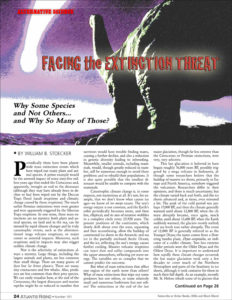
The end of the last Ice Age also marked the end for more than three dozen genera of large mammals in North America, from mammoths and mastodons to bison and saber-toothed cats. Details concerning the precise timing and circumstances, however, have remained murky ever since.
A team of scientists recently focused on the famous Rancho La Brea Tar Pits in southern California in their quest to provide answers to these questions, resulting in the most exact and detailed timeline for the extinctions that happened during the latter part of the Pleistocene period in North America, along with some foreboding insight into the area’s present and future. Their work is featured on the August 18, 2023 cover of Science (https://www.science.org/doi/10.1126/science.abo3594).
Texas A&M University archaeologist Dr. Michael Waters, along with roughly a dozen fellow researchers examined the timing and cause of the extinction of a variety of large mammals, known as megafauna, that got stuck in tar at Rancho La Brea, ensuring the preservation of their bones. The team used the radiocarbon dating method to date 169 bones from seven different animals — bison, horse, camel and ground sloths as well as the carnivores that ate them, including the saber-toothed cat, dire wolf and American lion. They also compared those findings to regional pollen and charcoal records along with continent-wide data on human and large mammal populations.
Armed with their new data, the researchers subsequently used time-series modeling to produce the most detailed chronobiology to date, showing the relationships between climate and vegetation change, fire activity, human demographics and megafauna extinctions — groundbreaking results they report in the world-leading academic journal.
Waters says the team’s findings reveal that Ice Age mammal populations in southern California were steady from 15,000 to around 13,250 years ago. Afterward, there was a sharp decline in the population of the seven animals studied, and they all became extinct between 13,070 to 12,900 years ago.
In an interesting modern-day parallel, this extinction event corresponds with a change in the environment from 13,300 to 12,900 years ago marked by warming and drying that made the land more vulnerable to fires in southern California. Charcoal records show that fires increased around 13,500 years ago and peaked between 13,200 and 12,900 years ago. Studies show that humans arrived in North America’s Pacific coast 16,000 to 15,000 years ago and lived alongside the megafauna for 2,000 to 3,000 years before their extinction.
While humans hunted animals during this period, Waters says the impact of hunting on the demise of the megafauna likely was minor because of the low population of humans on the landscape. However, the fires would have been devastating, resulting in the loss of habitat causing the rapid decline and extinction of the megafauna in southern California. The study suggests these fires were ignited by humans, which had increased in number by that time. “Fire is a way that small numbers of humans can have a large impact over a broad area,” said Waters, who also cautions that climate changes observed in present-day California are similar to those of the late Pleistocene. “This study has implications for the changes we see in southern California today,” Waters added. “The temperatures are rising, and the area is drying. We also see a dramatic increase in fires. It appears that history may be repeating itself.”
While Waters acknowledges that this is the story of extinction at Rancho La Brea, he says it has the potential to offer insights into when extinctions happened across all of North America.
“Mammoths and mastodons survived in many parts of North America until around 12,700 years ago,” he added. “These animals were hunted by the Clovis people between about 13,000 and 12,700 years ago. We are now dating megafauna remains from other locations to give a broader understanding of the Rancho La Brea research in the context of North America.”
The museum at La Brea Tar Pits holds the world’s largest collection of fossils from the Ice Age and has been central to the study of animal and plant life at the end of the Pleistocene epoch for more than a century. Its naturally occurring asphalt pools entrapped and preserved the bones of thousands of individual animals representing dozens of megafaunal species during the last 60,000 years, enabling scientists to determine when different species disappeared from the ecosystem and why.
The team’s research was supported by the National Science Foundation and various Texas A&M-specific grants, such as the CSFA and the North Star Archaeological Research Fund.
An Australian mathematician has revealed the origins of applied geometry on a 3700-year-old clay tablet that has been hiding in plain sight in a museum in Istanbul for over a century.
The tablet – known as Si.427 – was discovered in the late 19th century in what is now central Iraq, but its significance was unknown until a scientist’s detective work was revealed today.
Most excitingly, Si.427 is thought to be the oldest known example of applied geometry – and in the new study released in Foundations of Science, the research also reveals a compelling human story of land surveying.
“Si.427 dates from the Old Babylonian (OB) period – 1900 to 1600 BCE,” says lead researcher Dr Daniel Mansfield, from the University of New South Wales. This is a significant object because the surveyor uses what are now known as “Pythagorean triples” to make accurate right angles.
“The discovery and analysis of the tablet have important implications for the history of mathematics,” Dr Mansfield says. “For instance, this is over a thousand years before Pythagoras was born.”
In 2017, Dr Mansfield conjectured that another fascinating artifact from the same period, known as Plimpton 322, was a unique kind of trigonometric table.
“It is generally accepted that trigonometry – the branch of maths that is concerned with the study of triangles – was developed by the ancient Greeks studying the night sky in the second century BCE,” says Dr Mansfield.
“But the Babylonians developed their own alternative ‘proto-trigonometry’ to solve problems related to measuring the ground, not the sky.”
The tablet revealed today is thought to have existed even before Plimpton 322 – in fact, surveying problems likely inspired Plimpton 322.
“There is a whole zoo of right triangles with different shapes. But only a very small handful can be used by Babylonian surveyors. Plimpton 322 is a systematic study of this zoo to discover the useful shapes,” says Dr Mansfield.
Back in 2017, the team speculated about the purpose of the Plimpton 322, hypothesizing that it was likely to have had some practical purpose, possibly used to construct palaces and temples, build canals or survey fields.
“With this new tablet, we can actually see for the first time why they were interested in geometry: to lay down precise land boundaries,” Dr Mansfield says.
“This is from a period where land is starting to become private – people started thinking about land in terms of ‘my land and your land’, wanting to establish a proper boundary to have positive neighborly relationships. And this is what this tablet immediately says. It’s a field being split, and new boundaries are made.”
There are even clues hidden on other tablets from that time period about the stories behind these boundaries.
There’s just one mystery left that Dr Mansfield hasn’t unlocked: on the back of the tablet, at the very bottom, it lists the sexagesimal number ‘25:29’ in big font – think of it as 25 minutes and 29 seconds.
“I can’t figure out what these numbers mean – it’s an absolute enigma. I’m keen to discuss any leads with historians or mathematicians who might have a hunch as to what these numbers trying to tell us!”
Caption: Viable superconducting material created at low temperature and low pressure by University of Rochester
Super conductivity is a virtually miraculous condition, where all electrical resistance in a material ceases to exist and wondrous things happen. If it were easy to achieve, many dreams of science—super efficient electric power transmission systems, vastly greater power storage devices, exponentially more powerful electric motors, magnetic levitation devices, superconducting magnetic refrigeration, and much more—would soon be reality. Until, now though, it has not been easy. Conductors must be cooled to almost absolute zero (−273.15 °C; -459.67 °F) to make it happen, so, unsurprisingly, the quest for super conductivity at temperatures any warmer has been very hard indeed, and ‘room-temperature’ superconductivity it has been said is simply out of the question.
Nevertheless, researchers now claim they have not only raised the temperature, but also lowered the pressure required to achieve superconductivity. In a historic achievement, scientists at the University of Rochester have created a superconducting material at both a temperature and pressure suitable for practical applications.
“With this material, the dawn of ambient superconductivity and applied technologies has arrived,” according to a team led by Ranga Dias, an assistant professor of mechanical engineering and of physics. In a paper in Nature, the researchers describe a nitrogen-doped lutetium hydride (NDLH) that exhibits superconductivity at 69 degrees Fahrenheit and 10 kilobars (145,000 pounds per square inch, or psi) of pressure.
Although 145,000 psi might still seem extraordinarily high (pressure at sea level is about 15 psi), strain engineering techniques routinely used in chip manufacturing, for example, incorporate materials held together by internal chemical pressures that are even higher.
Previously, the Dias team reported creating two materials—carbonaceous sulfur hydride and yttrium superhydride—that are superconducting at 58 degrees Fahrenheit/39 million psi and 12 degrees Fahreneheit/26 million psi respectively, in papers in Nature and Physical Review Letters (https://www.nature.com/articles/s41586-023-05742-0).
Given the importance of the new discovery, Dias and his team went to unusual lengths to document their research and head off criticism that developed in the wake of a previous Nature paper, which led to a retraction by the journal’s editors. According to Dias, that previous paper has now been resubmitted to Nature with new data that validates the earlier work. The new data was collected outside the lab, at the Argonne and Brookhaven National Laboratories in front of an audience of scientists who saw the superconducting transition live. A similar approach has been taken with the new paper.
New observations of mud cracks made by the Curiosity rover show that high-frequency, wet-dry cycling occurred in early Martian surface environments, indicating that the red planet may have once seen seasonal weather patterns or even flash floods. The research has now been published in the journal Nature (https://www.nature.com/articles/s41586-023-06220-3).
The presence of long-term wet environments, such as evidence of ancient lakes on Mars, is well-documented, but far less is known about short-term climate fluctuations.
After years of exploring terrain largely comprised of silicates, the rover entered a new area filled with sulfates, marking a major environment transition. In this new environment, the research team found a change in mud crack patterns, signifying a change in the way the surface would have dried. This indicates that water was still present on the surface of Mars episodically, meaning water could have been present for a time, evaporated, and repeated until polygons, or mud cracks, formed.
“These exciting observations of mature mud cracks are allowing us to fill in some of the missing history of water on Mars. How did Mars go from a warm, wet planet to the cold, dry place we know today? These mud cracks show us that transitional time, when liquid water was less abundant but still active on the Martian surface,” said Nina Lanza, principal investigator of the ChemCam instrument onboard the Curiosity rover. “These features also point to the existence of wet-dry environments that on Earth are extremely conducive to the development of organic molecules and potentially life. Taken as a whole, these results a giving us a clearer picture of Mars as a habitable world.”
The presence of long-term wet environments, such as evidence of ancient lakes on Mars, is well-documented, but far less is known about short-term climate fluctuations.
After years of exploring terrain largely comprised of silicates, the rover entered a new area filled with sulfates, marking a major environment transition. In this new environment, the research team found a change in mud crack patterns, signifying a change in the way the surface would have dried. This indicates that water was still present on the surface of Mars episodically, meaning water could have been present for a time, evaporated, and repeated until polygons, or mud cracks, formed.
“A major focus of the Curiosity mission, and one of the main reasons for selecting Gale Crater, is to understand the transition of a ‘warm and wet’ ancient Mars to a ‘cold and dry’ Mars we see today,” said Patrick Gasda of the Laboratory’s Space Remote Sensing and Data Science group and coauthor of the paper. “The rover’s drive from clay lakebed sediments to drier non-lakebed and sulfate-rich sediments is part of this transition.”
On Earth, initial mud cracks in mud form a T-shaped pattern, but subsequent wetting and drying cycles cause the cracks to form more of a Y-shaped pattern, which is what Curiosity observed. Additionally, the rover found evidence that the mud cracks were only a few centimeters deep, which could mean that wet-dry cycles were seasonal, or may have even occurred more quickly, such as in a flash flood.
These findings could mean that Mars once had an Earth-like wet climate, with seasonal or short-term flooding, and that Mars may have been able to support life at some point.
Aromas While Sleeping Sparks 226% Cognitive Increase
A Roman road network that spanned Devon and Cornwall and connected significant settlements with military forts across the two counties as well as wider Britannia has been discovered for the first time.
Archaeologists at the University of Exeter have used laser scans collected as part of the Environment Agency’s National LiDAR Program to identify new sections of road west of the previously understood boundary.
Using sophisticated geographical modeling techniques, which incorporate information around gradients and flood risk, the researchers have then been able to map out the full extent of the network and begin to understand the rationale for its existence.
Among the things it reveals is that far from Exeter being the main nerve center of the network, it was North Tawton that supported strategically vital connections with tidal estuaries north and south of Bodmin and Dartmoor.
These findings are explored in Remote Sensing and GIS Modelling of Roman Roads in South West Britain, which has been published in the Journal of Computer Applications in Archaeology.
The research was led by Dr Christopher Smart and Dr João Fonte, specialists in landscape archaeology and the heritage of the Roman Empire, in Exeter’s Department of Archaeology and History. Dr César Parcero Oubiña, from the Institute of Heritage Sciences, Spanish National Research Council in Spain, specialist in geospatial technologies applied to archaeology, led the modelling of the Roman roads network.
“Despite more than 70 years of scholarship, published maps of the Roman road network in southern Britain have remained largely unchanged and all are consistent in showing that west of Exeter, Roman Isca, there was little solid evidence for a system of long-distance roads,” Dr Smart said. “But the recent availability of seamless LiDAR coverage for Britain has provided the means to transform our understanding of the Roman road network that developed within the province, and nowhere more so than in the far south western counties, in the territory of the Dumnonii.”
The National LiDAR (Light Detection and Ranging) Program was conducted between 2016 and 2022 by the Environment Agency covering the whole of England, and the data was made available via the DEFRA Data Services Platform. It transformed the amount of terrain mapped of Devon and Cornwall, which had previously stood at just 11%. The Exeter team, working with public volunteers, and funded by the National Lottery Heritage Fund as part of the Digital Skills for Heritage initiative, studied the scans and together, they were able to map around 100km of additional roads.
Earlier this year, ARPA-E, a US government agency dedicated to funding advanced energy research, announced a handful of grants for a field it calls “low-energy nuclear reactions,” or LENR. Most scientists likely didn’t take notice of the news. But, for a small group of them, the announcement marked vindication for their specialty: cold fusion.
Cold fusion, better known by its practitioners as LENR, is the science—or, perhaps, the art—of making atomic nuclei merge and, ideally, harnessing the resultant energy. All of this happens without the incredible temperatures, on the scale of millions of degrees, that you need for “traditional” fusion. In a dream world, successful cold fusion could provide us with a boundless supply of clean, easily attainable energy.
Tantalizing as it sounds, for the past 30 years, cold fusion has largely been a forgotten specter of one of science’s most notorious controversies, when a pair of chemists in 1989 claimed to achieve the feat—which no one else could replicate. There is still no generally accepted theory that supports cold fusion; many still doubt that it’s possible at all. But those physicists and engineers who work on LENR believe the new grants are a sign that their field is being taken seriously after decades in the wilderness.
“It got a bad start and a bad reputation,” believes David Nagel, an engineer at George Washington University, “and then, over the intervening years, the evidence has piled up.”
Igniting fusion involves pressing the hearts of atoms together, creating larger nuclei and a fountain of energy. This isn’t easy. The protons inside a nucleus give it a positive charge, and like-charged nuclei electrically repel each other. Physicists must force the atoms to crash together anyway.
Normally, breaking this limit needs an immense amount of energy, which is why stars, where fusion happens naturally, and Earthbound experiments reach extreme heat. But what if there were another, lower-temperature way?
Scientists had been theorizing such methods since the early 20th century, and they’d found a few tedious, extremely inefficient ways. But in the 1980s, two chemists thought they’d made one method work to great success.
The duo, Martin Fleischmann and Stanley Pons, had placed the precious metal palladium in a bath of heavy water: a form of H2O whose hydrogen atoms have an extra neutron, a form known as deuterium, commonly used in nuclear science. When Fleischmann and Pons switched on an electrical current through their apparatus and left it running, they began to see abrupt heat spikes, or so they claimed, and particles like neutrons.
Those heat spikes and particles, according to them, could not be explained by any chemical process. What could explain them were the heavy water’s deuterium nuclei fusing, just as they would in a star. If Fleischmann and Pons were right, fusion could be achievable at room temperature in a relatively basic chemistry lab. If you think that sounds too good to be true, you’re far from alone. When the pair announced their results in 1989, what followed was one of the most spectacular firestorms in the history of modern science. Scientist after scientist tried to recreate their experiment, and no one could reliably replicate their results.
Pons and Fleischmann are remembered as fraudsters. It likely didn’t help that they were chemists trying to make a mark on a field dominated by physicists. Whatever they had seen, “cold fusion” found itself at respectable science’s margins.
Still, in the shadows, LENR experiments continued. (Some researchers tried variations on Fleischmann and Pons’ themes. Others, especially in Japan, sought LENR as a means of cleaning up nuclear waste by transforming radioactive isotopes into less dangerous ones.) A few experiments showed oddities such as excess heat or alpha particles—anomalies that might best be explained if atomic nuclei were reacting behind the scenes.
“The LENR field has somehow, miraculously, due to the convictions of all these people involved, has stayed alive and has been chugging along for 30 years,” says Jonah Messinger, an analyst at the Breakthrough Institute think tank and a graduate student at MIT.
Fleischmann and Pons’ fatal flaw—that their results could not be replicated—continues to cast a pall over the field. Even some later experiments that seemed to show success could not be replicated. But this does not deter LENR’s current proponents. “Science has a reproducibility problem all the time,” says Florian Metzler, a nuclear scientist at MIT.
In the absence of a large official push, the private sector had provided much of LENR’s backing. In the late 2010s, for instance, Google poured several million dollars into cold fusion research to limited success. But government funding agencies are now starting to pay attention. The ARPA-E program joins European Union projects, HERMES and CleanHME, which both kicked off in 2020. (Messinger and Metzler are members of an MIT team that will receive ARPA-E grant funds.)
By the standards of other energy research funding, none of the grants are particularly eye-watering. The European Union programs and ARPA-E total up to around $10 million each: a pittance compared to the more than $1 billion the US government plans to spend in 2023 on mainstream fusion. But that money will be used in important ways, its proponents say. The field has two pressing priorities. One is to attract attention with a high-quality research paper that clearly demonstrates an anomaly, ideally published in a reputable journal like Nature or Science. “Then, I think, there will be a big influx of resources and people,” says Metzler.
A second, longer-term goal is to explain how cold fusion might work. The laws of physics, as scientists understand them today, do not have a consensus answer for why cold fusion could happen at all. Metzler doesn’t see that open question as a problem. “Sometimes people have made these arguments: ‘Oh, cold fusion contradicts established physics,’ or something like that,” he says. But he believes there are many unanswered questions in nuclear physics, especially with larger atoms. “We have an enormous amount of ignorance when it comes to nuclear systems,” he says.
Yet answers would have major benefits, other experts argue. “As long as it’s not understood, a lot of people in the scientific community are put off,” says Nagel. “They’re not willing to pay any attention to it.”
It is, of course, entirely possible that cold fusion is an illusion. If that’s the case, then ARPA-E’s grants may give researchers more proof that nothing is there. But it’s also possible that something is at work behind the scenes.
And, LENR proponents say, the Fleischmann and Pons saga is now fading as younger researchers enter the field with no memory of 1989. Perhaps that will finally be what lets LENR emerge from the pair’s shadow.“If there is a nuclear anomaly that occurs,” says Messinger, “my hope is that the wider physics community is ready to listen.”
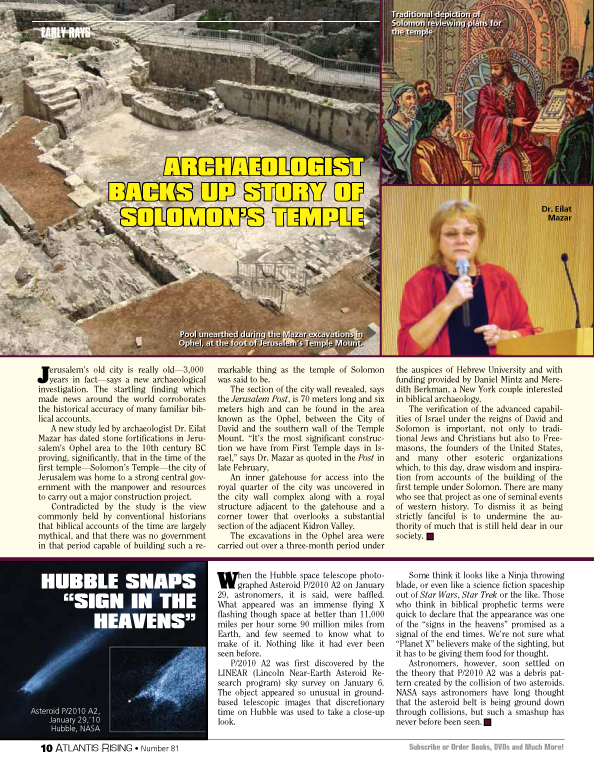
Contrary to previous beliefs that the expansion of the Kingdom of Judah took place only in the late 9th or 8th century BCE, 200 to 300 hundred years after King David, a new Hebrew University of Jerusalem (HU) study shows that it had already begun to spread into the hill country and the northern Shefela (lowlands) as early as the 10th century BCE. The expansion of southern Shefela followed about two generations later in the time of David’s grandson Rehoboam.
The finding is published in The Jerusalem Journal of Archaeology. “Early City Planning in the Kingdom of Judah: Khirbet Qeiyafa, Beth Shemesh 4, Tell en-Naṣbeh, Khirbet ed-Dawwara, and Lachish V” is by Prof. Yosef Garfinkel. The new study examines the earliest fortified sites in the kingdom of Judah during the 10th century BCE.
The five sites studied, reveal significant insights into the urbanization process, urban planning, and borders of the earliest phase of the Kingdom of Judah, The Shefela region located southwest of Jerusalem, played a crucial role in the Kingdom of Judah’s expansion due to its favorable ecological conditions for agriculture, the team said, because its low, rolling topography, fertile soil and enough rain make it the kingdom’s breadbasket that could feed a large population.
The study stressed the importance of the kingdom’s expansion into the Shefela and its agricultural resources as a key stage in its development.
Regarding the publication date of the research, Garfinkel explained that “the evidence was known before; it isn’t a matter of new discoveries. What was needed was someone to come along and observe the complete picture that these findings portray. I am glad that I was able to fulfill that role.”
The five sites showcased an urban plan characterized by a casemate city wall (a double wall with the space between the walls separated into chambers that could be filled up to better withstand battering rams in case of siege). They noted that Lachish, Level V, has a similar pattern but without casemates in its city wall. The findings have far-reaching implications for understanding the urban planning and territorial boundaries of the earliest phase of the Kingdom of Judah, they commented.
Three things were common to all these cities – they were fortified with a casemate city wall and were located on the kingdom border and on a main road leading into the kingdom. Khirbet Qeiyafa in the Elah Valley protected the southwest border of the kingdom. “Beth Shemesh” in the Soreq Valley protected the western border of the kingdom. Tell en-Naṣbeh near Ramallah protected the north and Khirbet ed-Dawwara protected the northeast border.
Some of the largest prehistoric artifacts ever found have been unearthed by archaeologists in Kent, UK. The excavations, were commissioned in advance of development of the Maritime Academy School in Frindsbury, revealed prehistoric artifacts in deep Ice Age sediments preserved on a hillside above the Medway Valley.
The researchers, from UCL Archaeology South-East, discovered 800 stone artifacts thought to be over 300,000 years old, buried in sediments which filled a sinkhole and ancient river channel, outlined in their research, published in Internet Archaeology, (https://intarch.ac.uk/journal/issue61/6/index.html)
Amongst the artifacts were two extremely large flint knives described as “giant handaxes”. Handaxes are stone artefacts which have been chipped, or “knapped,” on both sides to produce a symmetrical shape with a long cutting edge. Researchers believe this type of tool was usually held in the hand and may have been used for butchering animals and cutting meat. The two largest handaxes found at the site have a distinctive shape with a long and finely worked pointed tip, and a much thicker base.
Senior Archaeologist Letty Ingrey (UCL Institute of Archaeology), said: “We describe these tools as ‘giants’ when they are over 22cm long and we have two in this size range. The biggest, a colossal 29.5cm in length, is one of the longest ever found in Britain. ‘Giant handaxes’ like this are usually found in the Thames and Medway regions and date from over 300,000 years ago.
“These handaxes are so big it’s difficult to imagine how they could have been easily held and used. Perhaps they fulfilled a less practical or more symbolic function than other tools, a clear demonstration of strength and skill. While right now, we aren’t sure why such large tools were being made, or which species of early human were making them, this site offers a chance to answer these exciting questions.”
The site is thought to date to a period in the early prehistory of Britain when Neanderthal people and their cultures were beginning to emerge and may even have shared the landscape with other early human species. The Medway Valley at this time would have been a wild landscape of wooded hills and river valleys, inhabited by red deer and horses, as well as less familiar mammals such as the now-extinct straight-tusked elephant and lion.
While archaeological finds of this age, including another spectacular ‘giant’ handaxe, have been found in the Medway Valley before, this is the first time they have been found as part of large-scale excavation, offering the opportunity to glean more insights into the lives of their makers.
By Monica Grady Professor of Planetary and Space Sciences, The Open University
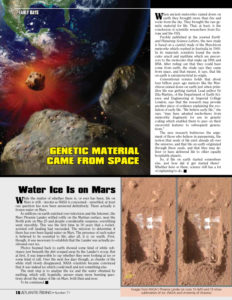
Avi Loeb, a physicist from Harvard University in the US, has recovered 50 tiny spherical iron fragments from the bottom of the Pacific Ocean that he claims may be material from an interstellar alien spaceship.
Loeb is linking his finding with the passage of a fireball in January 2014. The meteor was observed by sensors of the US Department of Defense that track all objects entering the Earth’s atmosphere. It was recorded as travelling faster than most meteors and eventually broke up over the South Pacific Ocean near Papua New Guinea. Data on the object is held by Nasa’s Center for Near Earth Object Studies (CNEOS). The meteor’s official name is CNEOS 20140108, and is also referred to as IM1 (for interstellar meteor). We have already had at least one visitor from interstellar space – the comet ‘Oumuamua. The appearance of 1I/2017U1, the official name for ‘Oumuamua, was certainly an unusual event. The object was observed in 2017 as it was leaving the Solar System. Its trajectory is different from the near-circular orbits of the planets and elliptical orbits of comets. The comet’s path was traced back, with scientists discovering that it had come from well beyond the outermost fringes of the Solar System. Scientists were excited but also intrigued – although its shape was not captured on camera, the way that light reflected from it as it rotated suggested that it had an odd shape like a cigar when viewed side-on or a plate when viewed from the top. In a thoughtful article written in 2018, Loeb speculated that ‘Oumuamua might be artificial, rather than natural in origin – the product of an alien civilization. He suggested that we should keep searching for interstellar debris in the Solar System. In pursuit of such debris, Loeb’s team interrogated the CNEOS database, looking for objects with unusual orbital characteristics. That’s when they found CNEOS 20140108 and, based on its high velocity, suggested it was an interstellar meteor – giving it the more manageable name of IM1. Modeling the path of the fireball, Loeb identified a specific area of the South Pacific where he believed debris from IM1 would be deposited. Following a dredging operation in the area with a powerful magnet, he now claims to have found material from IM1. But what are the chances that he has found genuine interstellar debris at all, never mind a spaceship? The metallic spherules that have been recovered are each about half a millimeter in diameter. It isn’t impossible for them to be of extraterrestrial origin: several previous expeditions have recovered spherules from space from the seabed. The first expedition to find such samples was HMS Challenger in 1872-76. Material dredged from the ocean floor contained many metallic droplets, described at the time, quite accurately, as “cosmic spherules”. Droplets from space are spherical because they solidify from molten material torn from the surface of meteorites as they traverse the atmosphere. Subsequent expeditions throughout the 20th century have also found cosmic spherules at the bottom of the ocean, but it has become harder to identify them. This is because, in the 150 years since the Challenger expedition, the amount of pollution has increased on Earth. In 1872, the industrial revolution was in its infancy in Europe and practically non-existent in the southern hemisphere. Hence pollution such as “fly ash” (waste from burning coal) and particles from vehicles was minimal. Many of these pollutants are also spherical in appearance and metallic in composition. Today, products from industrial processes and vehicles are everywhere. So, without an actual analysis of the composition of the spherules and a comparison with analyses of meteorites (and common terrestrial pollutants), it is not possible to identify any as extraterrestrial. But Loeb doesn’t just think the material is from space, he thinks it is from interstellar space – arguing “this could be the first time humans put their hands on interstellar material”. This is simply not true. We have an abundance of interstellar material on Earth. Some of it is almost certainly on the ocean floor, but not in the form collected by Loeb. The interstellar material to which I am referring comes in several different varieties. It is well known by astronomers that the interstellar medium – the space between stars – is not empty, but contains several different molecules, many of which are organic (made up of chains or rings of carbon). A portion of these molecules got mixed into the region of space where the Solar System was starting to form. Stars themselves have also contributed material to the interstellar medium, as they evolved or exploded as supernovas. Some of this material comes as tiny diamonds or sapphires – rare mementoes of stars that lived and died before the Sun was born. These grains became part of the dust cloud that collapsed to form the Solar System, and were eventually carried to Earth in meteorites. Loeb’s evidence for an extraterrestrial source for the material – never mind an interstellar origin – is rather shaky. He has found metallic spherules. For me (and many others) to accept that these spherules are extraterrestrial, I’d need firm analytical evidence. What is their composition? What is their age? Can we rule out terrestrial pollutants? Can we rule out debris from extraterrestrial material from within the Solar System? The first question, about composition, has been answered: analysis of the spherules shows them to be mainly iron with a few trace metals. We know meteors from our Solar System contain iron and nickel, echoing the relative abundances of these metals in the Sun. But the spherules apparently contain “negligible” amounts of nickel – thus indicating that they are almost certainly not from meteors within the Solar System. This does not, however, prove they are interstellar – it merely makes it more likely that they’re terrestrial pollutants. The most convincing evidence would be to measure an age for the spherules greater than that of the Sun – which would identify them as interstellar. And that would be amazing, but it would not necessarily identify them as having an artificial, rather than natural origin. I am not sure what evidence would be sufficiently convincing for this – maybe the autograph of the alien engineer who built the spacecraft?
s synchrotron X-ray scanning tunneling microscopy or SX-STM. X-ray spectroscopy in SX-STM is triggered by photoabsorption of core level electrons, which constitutes elemental fingerprints and is effective in identifying the elemental type of the materials directly.